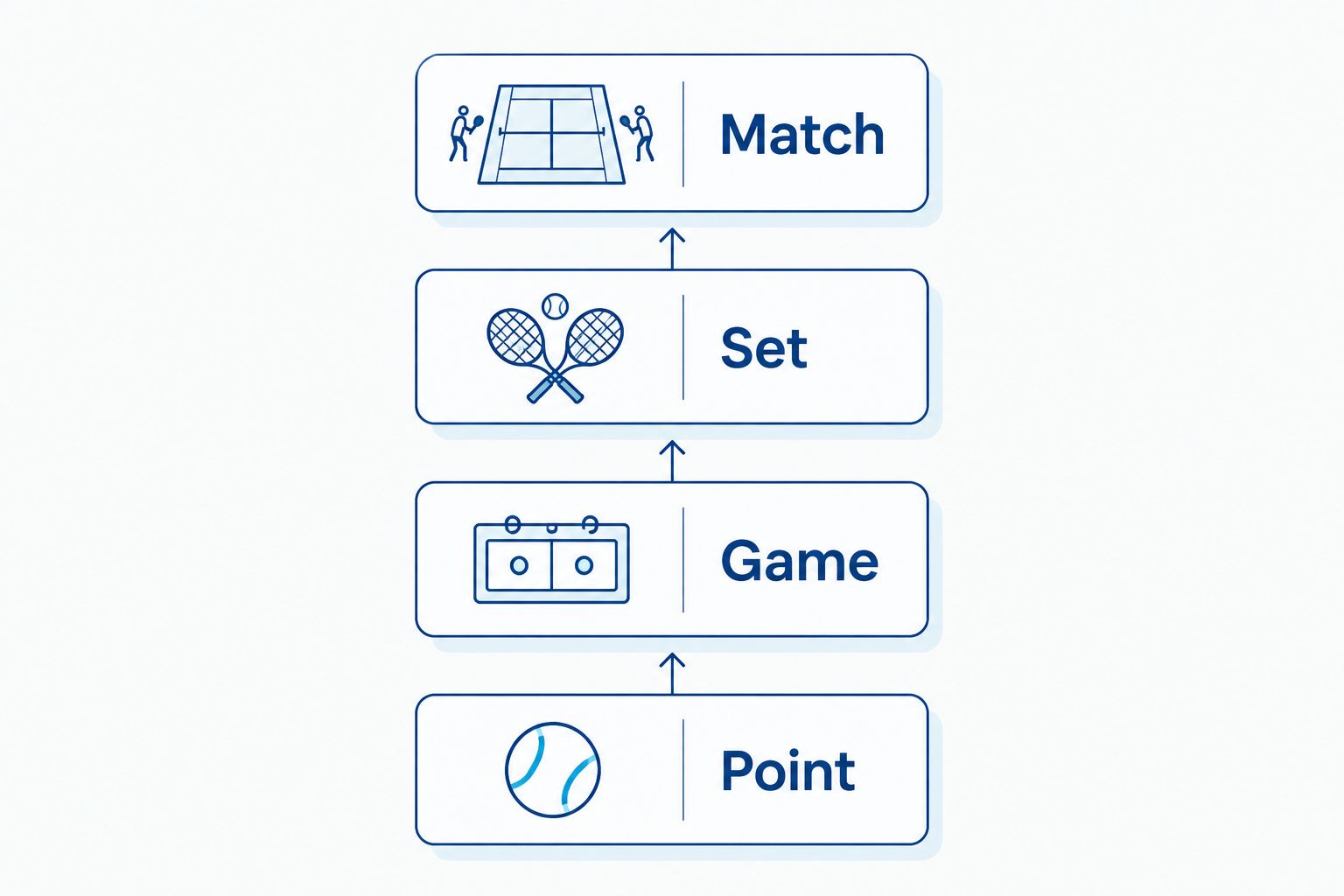
New tennis fans learning tennis scoring rules need one system: point, game, set, match, in that exact order, with deuce and tiebreaks built in to stop ties from running forever. Unlike a basketball scoreboard that just climbs, tennis resets the point count every single game, which throws off anyone counting the way football or basketball trained them to count.
- Tennis scoring rules explained: a match is won by sets, sets by games, games by points, in that order.
- A player needs 4 points to win a game and must win by at least 2 (that's deuce).
- A set goes to 6 games, win by 2; a 6-6 tie forces a tiebreak to 7 points.
- Grand Slam men's singles run best-of-5 sets in 2026; almost everything else is best-of-3.
- Love means zero — the count resets every new game, not the whole match.
Why tennis scoring rules matter for new fans
Tennis doesn't hand you a running score the way American sports do — there's no 24-17 ticking up all game. It hands you love, 15, 30, 40, then makes you restart at zero the moment someone wins the game. Miss that reset and every broadcast graphic looks like a foreign alphabet.
Tune into the 2026 Grand Slam season without knowing the hierarchy and you'll hear commentators call a "break point" with no idea what's actually on the line. SportsOrca tracks tennis the same way the sport is actually decided — set by set, game by game — because that's the level where momentum swings and match odds move. Learn the four layers once and every rally, not just the score, starts making sense.
How tennis scoring actually works, step by step
Step 1: Learn the point count inside a single game
Every game starts at love (0) for both players. Win a point and you move to 15, then 30, then 40. Win the point at 40 and the game is yours — unless your opponent also has 40, and that's deuce.
From deuce, whoever wins the next point gets "advantage," but the game isn't over until that same player wins the point right after. Lose the ad point and you're back to deuce, sometimes for eight or nine extra points in a row. Miss this loop and a 40-40 graphic looks like a stalemate instead of the mechanism it actually is.
Point counting cheat sheet:
- Love = 0 points
- 15 = first point won
- 30 = second point won
- 40 = third point won (one point from the game, unless tied)
- Deuce = 40-40, must win by 2
- Advantage = one point up from deuce, game ends only if you hold it
Step 2: Track games until someone wins a set
A set is a race to 6 games, and just like inside a game, you have to win by 2. Six games to four closes it out clean. Six games to five means the set keeps going, because the margin isn't there yet.
Sets used to run on forever under old "advantage set" rules with no cap. Nearly every tour event in 2026 caps that math with a tiebreak once the game score reaches 6-6, which is the entire reason Step 3 exists.
What to track inside a set:
- Games won by each player, not points
- Whether the leader has a 2-game cushion
- The score once it hits 5-5, since that's when the tiebreak clock starts ticking
- Which player is serving in the game that could close the set
Step 3: Know when a set needs a tiebreak
At 6-6 in games, a standard tiebreak decides the set: first to 7 points, win by 2. Miss that margin at 7-6 and the breaker, and the set, rolls to 8-6, 9-7, and beyond.
Final sets used to skip the tiebreak entirely at some majors. Not anymore — the current Grand Slam rulebook has a final set that reaches 6-6 end in a 10-point breaker at all four majors, a format the sport settled on to stop marathon deciding sets from swallowing entire broadcast windows.
Tiebreak basics:
- Triggered at 6-6 in games in a standard set
- First to 7 points, win by 2
- Final-set tiebreaks at the majors go to 10 points, win by 2
- Server rotation flips every 2 points once the breaker starts
Step 4: Count sets to a full match win
Win the majority of sets and you win the match. Best-of-3 means first to 2 sets; best-of-5 means first to 3.
Nearly every match on tour in 2026 — WTA, ATP, mixed doubles, college dual matches — runs best-of-3. The exception is men's singles at the four Grand Slams, where the format stays best-of-5, which is why a five-setter at the US Open can run past four hours while a tour final wraps in ninety minutes.
Match format at a glance:
- Best-of-3: most WTA and ATP tour-level singles and doubles
- Best-of-5: Grand Slam men's singles only
- Majority wins: 2 of 3 sets, or 3 of 5 sets
- No sudden death: every set inside the match follows the same game and tiebreak rules
Step 5: Learn server rotation and side changes
The serve alternates every game, win or lose, and players switch ends of the court after every odd-numbered game in a set. Break that rhythm mentally and you'll lose track of who's actually serving for the set.
Inside a tiebreak, the rotation shortens: the player who served the game before the breaker serves the first point alone, then serve flips every 2 points after that.
Serve and side-change rules:
- Serve alternates by game, not by point
- Players switch ends after games 1, 3, 5, 7 within a set
- Tiebreak server serves 1 point first, then it's 2 points per turn
- The receiver chooses ends for a deciding tiebreak in most tour events
Step 6: Follow live scoring without doing the math yourself
Reading the hierarchy in a rulebook is one thing. Watching a live match and doing point-game-set math in your head while also following the rally is another. That gap is where most new fans give up on tennis scoring rules entirely.
Coverage that flags break points, tiebreaks, and match points as they happen does the mental math for you. Pair that with a working grasp of beginner sports betting terms and the same score you're reading also tells you where the match odds are likely to move.
Faster ways to stay on top of live tennis scoring:
- Match trackers that show set and game score, not just a final line
- Live commentary that calls out deuce and break points as they happen
- Coverage that explains momentum swings instead of just posting the score
- A basic grip on betting terminology so in-play odds movement makes sense too
Step 7: Watch for tournament-specific quirks
Not every event uses the format above word-for-word. Some doubles matches swap a full third set for a 10-point match tiebreak to save time. Some college and developmental events experiment with no-ad scoring, where deuce games end on the very next point instead of looping.
Quirks worth knowing before you watch:
- Match tiebreaks (10 points) replacing a third set in many doubles formats
- No-ad scoring in some college and exhibition events, ending games at first point past 40-40
- Round-robin group stages at season-ending events, where win-loss record can matter as much as set score
- Retirement rules, where an injured player's already-completed sets still count
Ways to actually learn tennis scoring rules
| Option | Best for | Key limitation |
|---|---|---|
| Official ITF rulebook | Rules purists who want exact wording | Dense language, no context on why the rules exist |
| Broadcast commentary | Casual viewers already watching live | Assumes you already know the terms being used |
| Scoring cheat-sheet apps | Quick reference courtside or on your phone | No explanation, just a lookup table |
| SportsOrca match coverage | Fans who also want betting and momentum context | Built around tour-level matches, not local club rules |
Pair the ITF rulebook for exact wording with live match coverage for context — that combination covers both the rule and the moment it actually matters.
Ready to score tennis bets too?
Compare sportsbooks built for set-by-set and game-by-game tennis lines.
Common mistakes new fans make with tennis scoring
- Reading love-15-30-40 as a running match score. It resets every single game — it's not a season-long tally.
- Assuming every match is best-of-5. Only Grand Slam men's singles use that format in 2026; everything else is best-of-3.
- Missing the deuce loop. A 40-40 tie doesn't end the game — someone has to win by 2, even if that takes six extra points.
- Ignoring the 6-6 threshold. Commentators calling "seven-six" mid-set means a tiebreak is either happening or just finished, not that the set score jumped by seven games.
- Confusing old advantage-set rules with current tiebreak rules. Marathon sets without a breaker are largely a thing of the past at tour level.
FAQ
What is deuce in tennis scoring?
Deuce is a 40-40 tie inside a game, and the player must win by 2 points to close it out. From deuce, winning one point gives you advantage; winning the next point after that wins the game.
How many points do you need to win a tennis game?
You need 4 points to win a tennis game, and you have to win by at least 2. A player stuck at 40-40 has to work through deuce until that 2-point margin appears.
How many games do you need to win a tennis set?
You need 6 games to win a set, with the same win-by-2 rule as a game. A 6-6 tie in games triggers a tiebreak instead of letting the set run forever.
What happens at 6-6 in a tennis set?
A standard tiebreak decides the set at 6-6: first to 7 points, win by 2. In final sets at all four Grand Slams, that breaker goes to 10 points instead of 7.
Are all tennis matches best-of-5 sets?
No. Best-of-5 is reserved for Grand Slam men's singles matches in 2026. Every other tour-level match, plus women's singles at the majors, is best-of-3.
Why does tennis scoring start at love instead of zero?
Love is simply tennis's traditional term for zero points in a game. The count still functions exactly like zero — it resets to love at the start of every new game.
What is a match tiebreak in tennis?
A match tiebreak is a 10-point breaker used instead of a full third set, mostly in doubles. It shortens the match while still requiring a win-by-2 margin to close it out.
How does the server change during a tennis match?
Serve alternates by game, not by point, so each player serves an entire game before it switches. Inside a tiebreak, the rotation shortens to 2 points per turn after the first single point.
One last thing
Tennis is one of the only major sports where you can lose more total points than your opponent and still win the match, because the sport counts games and sets, not the raw point tally. A player can win a set 7-6, drop the next 6-7, take the decider 6-2, and end up with a losing point count overall while still walking off with the win. Once that sticks, tennis scoring rules stop looking like a language barrier and start looking like the actual strategy layer of the sport.