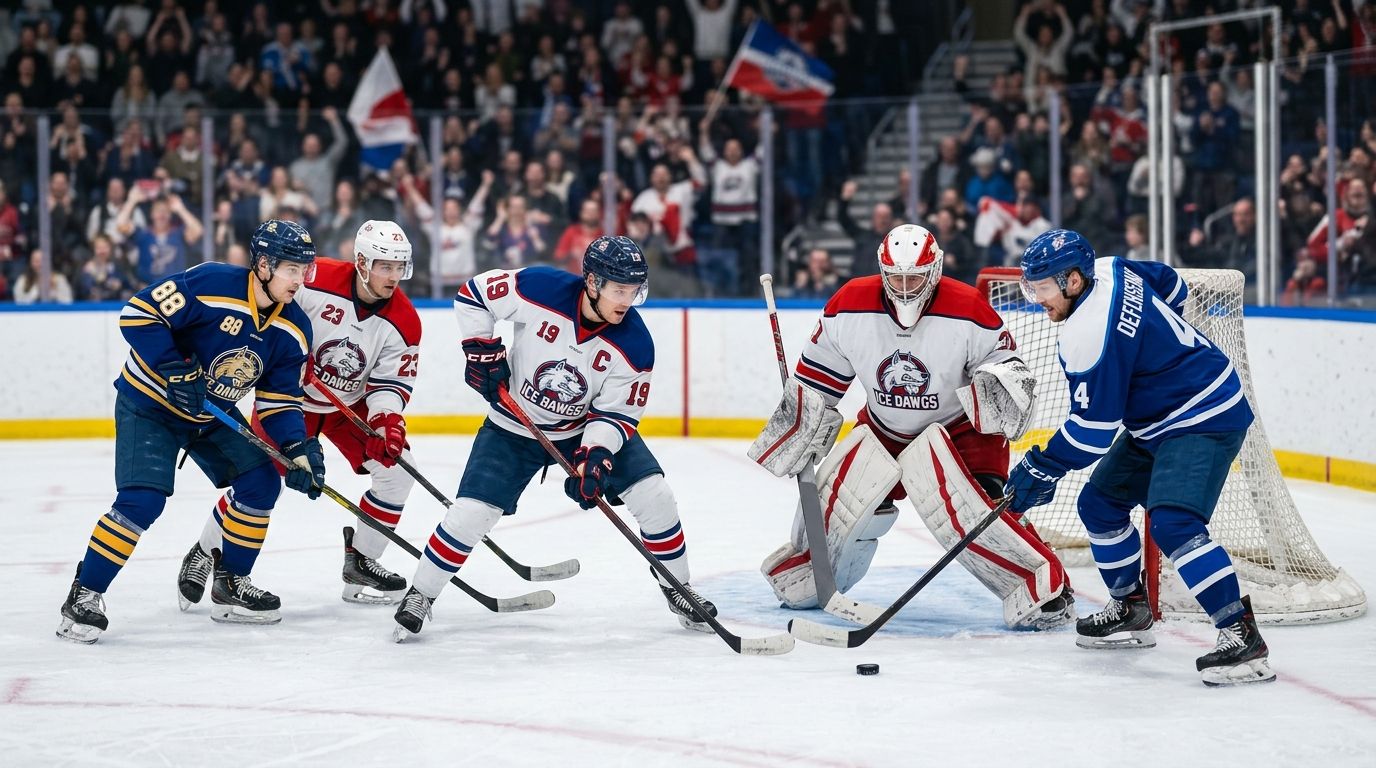
Hockey positions explained for new fans comes down to six jobs on the ice at once: three forwards, two defensemen, and a goalie, each with a distinct assignment that changes possession-by-possession. New fans get lost less by memorizing terms and more by tracking one position at a time until the pattern clicks. This guide breaks the six roles down the way a beat reporter would explain them rink-side, not the way a rulebook does.
- Hockey positions explained for new fans starts with six roles: center, two wingers, two defensemen, one goalie.
- NHL teams dress 12 forwards and 6 defensemen per game in 2026, plus two goalies.
- Centers take faceoffs and cover the most ice; wingers stay lane-disciplined; defensemen gap up on rushes.
- Shift changes happen every 45-60 seconds, which is why lines matter more than any single player early on.
- Track the goalie's rebound control before anything else — it explains more scoreboard swings than any skater stat.
Why hockey positions matter for new fans
A new fan watching an NHL broadcast for the first time in 2026 sees five skaters and a goalie moving fast, with almost no natural pause to explain who's who. Football has a huddle. Basketball has a shot clock reset. Hockey just keeps going, and possession can flip in under three seconds off a bad pinch.
That speed is exactly why position literacy matters more here than in most sports: if you can't identify a defenseman pinching or a center losing a faceoff, the broadcast reads as chaos instead of strategy. Learning the six roles turns a confusing blur into a readable game within a period or two.
Learn the three forward positions first
Forwards are the easiest entry point because they're the ones scoring and forechecking, the action a new fan's eye follows naturally.
- Center: takes faceoffs, covers the most ice of any forward, and is expected to back-check into the defensive zone
- Left wing / right wing: stay on their side of the ice in the offensive and neutral zones, which is why coaches call them lane-disciplined
- Watch which forward takes the draw after a whistle — that's always the center
- Notice who chases the puck into the corner first on a dump-in, usually the strong-side winger
- A winger drifting to the opposite side of the ice on a rush is either cheating for offense or covering for a pinching defenseman
Understand the two defenseman roles
Defensemen play left side and right side, not offense and defense the way a football fan might assume.
- The left defenseman and right defenseman each own a half of the defensive zone and swap sides rarely mid-shift
- Gap control is the term to learn here: how much space a defenseman gives a rushing forward before engaging
- A defenseman pinching means stepping up at the offensive blue line to keep the puck in — high reward, high risk if it fails
- Puck-moving defensemen start breakouts with a first pass rather than a rink-long clear
- Watch for the defense pair changing together on the fly; they rarely split a shift
For fans who want to go deeper on which defensemen actually shut down top lines, Norris Trophy voting tracks the position's best two-way performers in real time.
Know what the goalie actually does
The goalie is the only position that never changes on the fly and the one stat line new fans over-simplify the fastest.
- Save percentage tells you overall performance, but rebound control tells you whether a goalie is inviting second chances
- Playing the puck behind the net has become a real skill in the modern NHL — a goalie who can pass out of trouble erases odd-man rushes before they start
- Goalies get pulled for an extra attacker in the final two minutes when trailing, a rule every new fan should recognize instantly on the broadcast
- Two goalies dress per NHL roster in 2026, with the backup usually starting the second half of back-to-back games
- A goalie squaring his shoulders early to a shooter is playing angles correctly; one still moving laterally as the shot arrives is scrambling
Track line combinations and shift changes
Individual positions only make sense once you see them grouped into lines and pairs, which is where most new fans start actually watching instead of just following the puck.
- A line is one center plus two wingers; a pair is two defensemen who share every shift together
- Top lines face top lines more often than not — coaches match their best matchup deliberately, especially at home where they get last change
- Shift changes on the fly happen roughly every 45-60 seconds, which is why five tired skaters suddenly look slow before a whistle
- A line stuck in its own zone for 20-plus seconds usually means the change is coming next
- Watch the bench, not just the ice — players leaning over the boards are the tell that a change is imminent
Spot special-teams positioning
Power plays and penalty kills rearrange the standard six-position setup entirely, and it's one of the fastest ways a new fan can look like they know the sport.
- On the power play, teams often play four forwards and one defenseman in a 1-3-1 or umbrella setup instead of the usual three-two split
- Penalty kills flip to a box formation — two forwards up top, two defensemen low, protecting the middle of the ice over the perimeter
- The point man on a power play, usually a defenseman, holds the blue line for shots and re-entries
- A shorthanded rush happens when the penalty-killing team wins the puck and sends two skaters the other way, one of hockey's most exciting broken-play sequences
- Special-teams ice time is a good early signal of a team's most trusted position players, which shows up fast in NHL trade market coverage when contenders go shopping for depth
Build the habit with one position at a time
Trying to track all six positions on your first live game is the single biggest reason new fans give up on hockey being too fast to follow.
- Pick one defenseman for an entire period and watch only their gap control and pinches
- Switch to the goalie for the next period and count rebounds allowed versus rebounds controlled
- Follow a fantasy hockey roster if you want a reason to track specific positions across games — a category-league lineup build forces you to learn position value fast
- Rewatch a goal in slow motion and identify every position's job on that single play
- Compare two goalies during a playoff push to see how positioning changes under pressure, which is exactly what shows up in current goalie rankings heading into 2026
Position comparison for new fans
| Position | Skaters on ice | What to watch first | Learning curve |
|---|---|---|---|
| Center | 1 per line | Faceoffs, back-checking | Low, easiest to spot |
| Left/right wing | 2 per line | Lane discipline, forechecking | Low |
| Defenseman (L/R) | 2 per shift | Gap control, pinching | Medium |
| Goalie | 1 | Rebound control, puck-handling | Medium-high |
| Power-play specialist | Varies | Point shots, umbrella setup | High |
Verdict: start with centers and wingers, move to defensemen by your third game, and save special-teams reading for once the base six positions feel automatic.
Get more NHL breakdowns
Position-by-position previews and trade coverage all season long.
Common mistakes new fans make with hockey positions
- Watching only the puck carrier: the two off-puck wingers setting up a give-and-go tell you more about a team's system than the player with the puck
- Assuming defensemen never score: puck-moving defensemen routinely lead teams in assists by pinching into the play, not just clearing zones
- Treating wingers as interchangeable: left wing and right wing are lane-specific assignments, not a coin flip each shift
- Ignoring the goalie's stick skills: a goalie who can't play the puck forces defensemen into rushed retrievals all game
- Missing line changes entirely: if you're only watching the puck, you'll miss the five-player swap that explains why the next shift suddenly looks different
FAQ
How many positions are there in hockey?
Hockey has three forward positions (center, left wing, right wing), two defenseman positions (left and right), and one goalie, for six roles on the ice at once. NHL teams dress 20 skaters plus two goalies per game in 2026.
What does a center do in hockey?
A center takes faceoffs, covers the most ice of any forward position, and back-checks into the defensive zone. Centers are the easiest position for new fans to spot because every whistle restarts with one taking a draw.
What is the difference between left wing and right wing?
Left wing and right wing are lane-specific assignments tied to which side of the ice a forward plays. They are not interchangeable roles, even though both are primarily scoring positions.
What does a defenseman actually do?
A defenseman controls the gap between the blue line and an attacking forward, starts breakouts with outlet passes, and can pinch at the offensive blue line to keep the puck in. Left and right defensemen split zone responsibility rather than playing pure offense or defense.
Why does the goalie matter more than people think?
A goalie's rebound control and puck-handling behind the net directly affect how many second-chance shots and odd-man rushes a team allows. Save percentage alone misses both of those factors.
How often do hockey lines change?
NHL shifts typically last 45-60 seconds before a change on the fly. Watching the bench for players leaning over the boards helps predict the next substitution.
What positions play on a power play?
Power plays commonly use four forwards and one defenseman in an umbrella or 1-3-1 formation. That is a shift from the standard three-forward, two-defenseman setup used at even strength.
Is hockey harder to follow than football for new fans?
Hockey lacks the natural stoppages of football, which makes position tracking the fastest way to make the game readable. New fans who isolate one position per period usually find the six-role structure clicks within two games.
One last thing
Top-pair NHL defensemen now log more total ice time per game than most forwards, a shift from the era when defense meant staying home and clearing the zone. Watch one top pair for a full game in 2026 and you'll count more offensive-zone touches than a fourth-line forward gets all night. That single observation rewrites how most new fans think the position works.