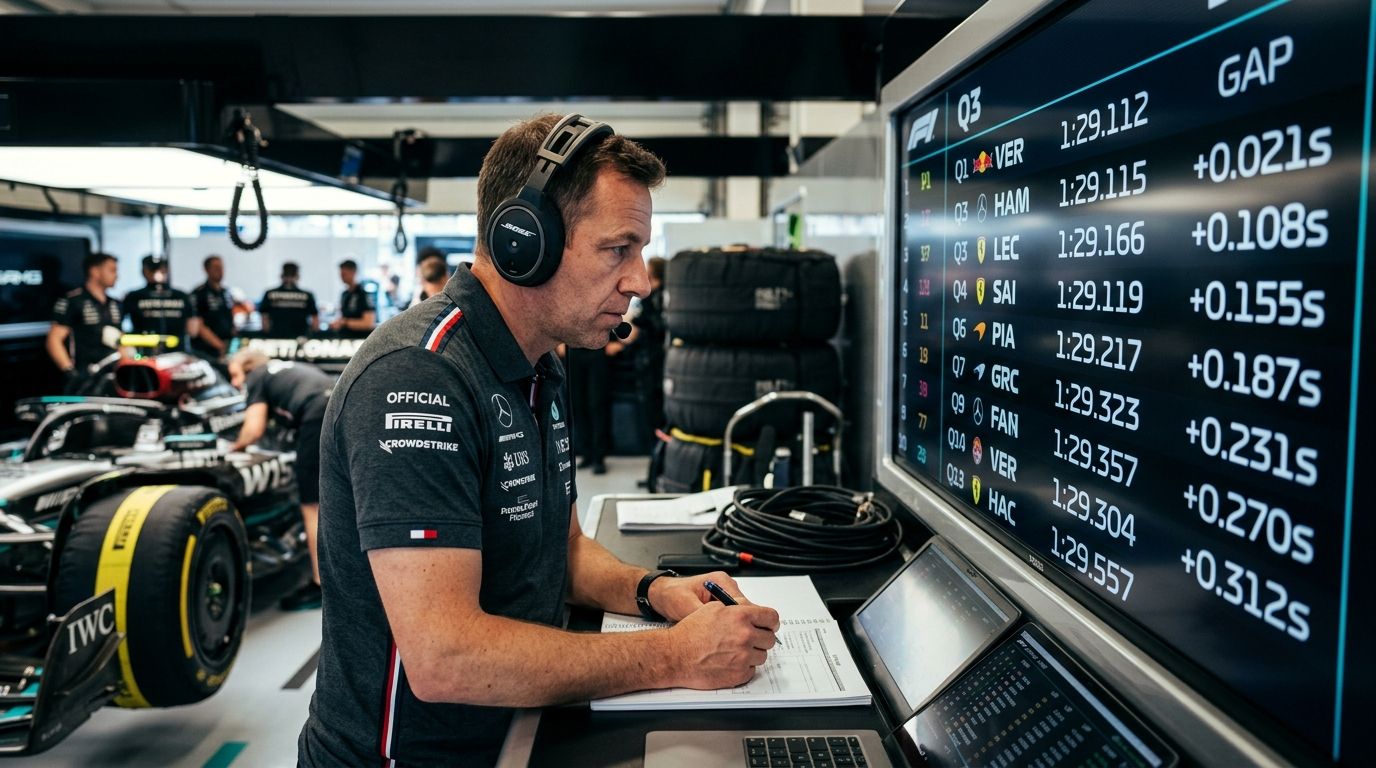
Qualifying gaps are the small numbers that decide where 20 cars line up on Sunday, and reading them wrong means missing the whole story of a session. The gap that matters is the time difference between a driver's fastest lap and the benchmark lap in that segment — usually the pole sitter's time in Q3 — and it's the relative order of those gaps, not the raw lap time, that sets grid position. A gap of two or three tenths often separates the front three rows, while a driver sitting more than a second off the pace in Q1 is usually headed for an early exit under the 15-car cutoff format still in place for 2026.
The part broadcasts skip: track evolution changes what a "good" gap looks like minute to minute. A lap that's six-tenths off pole at the start of Q3 can turn into a front-row time by the final runs, because rubber goes down and the track gets faster as the session progresses.
- Reading F1 qualifying gaps means comparing lap time to the session benchmark, not to a fixed number.
- Q1 cuts on tight margins — often two to three tenths separates survival from elimination in 2026.
- Track evolution shifts the benchmark lap-to-lap, so a gap late in Q3 means something different than the same gap early in Q1.
- Grid position follows the gap order at the end of each segment, and grid penalties can reshuffle it after the fact.
Why this matters
A driver can post the fifth-fastest raw lap time of the weekend and still start eighth because someone behind them found time on a later, faster piece of track. Commentators throw out "plus 0.087" or "P4, three tenths back" without explaining what that number does to the grid, and casual viewers end up watching the session without knowing who's actually under pressure.
Understanding the gap structure also matters for anyone following SportsOrca's F1 coverage through a race weekend, since grid position is the single biggest predictor of finishing position outside of Monaco-style street circuits. A pole gap of one-tenth is a genuine fight. A pole gap of eight-tenths means the front-runner had nothing to worry about.
How to read F1 qualifying gaps for grid position
The fastest way to read a qualifying session is to work through it in the same order the format runs:
- Check which segment you're in. Q1 runs all 20 cars and cuts to 15. Q2 runs those 15 and cuts to 10. Q3 is the 10 survivors fighting for pole — three separate gap tables, three separate stakes.
- Read the gap to the session leader, then the gap to the car directly ahead. The leader gap tells you the overall picture; the gap to the car ahead tells you who's actually racing whom for a specific grid slot.
- Note when each lap was set. A lap set on the first Q3 run means less than a lap set on the final run, because the track is still evolving.
- Cross-check sector splits. A driver can be quicker in sector one and still lose the overall gap in sector three — that tells you where the car (or the driver) is actually struggling.
- Watch for deleted times. A gap can look tight until a driver's best lap gets deleted for a track-limits violation, and the whole table reshuffles.
| Segment | Typical gap for survival/pole | What it signals |
|---|---|---|
| Q1 (20 to 15) | Inside two to three tenths of P15 | Backmarker teams fighting for a single spot |
| Q2 (15 to 10) | Inside four to five tenths of P10 | Midfield squeeze, tire choice starts to matter |
| Q3 (top 10, pole) | Often under two tenths, sometimes hundredths | Genuine title-fight margins |
Q1: gaps inside two to three tenths decide who survives
Q1 eliminates five cars, and the cutoff line is almost always tight. A car sitting six-tenths off the pace in Q1 is in real trouble, while anything inside two to three tenths of the 15th-place time is a coin flip that often comes down to the final runs.
Q2: half a second separates safety from an early exit
Q2 is where tire strategy starts bleeding into the gap numbers, since the top 10 must start the race on whatever compound they used to set their Q2 time. A driver half a second off P10 is fighting the clock and the strategy call at the same time — for a deeper look at how that tire decision plays out once the lights go out, how F1 teams read tire strategy breaks down the compound math.
Q3: pole fights come down to hundredths
By Q3, the ten fastest drivers of the weekend are separated by fractions that would be invisible anywhere else in the sport. A gap of one or two tenths at the front is a real fight for pole; a gap of eight-tenths or more means the pole sitter had margin in hand and didn't need the final run.
Why F1 qualifying gaps vary
- Track evolution — rubber laid down across a session lowers lap times run after run, so late laps beat early laps on a drying or "green" track.
- Fuel load and tire compound — qualifying runs are low-fuel, soft-tire laps, so a car's race pace and its qualifying gap can tell two different stories.
- Traffic and dirty air — a lap ruined by a slower car ahead can cost several tenths that have nothing to do with pace.
- Weather windows — a sudden shower mid-session can turn a half-second gap into a three-second gap within one lap.
- Red flags — a stoppage that eats into the session clock can strand drivers on an out-lap with no time to set a representative lap.
- Track temperature — tire windows shift through a session, so a car built for a hot track can lose time as temperatures drop late in the hour.
Track every F1 grid battle live
Follow qualifying breakdowns and race previews all season on SportsOrca.
Related questions
What is a good qualifying gap in F1?
A good qualifying gap is anything inside two to three tenths of the segment leader — that range is what usually separates a genuine fight from a driver coasting on margin. Anything over half a second against the benchmark lap suggests a real deficit rather than a close battle, and a gap over a full second in Q1 is usually a sign of trouble before the race even starts.
Why do gaps get smaller in Q3 than Q1?
Gaps compress in Q3 because only the ten fastest cars of the weekend remain, all running low fuel and fresh soft tires with nothing left to hold back. Q1 gaps stretch wider because backmarker teams and midfield cars are mixed together, so the spread between fastest and slowest is naturally bigger.
How does the gap to pole affect grid position?
The gap to pole doesn't set grid position by itself — the order of those gaps across all 20 drivers does, segment by segment. A driver could be nine-tenths off pole and still start second if everyone else is a full second back, which is why the gap number only means something in context of who's around it.
Watching how those gaps shift across a season also feeds directly into F1 championship contenders — a driver consistently inside two tenths of pole across a full year is a title threat, while one bouncing between P6 and P12 in gap terms usually isn't.
FAQ
How do you read F1 qualifying gaps?
You read F1 qualifying gaps by comparing each driver's best lap to the session leader's time, then checking the gap to the car directly ahead for grid-slot context. Track evolution means a gap late in a session reads differently than the same gap set early.
What does 'plus 0.2' mean in F1 qualifying?
Plus 0.2 means a driver's best lap is two-tenths of a second slower than the session leader's benchmark lap. In Q3, that gap is often enough to separate pole from third or fourth on the grid.
Why do F1 gaps change between Q1, Q2, and Q3?
F1 gaps change because each segment has a different field size and different stakes — Q1 mixes all 20 cars with a wide spread, while Q3's ten survivors are all running low-fuel, soft-tire laps with margins down to hundredths.
Does the fastest lap always get pole position?
Yes, the fastest lap in Q3 always sets pole position, but that lap's gap to the rest of the field varies wildly by circuit and conditions, from a few hundredths to nearly a full second.
Can a driver lose grid position despite having a small gap?
Yes, a driver can lose grid position despite a small gap to pole if a grid penalty for a gearbox change, power unit component, or driving infraction drops them back after qualifying ends.
Why does track evolution matter for reading gaps?
Track evolution matters because rubber laid down during a session lowers lap times as the hour goes on, so a driver setting a time early can look worse on the gap sheet than one who waits for the final runs.
What's considered a big gap in F1 qualifying?
A gap over half a second to the session leader is considered big in modern F1 qualifying, and anything over a full second in Q1 usually signals a car or driver well off the competitive pace for that weekend.
One last thing
The number worth watching isn't the pole gap — it's the gap between P10 and P11 at the end of Q2. That single tenth or two decides who gets a shot at pole and who starts the race already fighting through traffic from row six, and it's the margin that gets the least airtime on broadcast.