Reading F1 tire strategy during a race comes down to tracking three signals in real time: which compound each driver started on, when their pit window opens relative to rivals, and how fast their lap times are dropping off. The FIA's mandatory rule that every driver run two different dry compounds in a race is the backbone of the entire chess match — it forces at least one pit stop and dictates who can attack early and who has to play defense late. Once you know the starting compound and the gap to the car ahead, the rest of the strategy reveals itself lap by lap.
- Two dry compounds are mandatory in every F1 race in 2026 — that single rule drives most strategy calls.
- An undercut works by pitting first and using fresh-tire pace to jump a rival before they stop.
- Lap time drop-off of a few tenths per lap signals a tire is past its window and a stop is coming.
- Pit lane speed limits run 60 to 100 km/h depending on the circuit, and Red Bull holds the fastest recorded stop at 1.82 seconds (2019).
- Learning how to read F1 tire strategy turns a random pit stop into a move you can call before it happens.
Why This Matters
Tire strategy decides more races than raw pace does. A driver stuck on a degrading tire while a rival pits onto fresh rubber can lose 15-20 seconds of gap in under ten laps, even if the car itself is quicker on a clean lap.
Broadcasters flash pit windows and undercut threats on screen, but they rarely explain what you're actually watching. Once you know the mechanics — compound rules, pit windows, degradation curves — the graphics stop being noise and start being a prediction tool. That's the same skill SportsOrca applies across every F1 championship contenders breakdown in 2026: strategy reads like a story once you know the plot points.
How to Read F1 Tire Strategy During a Race
Follow these steps in order, in real time, as the race unfolds:
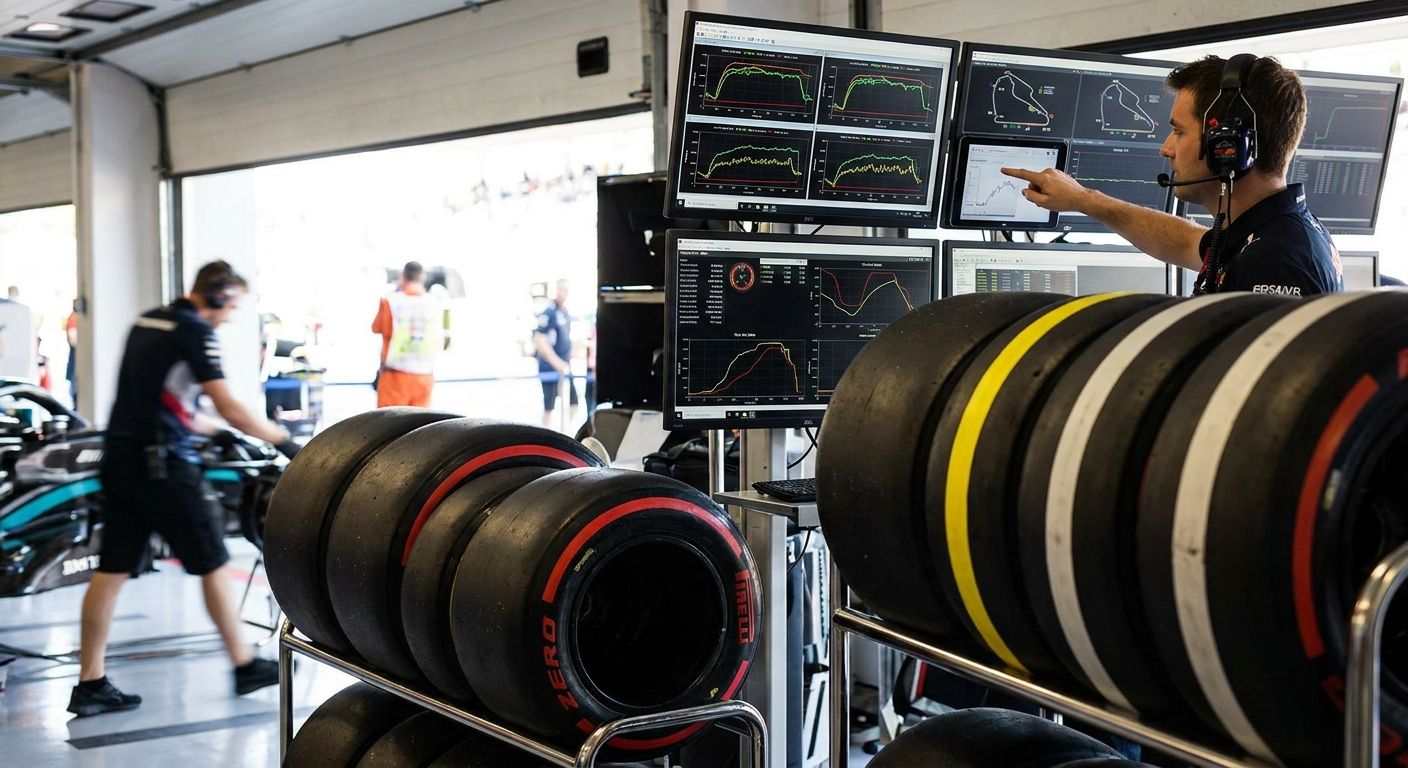
- Check the starting compound first. Every car's grid graphic shows a color: red for soft, yellow for medium, white for hard. That color tells you roughly how long the first stint can run before the two-compound rule forces a change.
- Watch the gap, not just the position. A driver running three seconds behind on older tires isn't out of the fight — they're setting up an undercut. If the gap holds steady or shrinks while their tires age, the strategy is already working.
- Track lap time delta lap over lap. Live timing shows purple, green, and red sector splits. When a driver's overall lap time climbs by 0.3-0.5 seconds a lap for three or four consecutive laps, that tire is falling off a cliff.
- Note who pits first among cars running close together. The first car to stop in a tight pack is usually attempting the undercut — banking on fresh-tire pace to jump the rival still on old rubber before that rival's own stop.
- Recalculate after every stop. A stopped car's in-lap and out-lap times tell you the pit stop's raw speed, and the following two laps confirm whether the undercut or overcut actually worked.
Reading the Compound Colors on Screen
| Compound | On-Screen Color | Typical Role |
|---|---|---|
| Soft (C4-C5) | Red | Fastest single-lap pace, shortest stint life |
| Medium (C3) | Yellow | Balanced pace and durability for mid-race stints |
| Hard (C1-C2) | White | Longest stint life, used to stretch strategy windows |
Pirelli brings five dry compounds to a race weekend (C1 through C5), and race control labels the three chosen for that event as soft, medium, and hard regardless of the actual compound number. That's why a hard tire at one circuit can be a different compound than the hard at another — the color tells you the role, not the exact rubber.
Undercut vs Overcut: The Two Core Strategy Plays
An undercut means pitting before a rival to exploit fresh-tire pace on a track where new rubber is dramatically faster than a worn set. The pitting driver gains time on the two or three laps immediately following the stop, often enough to jump track position once the rival finally pits.
An overcut is the mirror image: staying out longer than a rival, banking lap time while they're stuck in the pit lane, and hoping the tire holds up long enough to convert that gain into position once the driver eventually stops. Overcuts work best on tracks where degradation is mild and pit lane time loss is high.
The rule of thumb worth memorizing: if a driver's tire graph goes flat while a rival's keeps climbing, the box is coming next lap.
“If a driver's tire graph goes flat while a rival's keeps climbing, the box is coming next lap.”
Why F1 Tire Strategy Varies From Race to Race
- Track abrasiveness. Rougher asphalt chews through tread faster, shortening every stint window regardless of compound.
- Ambient and track temperature. Hotter track surfaces accelerate degradation and push teams toward harder compounds earlier.
- Safety car timing. A well-timed safety car lets a driver pit under a reduced time-loss window, flipping the whole strategy sheet instantly.
- Pit lane speed limit and length. Circuits enforce different limits, generally 60 to 100 km/h, which changes how costly a stop is and whether an undercut is worth the risk.
- Starting grid position. Cars starting further back often gamble on alternate strategies since they have less track position to protect.
- Tire allocation rules. Teams need unused sets available for the compounds they plan to run, which can force a strategy even when conditions suggest otherwise.
Track every title race storyline
See who is actually in the fight for the 2026 championship.
One-Stop vs Two-Stop: How Many Pit Stops Is Normal in 2026
Most dry F1 races in 2026 run one to three pit stops depending on the circuit and tire degradation. A one-stop race favors drivers who protect tires early and manage pace; a two- or three-stop race rewards drivers willing to push hard on fresh rubber and trade track position for lap time.
Watching which strategy a team commits to in the first ten laps tells you their read on tire wear that day — teams don't guess this live, they build it from practice long-run data before the race starts. That trend-reading instinct carries across sports: the logic behind how to read NHL possession stats works the same way — track the direction of the numbers, not one isolated data point.
FAQ
What is the mandatory two-compound rule in F1?
Every driver must use two different dry tire compounds during a dry race in 2026, unless the race runs under wet conditions. This rule forces at least one pit stop and shapes almost every strategy call teams make.
What is the difference between an undercut and an overcut?
An undercut means pitting before a rival to use fresh-tire pace to jump them in the pits, while an overcut means staying out longer to bank lap time before stopping. Undercuts work best when new rubber is dramatically faster; overcuts work best when degradation is mild.
How many pit stops does a typical F1 race have in 2026?
Most dry races in 2026 run one to three pit stops depending on the circuit and tire wear. One-stop races reward tire management, while multi-stop races reward aggressive pace on fresh rubber.
Why do tire colors matter in F1?
Tire colors, red for soft, yellow for medium and white for hard, tell you a compound's role for that specific race weekend, not its exact rubber makeup. Pirelli supplies five dry compounds from C1 to C5 and labels three of them soft, medium and hard depending on the track.
What causes tire degradation during a race?
Tire degradation comes from heat cycling, track abrasiveness and load pushing down on the rubber over a stint. As the surface wears, grip drops and lap times climb by tenths of a second per lap until the driver pits.
How fast is an F1 pit stop?
Elite F1 crews complete tire changes in roughly two to three seconds, with Red Bull holding the fastest recorded stop at 1.82 seconds set in 2019. Total time lost is much higher once pit entry, the speed limit and exit are included.
Is a soft tire always faster than a hard tire?
A soft tire is faster on a single fresh lap but degrades quicker, so it is not always the better race-day choice. Hard tires trade outright pace for a longer window before the driver needs to pit again.
What is tire graining versus tire blistering?
Graining happens when the tire surface tears into small rubber pellets from sliding, usually early in a stint before the tire reaches temperature. Blistering happens when the tire overheats internally and the surface bubbles, usually late in a long stint on a hot track.
One Last Thing
The number most fans overlook isn't the compound or the lap time delta — it's the pit lane speed limit itself. A track with a 100 km/h limit turns a stop into a far smaller time loss than one capped at 60 km/h, which is exactly why some circuits reward two-stop gambles and others punish them. Check that number before the 2026 race starts and the entire strategy sheet makes more sense before a single tire is changed.