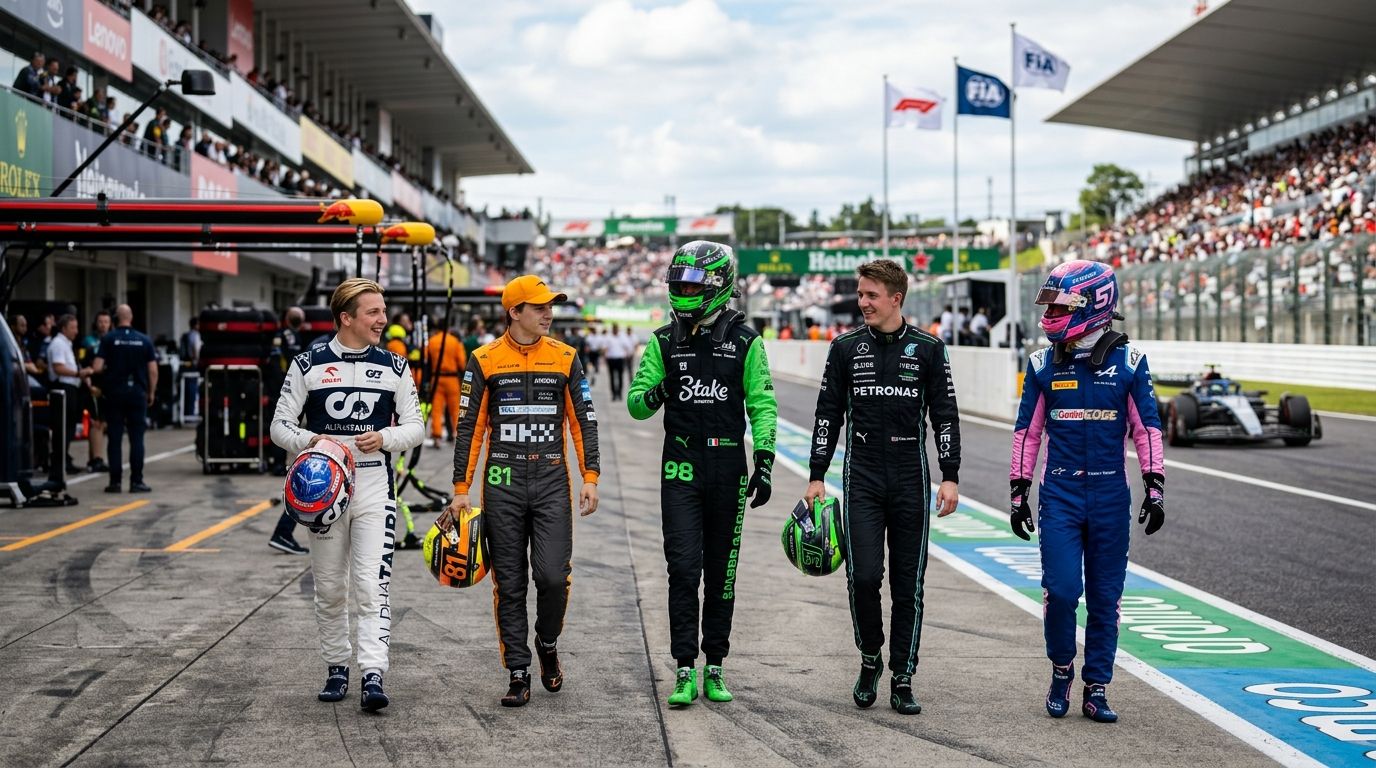
Arvid Lindblad tops the 2026 F1 Rookie of the Year candidates list as the best overall pick, backed by Red Bull's junior ladder and a résumé built for exactly this moment. Alex Dunne is the best bet for wheel-to-wheel racecraft under pressure. Victor Martins is the pure-pace pick for changeable conditions. Sebastian Montoya carries the best long-shot storyline, and Jak Crawford is the wildcard for anyone chasing value on a driver without a locked-in seat.
- Arvid Lindblad is the top F1 Rookie of the Year candidate for 2026 on résumé and Red Bull backing.
- Victor Martins brings F2 title-winning pace but needs a competitive 2026 car to convert it.
- Alex Dunne's strength is racecraft — he doesn't panic in traffic, a trait that matters more than raw pace early on.
- Sebastian Montoya and Jak Crawford are the long-shot and wildcard slots for bettors chasing value.
- 2026's regulation reset means every rookie walks in with a shorter learning curve than usual — nobody has a head start.
Why this matters
F1's 2026 season opens under the biggest technical reset since the hybrid engine era began — new power units, active aero, lighter cars. That reset flattens the field for exactly one season, and it's the best window a rookie gets to make noise before the established teams claw back their development edge.
That's also why the 2026 rookie class matters more than most. A midfield car with 2026's rules can genuinely out-qualify a front-running team that got the new regulations wrong, and a rookie who adapts fast to a reset grid looks a lot better than a rookie who adapts fast to a mature one. Watch how the F1 championship contenders shake out early — rookie form and title form are more linked in 2026 than in a normal season.
What makes the best F1 Rookie of the Year candidate
- Junior ladder results — F2 and F3 titles or podiums against strong fields, not just raw lap times
- Team backing — a manufacturer junior program (Red Bull, McLaren, Alpine) that guarantees seat time and technical support
- Racecraft under pressure — how a driver handles first-lap chaos and wheel-to-wheel battles, not just single-lap pace
- Seat security — a locked 2026 race seat beats a reserve or part-season role, no matter how talented the driver is
- Adaptability to new regulations — 2026's rules reset rewards drivers who learn a car fast, since nobody has old-car muscle memory to fall back on
- Media and fanbase pull — a rookie who moves TV numbers and betting markets gets more scrutiny, which cuts both ways
F1 Rookie of the Year candidates at a glance
| Candidate | Best for | Standout trait | Key limitation |
|---|---|---|---|
| Arvid Lindblad | Best overall | Junior ladder titles at GB3 and F3 level | Superlicence and seat timing still need to line up |
| Alex Dunne | Race-day maturity | Calm decision-making in wheel-to-wheel battles | Less proven at the very top of F2 qualifying |
| Victor Martins | Raw pace in mixed conditions | F2 championship pedigree | Needs a car capable of showing that pace on Sundays |
| Sebastian Montoya | Long-shot storyline | Name recognition and manufacturer academy support | Furthest back on the ladder of this group |
| Jak Crawford | Wildcard value | Multiple FP1 outings across F1 paddocks already | No locked 2026 seat as of writing |
1. Arvid Lindblad: best F1 rookie candidate for overall upside
Lindblad has moved through the Red Bull junior pipeline the way the program is designed to work — GB3 title, F3 title, straight into F2 with zero wasted seasons. That kind of ladder progression is rare, and it's the single biggest reason he sits atop this list for 2026.
Arvid Lindblad pros:
- Fastest and cleanest junior ladder résumé of this group
- Direct pipeline into a Red Bull-affiliated seat if the timing works
- Already tested current-generation F1 machinery in support roles
Arvid Lindblad cons:
- Superlicence points and seat availability both need to align for a full 2026 campaign
- No F1 race mileage yet, so pressure situations are still untested at this level
Best for: bettors and fans who want the safest bet on raw talent translating to results.
Verdict: Back.
2. Alex Dunne: best F1 rookie candidate for race-day maturity
Dunne's edge isn't one blistering qualifying lap — it's what he does on Lap 1 when four cars are fighting for the same piece of track. McLaren's junior program has fast-tracked him because that racecraft translates directly to F1, where survival instinct matters as much as outright pace.
Alex Dunne pros:
- Strong wheel-to-wheel decision-making under pressure
- McLaren junior backing means technical support and simulator time
- Consistent F2 form across a full season, not just flashes
Alex Dunne cons:
- Not the outright fastest qualifier in this group
- McLaren's own 2026 seat situation adds uncertainty to his path
Best for: anyone betting on a rookie who avoids the rookie-mistake crashes that sink a debut season.
Verdict: Back.
3. Victor Martins: best F1 rookie candidate for pure pace
Martins won the FIA F2 championship on pure speed, and that kind of single-lap pace doesn't disappear when a driver moves up a level. The question for 2026 isn't whether he's fast — it's whether the car under him lets that pace show up in the results column.
Victor Martins pros:
- F2 title-winning single-lap pace
- Alpine junior program backing with clear development support
- Strong record in mixed and changeable conditions
Victor Martins cons:
- Race pace and tire management are less proven than his qualifying speed
- Alpine's competitiveness in 2026 is still an open question
Best for: fans who care about qualifying results and pole-position upside over a full season of consistency.
Verdict: Monitor.
The tire-management piece is the real swing factor here — a rookie who qualifies P6 and finishes P14 because of degradation isn't converting pace into points. Track how each candidate handles F1 tire strategy across the first few races before locking in a season-long pick.
4. Sebastian Montoya: best F1 rookie candidate for the long-shot storyline
Montoya carries a name that F1 fans already know, and a Red Bull junior academy slot that keeps him in the conversation even though he's further back on the ladder than the other names here. The storyline value is real — the results case is still being built.
Sebastian Montoya pros:
- Manufacturer academy backing and media attention
- Developing steadily through junior categories
- Name recognition that draws casual fan interest to a rookie season
Sebastian Montoya cons:
- Least proven ladder results of the five candidates here
- A 2026 seat is far from locked
Best for: bettors chasing long-shot value and fans who want a storyline over a stat line.
Verdict: Long-shot.
5. Jak Crawford: best F1 rookie candidate as the free-agent wildcard
Crawford has already logged FP1 sessions across more than one F1 paddock, which puts him ahead of most rookies on actual seat-time in a current car. What he doesn't have, as of this writing, is a locked 2026 race seat — which is exactly what makes him the wildcard slot on this list. Silly season moves fast, and a mid-season call-up isn't out of the question.
Jak Crawford pros:
- Real FP1 mileage in modern F1 cars, unlike most on this list
- Flexible enough to fit multiple team programs
- Proven pace across junior categories
Jak Crawford cons:
- No confirmed 2026 race seat as of writing
- Depends entirely on another driver's underperformance or a team's mid-season reshuffle
Best for: bettors watching F1 driver market moves for a value seat opening mid-season.
Verdict: Watch closely.
“The 2026 rookie class walks into the biggest technical reset of the hybrid era, and there's no learning curve to hide behind — you adapt on Lap 1 or you don't.”
How we ranked these F1 rookie candidates
The order above weighs junior ladder results, team backing, and seat security first — the three things that separate a rookie who gets a full 2026 season from one who gets three races and a reserve role. Racecraft and adaptability to 2026's new regulations broke the tie between candidates with similar résumés. Lindblad and Dunne rank ahead of Martins because seat certainty and racecraft carry more weight in a rookie's first season than raw one-lap speed alone.
Which F1 rookie should you back for 2026?
If you want the safest read on talent translating into results, Arvid Lindblad is the pick — his ladder résumé and Red Bull backing check every box this list cares about. If you're betting on composure over a full season, take Alex Dunne. If you want upside with more variance, Victor Martins and the long-shot names round out a live market once 2026 grids are confirmed.
FAQ
Who is the favorite for F1 Rookie of the Year in 2026?
Arvid Lindblad is the favorite among 2026 F1 rookie candidates based on his GB3 and F3 title-winning ladder résumé and Red Bull junior program backing. He still needs a confirmed race seat and superlicence points to lock in a full season.
Is Alex Dunne a better rookie pick than Arvid Lindblad?
Alex Dunne edges Lindblad on race-day racecraft and composure in traffic, but Lindblad has the stronger overall ladder résumé and clearer path to a seat. Both rank near the top of the 2026 rookie class.
What makes F1's 2026 season different for rookies?
2026 brings F1's biggest technical reset since the hybrid era began, with new power units and active aero rules. That flattens the competitive field for one season, giving rookies a rare shot to outperform established teams that misjudge the new regulations.
Does Victor Martins have a locked 2026 F1 seat?
Victor Martins holds Alpine junior program backing and an FIA F2 championship on his résumé, but his path to a full 2026 race seat depends on Alpine's driver lineup decisions and program timing.
Who is the long-shot F1 rookie candidate for 2026?
Sebastian Montoya carries the long-shot label among 2026 rookie candidates, with Red Bull junior academy support but the least proven ladder results of the group.
Can a driver without a confirmed seat still win F1 Rookie of the Year?
Yes, if a mid-season call-up happens. Jak Crawford's FP1 mileage across multiple teams makes him the wildcard candidate most likely to benefit from a silly-season opening.
How is F1 Rookie of the Year decided?
F1 Rookie of the Year isn't an official FIA award, so it's determined by media and fan consensus based on race results, qualifying pace, and performance relative to a rookie's teammate across the season.
Do junior series titles predict F1 rookie success?
F2 and F3 titles are a strong indicator but not a guarantee — race pace, tire management, and racecraft under F1-level pressure separate junior champions who thrive from those who stall out.
One last thing
The name to watch after the checkered flag drops on the opening races isn't necessarily the fastest qualifier — it's whichever rookie's teammate comparison looks best. In a regulation-reset year like 2026, teammate battles are the cleanest signal because both drivers are learning the same unfamiliar car at the same time, with no old-car experience to lean on.