Sports betting basics for newly legal states in 2026 come down to three things before the first bet: a licensed app, a bankroll rule, and a working knowledge of what -110 actually means. Skip any of the three and the sportsbook banks the edge it built in from day one.
- Sports betting basics for newly legal states in 2026 start with confirming your sportsbook's state license, not its national ad campaign.
- A 1% to 5% per-bet bankroll rule outperforms parlay chasing across a full season.
- American odds like -110 and +150 show up on every legal book — learn the format before the first slip.
- Same-game parlays carry the book's highest hold; treat them as occasional swings, not a weekly plan.
- Winnings can trigger a W-2G tax form depending on the payout odds — plan for that before you cash out.
Why sports betting basics matter for newly legal states
Every state that flips from illegal to regulated in 2026 goes through the same 90 days: a flood of app ads, a wave of "bet $5, get $200" style promos, and a spike of new bettors who can't tell a parlay from a prop. Bettors in newly legal states arrive without the years of house-shopping that bettors in New Jersey or Nevada already logged.
That gap matters because sportsbooks build their entire promotional calendar around bettors who bet before they understand the terms. SportsOrca's betting coverage sees this pattern repeat every time a new state flips legal — a rookie who can't define the vig is exactly the customer the -110 line was priced for. A quick read through sports betting terms explained for beginners closes that gap in ten minutes.
State regulators require every licensed book to verify your age (21 in nearly every regulated state), geofence your bets inside state lines, and register your real identity — friction offshore books never asked for. Bettors moving from an offshore account or a neighboring legal state hit that wall on day one and burn real time solving it instead of learning the market.
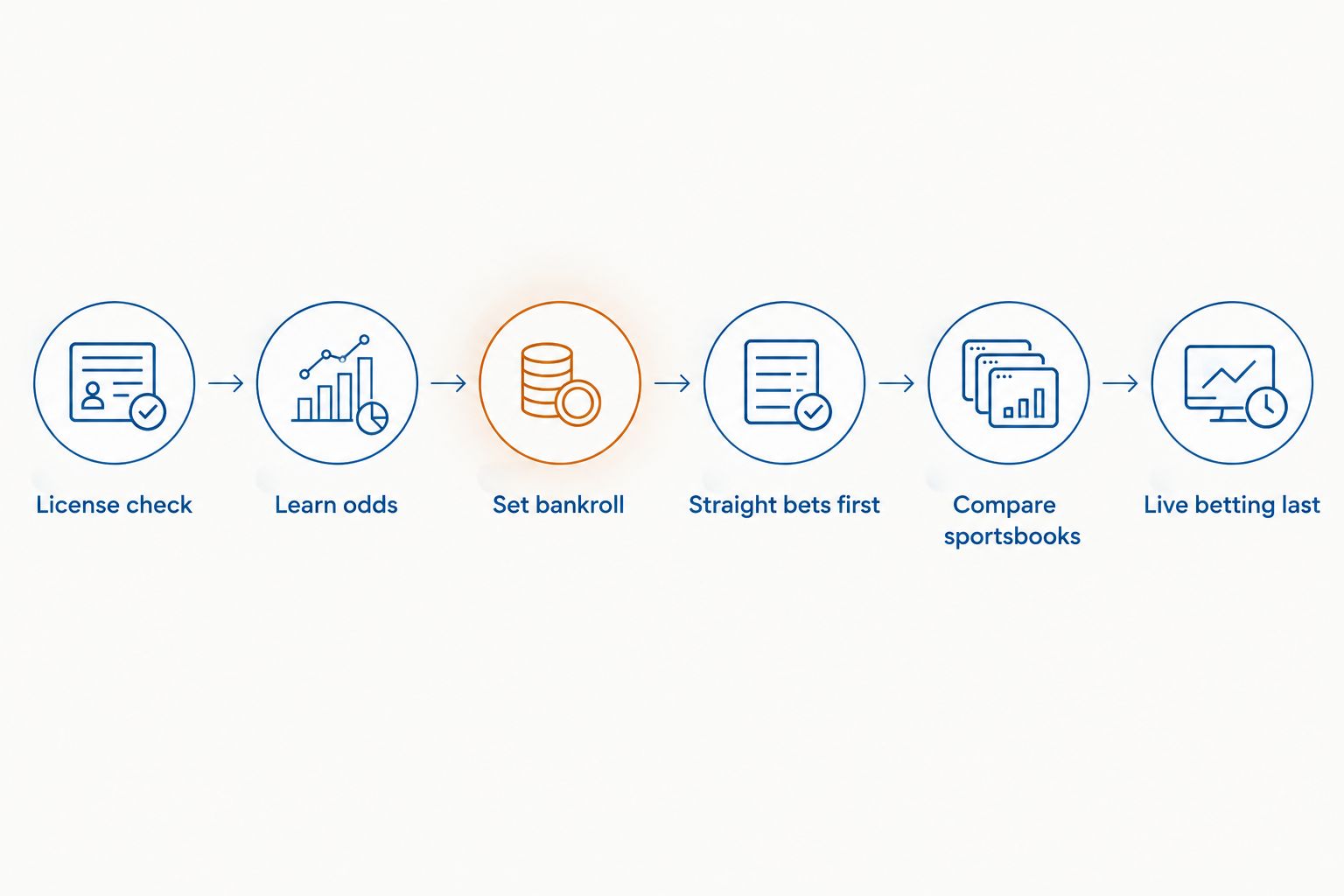
Build your sports betting basics in six moves
None of these six moves need a subscription or a bookie's phone number. They're the free, manual steps every regulated bettor works through before staking real money — the sportsbook app is the fast path, not the starting line.
1. Confirm your sportsbook is licensed in your state
A licensed operator answers to a state gaming commission; an unlicensed one answers to nobody if a bet gets graded wrong.
- Check your state gaming or lottery commission's list of licensed operators before downloading anything
- Match the app's license number, usually printed in the footer, against the state registry
- Drop any book still marketing itself as offshore once your state has a regulated market
- Confirm the book enforces your state's minimum betting age, 21 in nearly every regulated state
- Read the book's responsible-gaming page — a licensed operator always publishes one
2. Learn the odds format before you read a single line
Every regulated book in the US quotes American odds, and the format doesn't change by state or by sport.
- A minus number (-110) shows the favorite and what you stake to win $100
- A plus number (+150) shows what a $100 bet on the underdog pays out
- Spread: the favorite has to beat the posted number, not just win the game
- Total: the combined score lands over or under the book's line
- Vig: the book's built-in cut, usually close to 4.5% on a standard -110 line
3. Set a bankroll before you set a parlay
A fixed betting budget matters more in 2026 than ever, with sportsbook apps making it one tap easier to raise a stake mid-game.
- Separate a fixed betting budget from your regular monthly expenses
- Stake 1% to 5% of that budget on any single bet, win or lose
- Log every bet in a spreadsheet, including the odds and the result
- Never raise your stake mid-session to chase a loss
A full breakdown of the staking math lives in how to manage a sports betting bankroll.
4. Start with straight bets before same-game parlays
The fastest way to learn a market is to bet it in its simplest form first.
- Bet moneylines and spreads on sports you already watch closely
- Skip player props on athletes you don't follow during the season
- Track your win rate on straight bets for a full month before adding parlay legs
- Treat a same-game parlay as an occasional swing, not a weekly plan
5. Compare sportsbooks by market, not by welcome offer
SportsOrca compares regulated sportsbooks by actual market pricing, not by their splashiest sign-up promo — the welcome offer disappears after week one, but the book's real pricing on spreads and parlays doesn't.
- Check which books post the sharpest (lowest vig) spread numbers for your sport
- Compare same-game parlay payouts across two or three books before placing one
- Look at how fast each app grades and pays out a settled bet
- Note which books push same-game parlay boosts and treat them as marketing, not free money
For a side-by-side look at how regulated books price spread markets, see best sportsbooks for NFL spread betting.
6. Wait on live betting until the basics are automatic
Live markets move faster than pre-game markets, and slow decisions cost real value.
- Learn the pre-game markets first — moneyline, spread, total
- Practice reading American odds fast enough to act before a line moves
- Watch a full game before betting on it live, even after you've started
- Set a separate, smaller stake limit for in-game bets
Which bet type fits a first-time bettor
| Bet Type | Best For | Key Limitation |
|---|---|---|
| Moneyline | Bettors picking a straight winner, no spread math | Payout shrinks fast on heavy favorites |
| Point spread | Bettors who track a team's margin, not just wins | Needs real knowledge of team strength |
| Total (over/under) | Bettors without a side but a read on scoring pace | Late scratches and pace shifts swing the number |
| Same-game parlay | Bettors chasing one big payout on a single game | Hold for the book climbs with every added leg |
| Live/in-game betting | Bettors watching the full game who react to momentum | Lines move fast; a slow tap costs value |
Common mistakes bettors make in newly legal states
- Betting the welcome promo's wagering requirement before reading the terms, which locks up the bankroll in bets you wouldn't otherwise make
- Treating the same-game parlay as a primary strategy instead of an occasional swing
- Ignoring the state's tax reporting rules until a W-2G form shows up at the cashier window
- Chasing a loss with a bigger stake in the same session instead of closing the app
- Jumping into live betting in week one, before the base markets — moneyline, spread, total — are automatic
“If you can't explain the vig on a -110 line, you're already betting behind the count.”
Want sharper betting angles?
SportsOrca publishes weekly matchup breakdowns and betting analysis across every major league.
FAQ
What's the first thing to check when sports betting becomes legal in my state?
Confirm the sportsbook's license number against your state gaming commission's registry before creating an account. Regulated books geofence bets inside state lines and verify your age, usually 21, at signup.
How much money should a beginner bet per game?
Stake 1% to 5% of a fixed betting budget on any single bet in 2026, not a percentage of your full bank account. That range keeps one bad week from wiping out the bankroll.
Is a same-game parlay a good bet for beginners?
A same-game parlay carries a higher hold for the sportsbook than a straight bet, so it works better as an occasional swing than a weekly strategy. Beginners get more consistent reads from straight moneylines and spreads while learning the market.
Do I owe taxes on sports betting winnings?
Sportsbooks can issue a W-2G tax form on certain winnings depending on the odds and payout size, and all gambling winnings count as reportable income regardless of the form. Keep a running log of wins and losses through the year instead of reconstructing it in April.
What's the difference between the moneyline and the spread?
The moneyline is a bet on which team wins outright, while the spread requires the favorite to win by more than the posted number. Moneyline favorites pay less because there's no margin to cover.
How does live betting differ from pre-game betting?
Live betting lets you wager after kickoff or tip-off as the odds shift with the action, instead of locking in a number before the game starts. It moves faster than pre-game markets and rewards bettors who already know the base markets cold.
Are offshore sportsbooks legal once my state legalizes betting?
No. Once a state has a regulated market, licensed in-state sportsbooks are the legal option and offshore books fall outside state consumer protections. A licensed app also gives you real dispute resolution if a bet gets graded wrong.
What does the plus and minus in betting odds mean?
A minus number, like -110, shows the favorite and how much you need to stake to win $100. A plus number, like +150, shows how much a $100 bet on the underdog would pay out.
One last thing
The standard -110 line on a two-sided bet already bakes in roughly a 4.5% hold for the sportsbook before either team takes the field. Stack four legs into a same-game parlay and that hold compounds with every leg added — it's the single reason books push parlay boosts so hard in every newly legal market in 2026. SportsOrca tracks these odds shifts every week during the season, and the -110 math above holds regardless of sport or state. Learn to price a straight bet against that hold before touching a parlay slip, and the math starts working for you instead of the book.