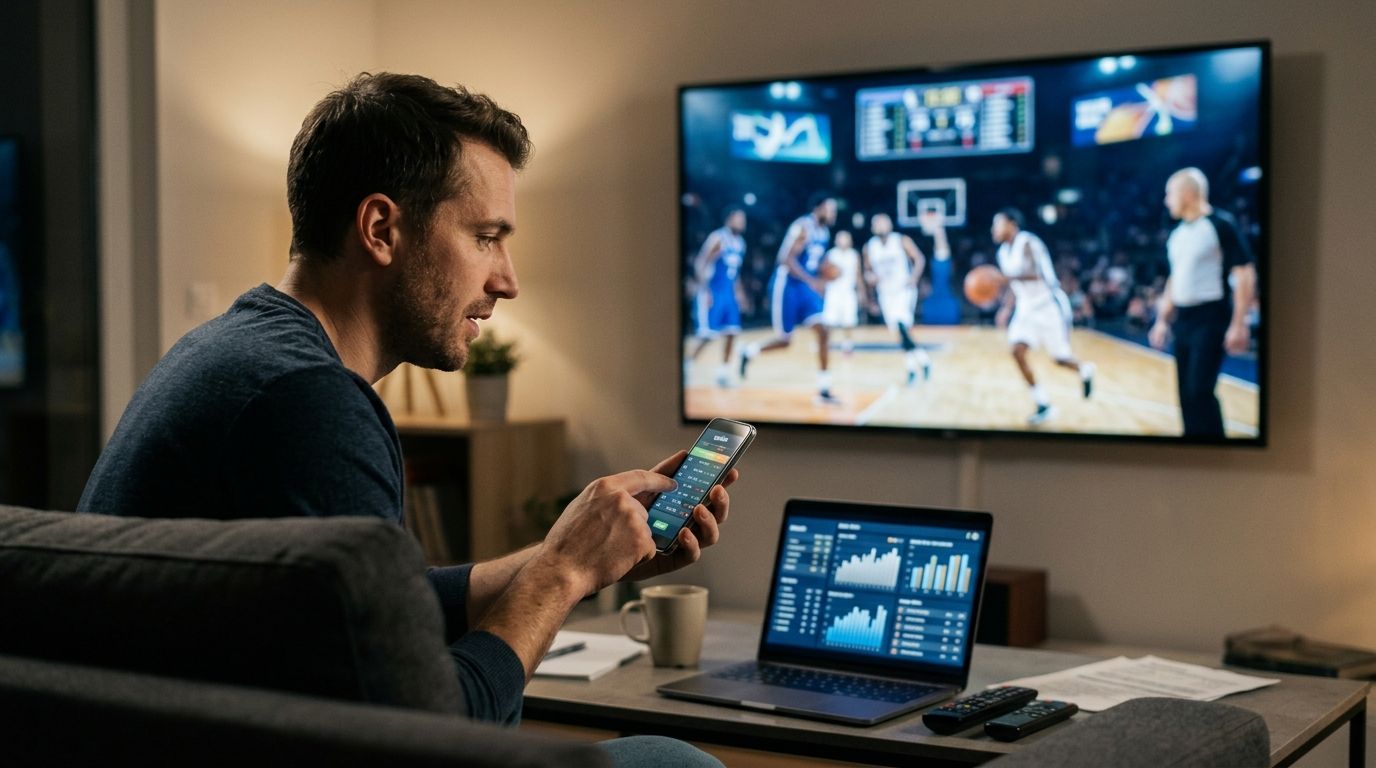
Live betting strategies for NBA games work only when you treat the scoreboard as a moving target, not a snapshot — the sharpest bettors are watching pace, foul trouble, and bench rotations while the recreational money is still staring at the pregame spread. NBA bettors who bet live need a different toolkit than pregame bettors: shorter decision windows, faster line moves, and a scoreboard that can flip a number by four or five points in under two minutes.
- Live betting strategies for NBA games reward bettors who track pace and foul trouble, not just the score.
- The first-quarter run is the most overreacted-to number in live NBA betting — fade it more than you ride it.
- Totals move fastest in live NBA markets; bet the number once pace stabilizes after six minutes.
- Garbage time offers real value on player props but almost none on game lines once a lead exceeds 20 points.
- Bankroll discipline across four quarters matters more in live betting than any single read on a run.
Why live betting matters for NBA bettors
Pregame numbers get set once and sit for hours. NBA live lines move possession by possession, and a team's real form on a given night — hot shooting, a tired starter, a crew letting the game get physical — shows up on the floor long before it shows up in a box score. That gap between what's visible and what the market has priced is where live betting profit lives.
NBA bettors also get more swings per game than any other major sport: 48 minutes, four quarters, a 24-second shot clock forcing roughly 90-100 possessions a night. That volume means more mispriced moments. It also means more chances to make an impulsive bet off one hot streak.
SportsOrca covers these swings across the league every night in 2026, and the pattern repeats: the bettor who waits for the market to overcorrect beats the bettor who reacts to the first sign of momentum. Live betting is not a speed contest. It is a patience contest with a clock attached.
Step 1: Set a pregame baseline before tip-off
You cannot read a live move if you do not know the opening number. Lock in a baseline so every shift means something.
- Note the opening spread, total, and moneyline at least an hour before tip
- Flag which side the public is hammering pregame — live markets often overcorrect against that side early
- Write down the pace projection both teams are expected to play at
- Recheck injury reports 30 minutes before tip; a late scratch moves the live total fast
- Decide, in advance, how many live bets this game gets
Step 2: Fade the first-quarter overreaction
Books move totals and spreads hard after a 12-2 opening run. Most of that is noise. Teams settle into rotation patterns by the midpoint of the first quarter, and the number settles with them.
- Wait until at least the 6-minute mark of the first quarter before placing a live spread bet
- Compare the live number to your pregame baseline; a shift of more than 3-4 points on one run is usually an overreaction
- Bet against the team that just had one exceptional shooting stretch — four straight threes rarely repeats
- Check who is actually on the floor for both teams before touching the live moneyline
Step 3: Bet the total at the right number, not the opening one
Totals are the most volatile live NBA market because pace swings possession by possession. The edge is timing, not reflexes.
- Let the game establish real pace; the first five minutes rarely reflect the full 48
- Track free-throw rate — a whistle-heavy first quarter inflates the live total artificially
- Watch for trailing teams pushing tempo, which pulls scoring up in the second half
- Bet the gap between live total and actual pace only when the two are clearly out of line
- Ignore a total that has barely moved off the pregame number; there is no edge in a stale price
Step 4: Read foul trouble and rotations in real time
A star with two fouls in the first quarter changes the entire live math, and the market is often a beat slow to reflect it. This is the single fastest live edge available to an NBA bettor in 2026.
- Note foul trouble on a team's best player before the line moves
- Identify the backup replacing that starter and whether it is a downgrade on offense, defense, or both
- Track minutes restrictions on players returning from injury; late-game numbers shift once that player sits
- Check back-to-backs — a team on its second game in two nights fades more often in the second half
Step 5: Use halftime as your best re-entry point
Halftime is the cleanest reset in NBA live betting. Coaches make real adjustments, and the market re-prices largely off the first-half score.
- Fade a team up big at half if their bench built the lead; bench-driven leads shrink in the third
- Look at first-half three-point variance — a team shooting well above its season rate almost always regresses
- Check free-throw discrepancies; a lopsided first-half whistle usually evens out
- Compare the second-half line to what a neutral-pace second half should actually produce
Step 6: Treat garbage time as a props market
Once a lead crosses 20 points, game lines stop mattering and player props take over. This is where most NBA bettors walk away and leave value behind.
- Track which bench players get extended minutes as starters sit
- Stop betting live spreads and moneylines once the lead is well outside single digits late
- Look at unders on stars likely to sit the entire fourth quarter of a blowout
- Watch garbage-time pace; teams often slow down, which caps role-player scoring props
Step 7: Manage bankroll pace across four quarters
Live betting multiplies your decisions per game, which multiplies your ability to chase. Treat each quarter as its own decision point, not a continuation of the last bad bet.
- Cap live bets per game at a number set before tip-off and never revised mid-game
- Size each live bet below your standard pregame unit — higher volatility, lower exposure
- Stop after two losing live bets in a row rather than doubling up
- Keep pregame and live bankrolls separate so one bad run does not drain both
For structured pregame-to-live combinations, building a winning NBA parlay covers how to stack legs without overexposing to one game script — which matters more once you are layering live bets on top of a pregame position.
Comparison: live NBA betting approaches
| Approach | Best for | Key limitation |
|---|---|---|
| Live spread reaction | Bettors acting on foul trouble or a run | Lines move in seconds; needs constant attention |
| Live total fading | Bettors who wait for pace to stabilize | Slower payoff; you sit out the first 5-6 minutes |
| Live player props | Garbage time and second-half value | Thin liquidity on role players at some books |
| Same-game live parlays | Bettors combining a spread with a prop mid-game | Correlation risk stacks fast if one leg misses |
| Live moneyline hedging | Bettors protecting a pregame position | Only works if the pregame side is still live-bettable |
For props specifically, best sportsbooks for NBA player prop betting breaks down which books keep live prop markets open deepest into the fourth quarter — the difference between cashing garbage-time value and watching a market close.
“If the lead was built by the bench, it will not survive the third quarter.”
Get more NBA betting breakdowns
Matchup previews and betting angles from SportsOrca, updated through the 2026 season.
Common mistakes NBA live bettors make
- Chasing the first-quarter run. Betting into a hot streak instead of waiting for it to cool is the most common losing pattern in live NBA betting.
- Ignoring back-to-backs. Teams on the second night of consecutive games fade in the second half, and live bettors miss it once they lock onto the score.
- Overloading same-game live parlays. Stacking a spread, a total, and a prop on one game multiplies variance without multiplying edge.
- Betting the moneyline off one shooting stretch. Four straight threes is a sample of four, not a trend.
- Refusing to walk away. Two losing live bets in a row should end the session, not trigger a bigger third bet.
FAQ
What are the best live betting strategies for NBA games?
The strongest live betting strategies for NBA games are fading first-quarter overreactions, betting totals once pace stabilizes around the six-minute mark, and reacting quickly to foul trouble on a team's best player. Patience on spreads and totals beats reacting to the opening run.
Is live betting better than pregame betting for NBA games?
Neither is universally better. Live betting offers more decision points and faster line moves, while pregame betting gives you time to research matchups. Most bettors use pregame bets for value and live bets for in-game overreactions.
How much do NBA live lines move during a game?
NBA live lines can shift several points inside a single quarter on a run, foul trouble, or an injury. The size of the move depends on the sportsbook's in-game model and the liquidity in that market at the time.
When is the best time to bet an NBA total live?
Around the six-minute mark of the first quarter, once both teams have settled into real rotations and pace. Betting a total in the opening minutes prices a sample too small to mean anything.
Do live player props pay off in garbage time?
Live props on bench players can carry real value once a lead crosses 20 points and starters sit. Liquidity on those props is thinner than on main game lines, so limits are lower at most books.
How many live bets should I place per NBA game?
Set a fixed cap before tip-off instead of deciding mid-game. Two or three planned entry points per game is a common structure among disciplined live bettors.
Does foul trouble actually move NBA live lines?
Yes. A star picking up two fouls in the first quarter is one of the fastest-moving inputs in live NBA markets, and the number often lags the actual rotation change on the floor.
Are same-game live parlays worth the risk in the NBA?
They can pay well but stack correlation risk fast. A spread, a total, and a prop tied to the same game script can all miss together the moment that script changes.
One last thing
The biggest edge in live NBA betting in 2026 is not spotting a hot streak. It is spotting the moment a star's second foul changes a rotation, because that number moves on the floor before it moves on the board. Bettors watching the bench instead of the scoreboard are the ones cashing the live total while a backup center gets picked apart at the rim for six straight minutes.