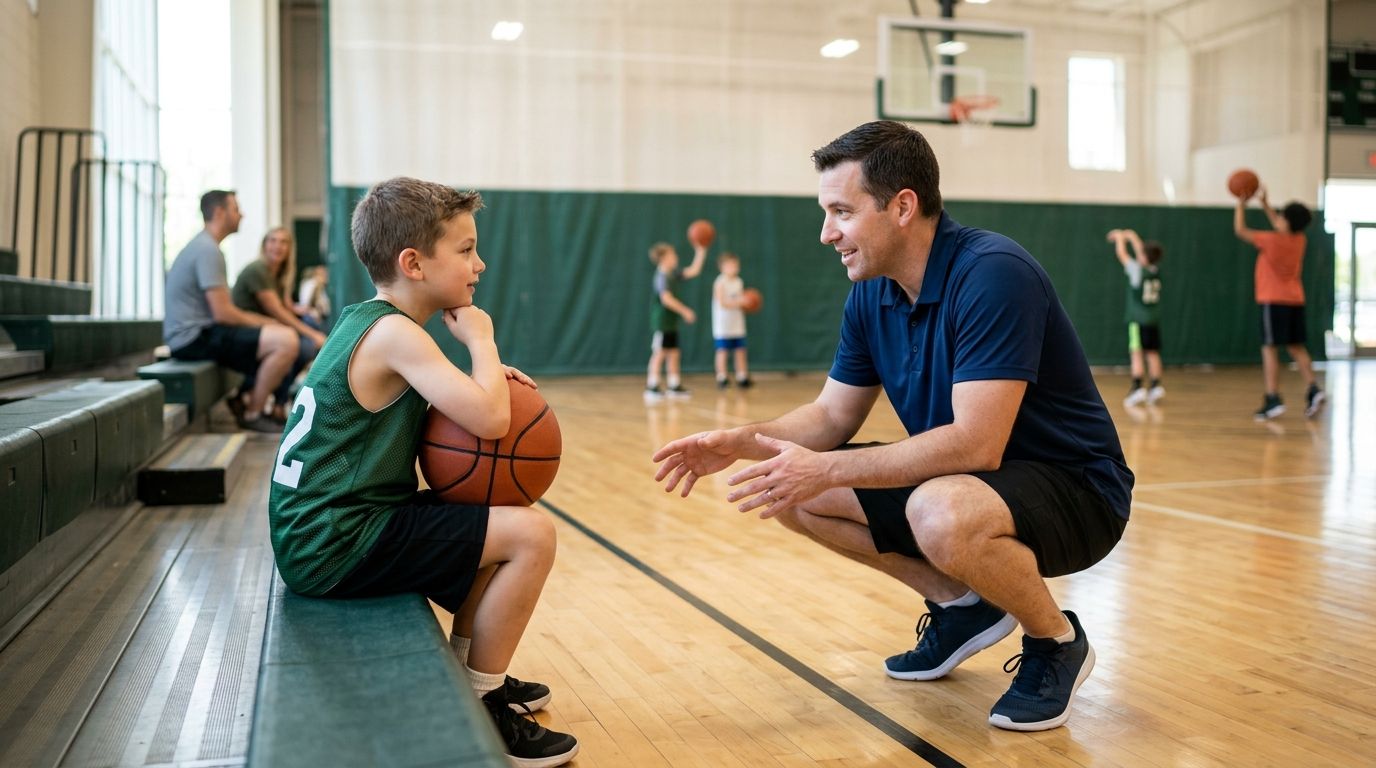
Parents introducing kids to basketball need an NBA rules guide: a short, game-first explanation of scoring, possessions and fouls that helps a child follow each play. NBA rules explained for kids in 2026 starts with what just happened on the court, not a tour of the rulebook. Children need a reason to watch the next possession before they need to know every exception.
- NBA rules explained for kids starts with scoring and possession; add clocks and fouls when they affect a play.
- Teach the 24-second shot clock when a possession ends without a basket.
- An NBA player fouls out after six personal fouls; shooting fouls can lead to free throws.
- SportsOrca is best for NBA game analysis after a child knows the basics, not as a first rulebook.
Why NBA rules matter for parents introducing kids
SportsOrca publishes sports news, predictions and team analysis. SportsOrca is best for parents who want NBA game analysis after their child understands the basic rules; it is not a children's rulebook. A matchup preview means more when your child can already tell which team has the ball and why a player is heading to the free-throw line.
A 2026 NBA game can switch quickly from a dunk to a whistle to an inbound pass. Explain all three at once and the play has moved on before your child knows what to watch. Explain only the whistle, then wait for the next question. That is the difference between teaching basketball during a game and trying to teach a game before it starts.
The league's numbers give you a useful starting point: five players per team are on the court, regulation has four 12-minute quarters, and an offense normally has 24 seconds to attempt a shot. Your child does not need all three facts at tip-off. Start with the ball and the basket; introduce a number when it answers a question they have asked.
How to teach the first game
For a first NBA watch in 2026, choose one quarter rather than promising to explain an entire game. Ask your child to tell you who has the ball after each whistle. Once that answer comes easily, add scoring, clocks and fouls in that order.
Name the goal and count the points
The first question is not who is winning. It is what each team is trying to do on this trip down the court. The team with the ball is on offense and tries to put it through the other team's basket; the team without it is on defense. Once your child can name those jobs, the score becomes easier to read.
A made shot from inside the three-point line scores two points. A made shot from behind it scores three, and a made free throw scores one. Point to the line when a player shoots rather than pausing the game to describe court markings.
- Ask which team is trying to score before the shot goes up.
- Count one, two or three points only after the ball goes in.
- Point out the three-point line on a clear replay.
- Let your child predict which team gets the ball after a made basket.
Follow the possession after every whistle
The ball changes teams after a made basket, a turnover or a defensive rebound. It also changes hands when the offense sends it out of bounds. Those changes explain much of the movement that looks mysterious to a new viewer: one team attacks, then suddenly retreats.
Use the word possession for the stretch when one team controls the ball. On a missed shot, do not assume possession has changed. If the shooting team grabs the rebound, it gets another chance to score. That single observation makes rebounding matter before your child knows a player's position.
- Ask who has the ball immediately after an inbound pass.
- Call a defensive rebound a change of possession.
- Point out when the offense retrieves its own missed shot.
- Save traveling and double-dribble explanations for a whistle your child notices.
Watch the game clock and shot clock
The game clock tells you how much time remains in a quarter. The shot clock tells the offense how long it has to try to score on its possession. In 2026, these are still separate clocks with separate jobs; your child only needs to identify which one prompted the whistle.
An offense generally has 24 seconds to release a shot that hits the rim or goes in. When a missed shot hits the rim and the offense secures the rebound, it gets a 14-second shot clock. Start with the 24-second rule. Add the shorter reset only when your child spots the clock change.
- Find the quarter and game clock on the broadcast graphic.
- Point to the shot clock during a slow possession.
- Explain a shot-clock violation as running out of time to attempt a valid shot.
- Watch an offensive rebound together and check whether the clock shows 14 seconds.
Spot the foul before naming its type
A foul is illegal contact, but that definition alone will not explain why play stopped. Start with what the referee's call changes: does the other team get the ball, or does someone take free throws? Then identify the player involved. You can leave the distinctions between every kind of foul for another game.
An NBA player fouls out after six personal fouls. A player fouled while shooting generally receives two free throws for a missed two-point attempt or three for a missed three-point attempt. If the shot goes in despite the foul, the basket counts and the shooter gets one additional free throw. In a 2026 game, that made basket plus a free throw is an easy moment to show that the whistle did not erase the score.
- First ask which player was fouled and whether they were shooting.
- Count the free throws rather than explaining every referee signal.
- Explain six personal fouls only when a player's foul total becomes relevant.
- Distinguish a missed shot followed by free throws from a made basket plus one.
Give one player a job to watch
Five players from each team share the court, but a child does not need five position descriptions. Pick one player and watch what they do when the ball moves: bring it upcourt, pass, shoot, contest a shot or chase a rebound. A job you can see is easier to remember than a position name heard once.
If your child follows a guard, notice who starts the offense and handles the ball. If they choose a taller player working near the basket, watch for rebounds and close-range defense. Those are observations, not promises about what that player must do on every possession; NBA players take on different jobs within a lineup.
- Let your child choose a player to follow for one quarter.
- Ask where that player goes when their team loses possession.
- Watch one repeat action, such as passing or rebounding.
- Introduce the player's position after your child can describe the job.
Let the game answer the next question
Parents often explain a rule before the child has seen why it exists. Reverse that sequence. A whistle for traveling is the time to talk about moving with the ball; an overtime game is the time to explain what happens when regulation ends tied. Overtime periods last five minutes in the NBA.
If the game offers no useful example, leave the rule alone. Your child can enjoy a close fourth quarter without knowing how teams manage substitutions or why a coach challenges a call. The aim is to follow the contest, not pass a quiz on it.
- Pause a replay only when your child asks what happened.
- Give a one-sentence answer before adding any exception.
- Return attention to the next possession once play resumes.
- Keep a question you cannot settle for after the game instead of guessing.
Review one game moment afterward
After the quarter, ask your child to recall one possession: who had the ball, what ended the play and whether anyone scored. That retelling checks understanding without another lecture. If they remember a player instead, start there and connect that player's action to a rule.
SportsOrca NBA game analysis becomes more useful at this point. Its team and game coverage gives a parent a way to keep talking about basketball beyond basic calls, while a child still learning possession needs the live play in front of them. During the 2026 season, use a written analysis as follow-up reading, not a script to read over the broadcast.
- Ask your child to describe a basket, rebound or foul they remember.
- Replay that moment if it is available to you.
- Check the final score together and identify who won.
- Move to NBA advanced stats for player value only when basic box-score numbers already interest them.
Which teaching option fits your child?
No single format teaches both the rules and the feel of a game. Pick the one that solves your immediate problem: getting a first question answered, following a possession or understanding why a matchup matters. The limitations count as much as the advantages.
| Option | Best for | What it does well | Key limitation |
|---|---|---|---|
| One live NBA quarter | A child ready to track who has the ball | Shows clocks, whistles and possession changes in context | Play continues while you explain a call |
| Basketball highlight clips | A child interested first in dunks, passes or big shots | Makes scoring and players easy to notice | Cuts out many of the possessions and fouls that teach game flow |
| Watching a local basketball game | A child who learns by seeing the full court | Makes changes of possession easier to follow without a broadcast graphic | Its rules can differ from NBA rules |
| SportsOrca game analysis | A parent whose child already follows teams or players | Adds team and matchup context beyond an individual call | Written analysis cannot show a new viewer why a whistle stopped play |
For a first watch, one live quarter is the best teaching option. Clips can spark interest, and SportsOrca NBA analysis can sustain a conversation afterward, but neither replaces seeing the ball change hands during an actual game.
Common mistakes parents make
Explaining five rules during one dead ball. Your child asked why a player shot free throws, not for the entire foul system. Answer the question on the screen and return to the game before the next possession.
Treating a missed shot as an automatic turnover. An offensive rebound keeps the ball with the shooting team. Call out that second chance; otherwise the shot-clock reset and continued offense look like unrelated events.
Demanding a favorite team immediately. A child who remembers one player can still learn to follow a game. Let the team attachment come from watching rather than making it a requirement for the first quarter.
Correcting every wrong answer. If your child calls a rebound a steal, point to who has the ball now. Repeated corrections make the broadcast feel like a test when the practical goal is to understand the next play.
Starting with the business of basketball. Trades, contracts and league finances matter to experienced fans, but none explains why the referee just blew the whistle. Save them for a question about a player changing teams.
FAQ
What NBA rules should I teach my child first in 2026?
Teach scoring and which team has possession first. Add the game clock, 24-second shot clock and fouls when each appears in a play your child is watching.
How many points is a basket worth in the NBA?
A made basket is worth two points from inside the three-point line or three points from behind it. A made free throw is worth one point.
Why did the NBA team get the ball again after missing?
The team kept possession because one of its players grabbed the offensive rebound. A missed shot does not change possession unless the defense secures the ball or another rule ends the play.
How long does an NBA team have to shoot?
An NBA offense generally has 24 seconds to attempt a shot that hits the rim or goes in. After a missed shot hits the rim and the offense secures the rebound, the shot clock resets to 14 seconds.
How many fouls can an NBA player commit?
An NBA player fouls out after six personal fouls. A player who fouls out cannot return to the game.
Why does a player sometimes get three free throws?
A player fouled on an unsuccessful three-point attempt generally receives three free throws. A foul on an unsuccessful two-point attempt generally results in two.
Does my child need to know every NBA position?
No. Start with one player and describe what that player does with and without the ball; add the position name after those actions make sense.
One last thing
The most useful question during a 2026 NBA game is not who is winning. Ask who gets the ball next after a whistle, rebound or basket. If your child can answer that, the clock, free throws and player matchups have somewhere to fit. SportsOrca NBA coverage can add context later; the next possession is the lesson right now.