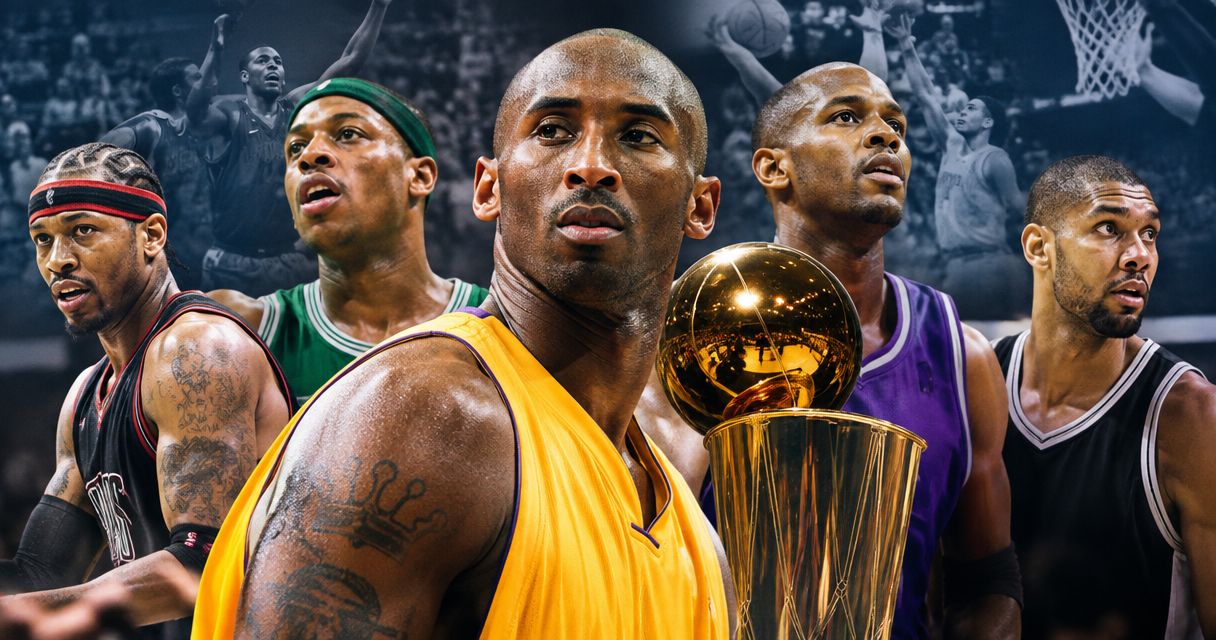
The 2000s didn't have one NBA dynasty — it had four teams that spent a decade trading the throne, and in 2026 the argument over who really ran the league from 2000 to 2009 still gets loud in every sports bar from Los Angeles to Boston.
- Best NBA dynasties 2000s ranking: the Los Angeles Lakers win outright with four titles between 2000 and 2009.
- San Antonio Spurs built the most repeatable model, winning in 2003, 2005 and 2007 with almost no roster turnover.
- Detroit Pistons' 2004 title is still the decade's biggest star-power upset.
- Boston Celtics proved in 2008 that a superteam built in one trade summer can win immediately.
Why this matters
Every generation of NBA fans re-litigates the 2000s because it's the last decade before advanced stats and superteam free agency rewrote how rosters get built. Fans who grew up on Shaq-and-Kobe now argue with fans who grew up on Duncan-and-Parker, and both sides drag numbers into the fight without agreeing on what a "dynasty" even requires. For anyone doing best NBA players ever debates, the 2000s dynasty argument is the entry point — it's where Shaq, Kobe, Duncan, Garnett and the Pistons' no-star roster all get compared on equal footing.
This matters in 2026 specifically because streaming has put every Finals from 2000 through 2009 back in front of a new audience that never saw them live. The take is forming in real time, and it's worth getting the facts straight before the hot-take crowd rewrites history.
What makes the best NBA dynasty
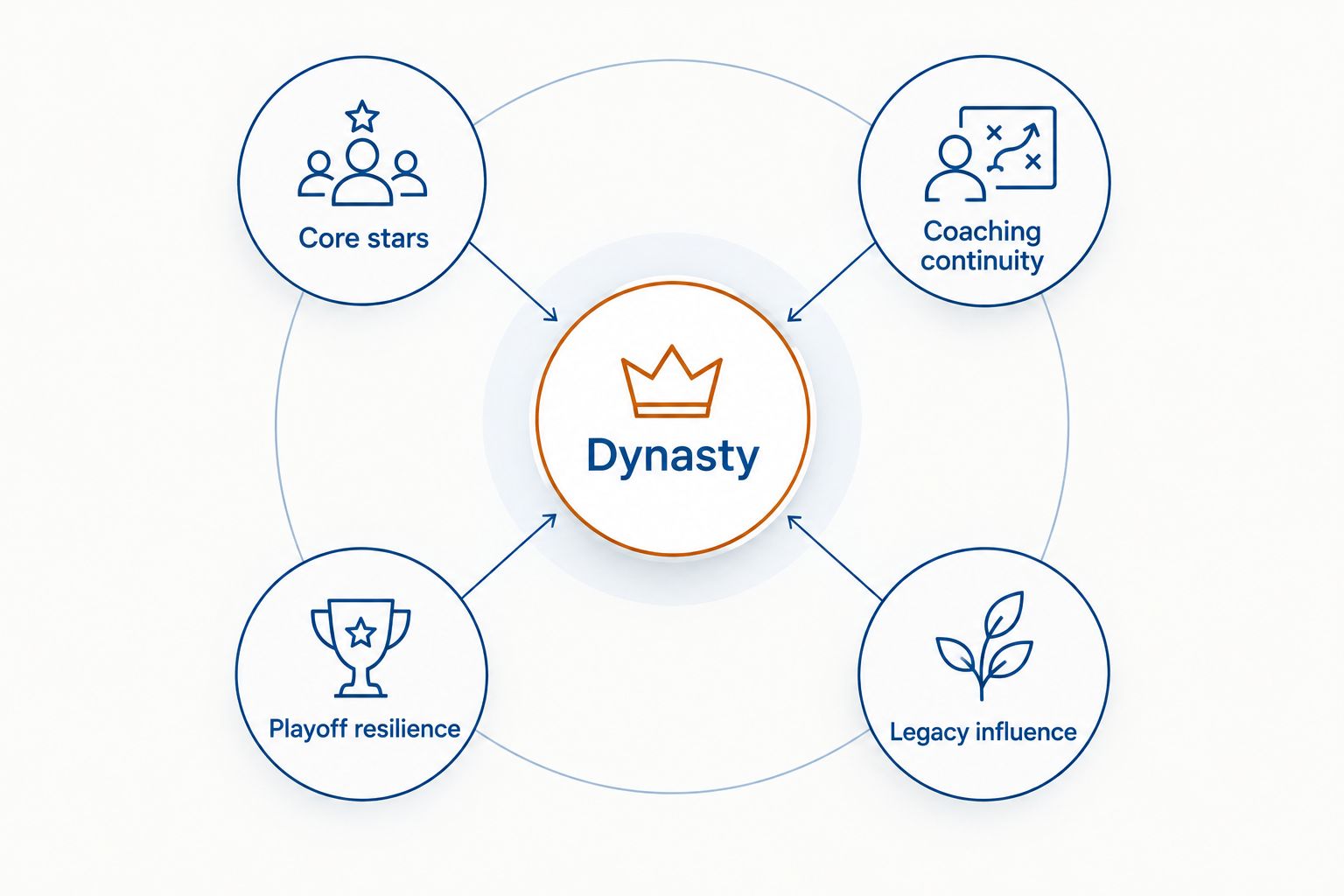
Four teams qualify for this conversation. Here's the criteria that separates a real dynasty from a good three-year run:
- Championship count within the decade — how many banners actually went up between 2000 and 2009
- Roster continuity — did the same core stay together across multiple title runs, or was it a one-off
- Head-to-head resistance — did the team beat other elite contenders in the playoffs, not just weaker fields
- Statistical dominance during the run — regular-season win totals and playoff series scorelines
- Legacy influence — did the roster-building blueprint get copied by later contenders
Best NBA dynasties of the 2000s at a glance
| Dynasty | Best for | Standout feature | Key limitation |
|---|---|---|---|
| Los Angeles Lakers | Championship volume | Four titles in the decade across two different core groups | Both runs ended in messy breakups (2004 trade demand, 2010 aging roster) |
| San Antonio Spurs | Sustained excellence | Three titles with almost no roster overhaul between them | Never dominated the ratings conversation the way the Lakers did |
| Detroit Pistons | Team defense over star power | Beat a 67-win Lakers team without a single top-5 MVP vote-getter | Couldn't repeat — lost the 2005 Finals rematch to San Antonio |
| Boston Celtics | Trade-built superteam | Went from lottery team to champion in one offseason | Core aged fast and never won a second title together |
1. Los Angeles Lakers: best NBA dynasty of the 2000s for championship volume
The Los Angeles Lakers are the only team in this conversation with two separate dynasty runs inside the same decade. Shaquille O'Neal and Kobe Bryant won three straight titles from 2000 to 2002, then Bryant paired with Pau Gasol to add a fourth in 2009. No other 2000s roster produced four championships under one franchise.
The first run collapsed under its own weight — Shaq and Kobe's relationship fractured publicly, and O'Neal was traded to Miami in 2004. The second run started almost from scratch, built around Bryant and a completely different supporting cast just five years later.
Los Angeles Lakers pros:
- Four championships between 2000 and 2009, more than any other team in the decade
- Two Finals MVPs from two different superstars (O'Neal in 2000-2002, Bryant in 2009)
- Deep playoff runs almost every year, even in seasons without a title
Los Angeles Lakers cons:
- The 2000-2002 core imploded from internal conflict, not opponent play
- Lost the 2004 Finals to Detroit as heavy favorites, exposing the first core's cracks
- The 2009 title run leaned on a rebuilt roster, which weakens the "one continuous dynasty" argument
Best for: fans who care about total banners over roster continuity.
Verdict: certified dynasty on paper, split dynasty in practice — the trophy count wins the argument even if the story is two teams wearing one jersey.
2. San Antonio Spurs: best 2000s dynasty for sustained excellence
The San Antonio Spurs never had the biggest names in the room, but Tim Duncan, Tony Parker and Manu Ginóbili won three titles — 2003, 2005 and 2007 — with the same core intact the entire time. That continuity is the argument for calling San Antonio the decade's real dynasty, even without the Lakers' banner count.
The 2007 title made the point loudest: a sweep of a LeBron James-led Cleveland team, 4-0, with almost no drama and no roster shakeup afterward. Duncan anchored all three runs at power forward, which no other 2000s champion can claim about a single player.
San Antonio Spurs pros:
- Three titles across the decade with the same core group, not a rebuilt roster
- Beat the Pistons in the 2005 Finals in seven games, settling the Detroit rematch
- Zero major public dysfunction across seven-plus seasons together
San Antonio Spurs cons:
- Never produced the ratings or cultural moment the Lakers or Celtics did
- Duncan's low-key style meant the dynasty got less national attention than its results deserved
- Three titles is one fewer than the Lakers' decade total
Best for: fans who value continuity and a repeatable system over star wattage.
Verdict: the most defensible dynasty of the 2000s by pure consistency, even if it never got the credit in real time.
3. Detroit Pistons: best 2000s dynasty for team defense over star power
The Detroit Pistons won the 2004 title with a roster that had zero top-tier MVP candidates. Chauncey Billups, Ben Wallace, Rasheed Wallace, Richard Hamilton and Tayshaun Prince beat a Lakers team featuring O'Neal, Bryant, Karl Malone and Gary Payton — four Finals in five games.
Detroit made it back to the Finals in 2005 but lost to San Antonio in seven games, which is the one thing keeping this from being a true multi-title dynasty. Still, no team in the decade did more with less individual star power.
Detroit Pistons pros:
- Won a title as a genuine underdog against a stacked Lakers roster in 2004
- Built the decade's best defensive identity — no All-NBA First Team scorer on the roster
- Returned to the Finals the very next year in 2005
Detroit Pistons cons:
- Couldn't close out the 2005 rematch against the Spurs
- Only one championship, the lowest total of the four teams here
- The core aged out fast — no third Finals trip before the group broke up
Best for: fans who rate team defense and chemistry above individual talent.
Verdict: a one-year dynasty, but the single most impressive title run of the decade given the roster it beat.
4. Boston Celtics: best 2000s dynasty for a trade-built superteam
The Boston Celtics won 24 games the season before trading for Kevin Garnett and Ray Allen to pair with Paul Pierce in the summer of 2007. The Big Three won the championship in their first season together, beating the Lakers 4-2 in the 2008 Finals.
That turnaround — a lottery team to champion in a single offseason — became the blueprint every front office copied over the next fifteen years. Reading the salary cap rules that governed those trades explains why building a superteam in one summer was so rare before Boston did it.
Boston Celtics pros:
- Went from a losing record to champion in one offseason, a first for the decade
- Beat the rival Lakers directly in the 2008 Finals, 4-2
- Set the template for later star-trio builds across the league
Boston Celtics cons:
- Never won a second title with the same three stars together
- The core was already in its 30s by the time it clicked, limiting the run's length
- Only one championship out of the group's four seasons together
Best for: fans who want proof a superteam can be assembled fast and still win.
Verdict: one perfect year, not a dynasty by volume — but the blueprint mattered more than the banner count.
How we ranked
The ranking above weighs championship count first, then roster continuity, then head-to-head results against other contenders on this list. The Pistons beating the Lakers in 2004 and the Spurs beating the Pistons in 2005 both factored directly into where each team lands. Reading up on advanced stats helps separate a team that won because of talent from one that won because of system — which is exactly the gap between the Lakers' star power and the Pistons' defensive scheme.
Which 2000s NBA dynasty should you rank first?
If total championships is the only metric that matters to you, the Los Angeles Lakers win with four titles between 2000 and 2009 — no other team comes close. If continuity and a repeatable system matter more, the San Antonio Spurs' three titles with one unchanged core is the stronger dynasty. Either answer is defensible in 2026; the disagreement is really about what the word "dynasty" should require.
See who's chasing a title now
Current-season trade candidates for teams building toward a ring.
FAQ
What is the best NBA dynasty of the 2000s?
The Los Angeles Lakers are the best NBA dynasty of the 2000s by championship count, winning four titles between 2000 and 2009. The San Antonio Spurs are the stronger pick if roster continuity matters more than total banners.
How many championships did the Lakers win in the 2000s?
The Lakers won four championships in the 2000s: 2000, 2001, 2002 and 2009. The first three came with Shaquille O'Neal and Kobe Bryant, the fourth with Bryant and Pau Gasol.
Did the Pistons really beat the Lakers in the Finals?
Yes, the Detroit Pistons beat the Los Angeles Lakers 4-1 in the 2004 NBA Finals as significant underdogs. It remains the decade's biggest star-power upset.
Were the Spurs better than the Lakers in the 2000s?
The Spurs won three titles to the Lakers' four, so the Lakers have the higher championship count. The Spurs argument rests on roster continuity — the same core won all three titles without a major overhaul.
Was the Celtics' Big Three actually a dynasty?
No, by strict definition — the Big Three won one championship together in 2008 and never repeated. It's better described as a superteam blueprint than a multi-title dynasty.
How did the Spurs beat LeBron James' Cavaliers in 2007?
The Spurs swept the Cleveland Cavaliers 4-0 in the 2007 NBA Finals behind Tony Parker's Finals MVP performance. It was San Antonio's third title of the decade.
Which 2000s dynasty had the best defense?
The Detroit Pistons built the decade's best defensive identity, winning the 2004 title without a single All-NBA First Team scorer on the roster.
Why did the Lakers' first three-peat end?
The 2000-2002 Lakers core broke apart due to a public conflict between Shaquille O'Neal and Kobe Bryant, culminating in O'Neal's trade to Miami in 2004 and the Finals loss to Detroit that same year.
One last thing
The stat that gets buried in every 2000s dynasty debate: the Pistons and Spurs met in back-to-back Finals-adjacent seasons — Detroit beat the Lakers in 2004, then lost to San Antonio in a seven-game 2005 rematch — meaning the two least glamorous teams in this ranking settled the era's real power struggle between themselves, not against Los Angeles or Boston. That's the part the highlight reels skip in 2026.