Serve stats separate the tennis matches with real betting value from the ones the market already priced correctly. Here's how to read the five numbers that move a line in 2026 -- not the ace total a broadcast flashes on screen.
- Reading tennis serve stats means stacking first serve percentage, first serve points won, and second serve points won together, never alone.
- A big first serve percentage without first serve points won hides how much a server actually wins in play.
- Second serve points won under 50% is the clearest fade signal in tennis serve stats.
- Break points saved separates composed closers from stat-padders when two players look identical on paper.
- Return points won is the mirror number sharp bettors check before trusting a serve-heavy narrative.
Why This Matters
Public bettors bet the name on the shirt. Tennis serve stats let you bet the shape of a match instead -- who controls the free points, who cracks on break point, who needs their first serve to fall just to survive a set. A player can hold serve at a normal rate and still be bleeding value on the deuce points that decide close matches, and that gap shows up in tennis match betting lines before the public catches on.
Ignore the underlying serve numbers and you're betting last week's scoreline, not the match sitting in front of you right now. That's the whole reason serve stats matter more in 2026 than a player's ranking or their head-to-head record against an opponent they haven't faced in two years.
How to Read Tennis Serve Stats
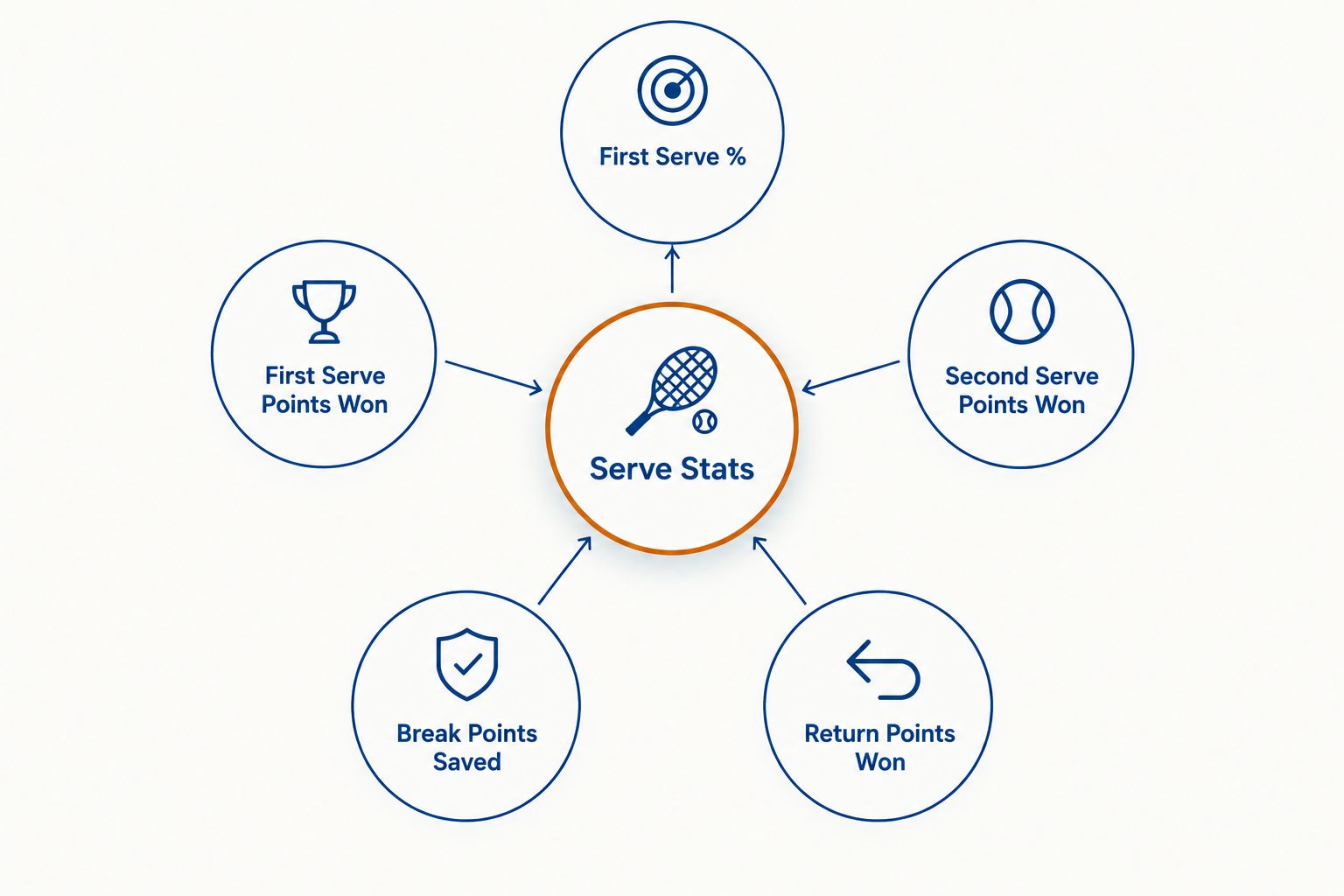
Five numbers tell you almost everything about a server's shape on a given surface: first serve percentage, first serve points won, second serve points won, break points saved, and return points won. None of them work alone -- a huge first serve percentage from a player who can't finish points off it is a mirage, and a modest ace total from a player winning most of their second-serve points is the real signal.
| Stat | What It Measures | Why Bettors Care |
|---|---|---|
| First Serve % | Share of first serves landed in play | Sets up win rate -- meaningless as a standalone number |
| First Serve Points Won | Win rate once the first serve lands | Shows real dominance behind a big delivery |
| Second Serve Points Won | Win rate on the more vulnerable shot | Exposes servers who can't survive a rally |
| Break Points Saved | Win rate on pressure points | Separates composed closers from frontrunners |
| Return Points Won | Win rate when receiving serve | The mirror stat showing who actually controls points |
First Serve Percentage: The Setup Stat
First serve percentage tells you how often a server lands the ball in on the first attempt, nothing more. A rate in the low-to-mid 60s is considered strong and repeatable on tour, while anything under 55% usually means a server is spraying serves under pressure or managing a nagging issue. On its own, first serve percentage is close to useless for betting -- a player can post a strong first-serve rate and still lose the match if the returner camps on that serve and rips it back. Treat it as context, not a conclusion: it explains why the next two numbers look the way they do, and it flags servers compensating for a weak second serve by forcing more first serves in.
First Serve Points Won: Where the Real Value Lives
First serve points won measures the win rate once that first serve actually lands, and this is where betting value hides. A server winning north of 75% of points behind a landed first serve is applying real pressure regardless of the raw percentage of serves going in; a server stuck below 65% behind a clean first serve is vulnerable even with a good delivery motion. Cross-reference this against the returner's numbers on the same surface: a returner who consistently drags an opponent's first serve points won down against comparable competition is the live dog the market hasn't fully priced yet.
Second Serve Points Won: The Number That Exposes Frontrunners
Second serve points won is the stat sharp tennis bettors check before anything else, because it measures how a player survives when the first serve fails -- the moment true quality shows up. A rate sitting near 50% or below is the clearest fade signal in tennis serve stats: that player is one bad service game away from getting broken, no matter how many aces show up in the box score. Elite servers keep this number in the mid-50s or higher even against strong returners, and that consistency turns a shaky first set into a routine straight-sets win. Second serve points won is the most reliable single tennis serve stat for betting in 2026, ahead of aces, ahead of overall hold percentage, ahead of ranking.
“Second serve points won below 50% is the clearest fade signal in the sport.”
Break Points Saved: The Composure Filter
Break points saved measures how often a server holds when the game reaches a pressure point -- deuce, break point, ad-out, the moments the tennis scoring rules turn into swing points worth an entire game. A player saving 60% or more of break points faced is playing composed tennis under duress; a player who wins routine service games but folds anytime the score tightens is a live betting target in tight sets. Weight recent matches on similar surfaces heavier than the full-season figure, since one bad match against a heavy returner can tank a season-long number without meaning much going forward.
Return Points Won: The Mirror Metric Sharps Check First
Return points won flips the lens: it measures how often a player wins the point while receiving serve, and it tells you who's actually controlling a match rather than just holding serve on autopilot. A returner winning 40% or more of return points against comparable opposition is generating break chances every set, which matters more for total-games and set-betting markets than raw hold percentage. Pair return points won with the opponent's second serve points won and you get a two-sided picture -- if the returner's number is climbing while the server's is sliding, that match is trending toward a break before the live line catches up.
Why Serve Stats Vary
- Surface: clay slows the ball and lifts league-wide second serve points won; grass and hard courts favor big servers.
- Altitude and ball brand: high-altitude events and lighter balls inflate ace counts and first serve points won across the board.
- Opponent return quality: a plus-return specialist drags every serve stat down regardless of the server's own form, which is exactly why clay-court specialists live and die on second serve points won -- the surface strips away free points other surfaces hand them.
- Fatigue and scheduling: back-to-back three-set matches erode second serve points won and break points saved before it shows up in the results.
- Weather and wind: outdoor first serve percentage drops in windy conditions on every surface, not just grass.
- Injury and physical strain: a server nursing a shoulder or back issue loses velocity first, and that shows up in second serve points won weeks before it shows up in a loss.
SportsOrca's tennis match previews weigh these same five numbers before setting a lean on any Grand Slam or clay-court matchup, because a player's last win on the scoreboard tells you nothing about how they're serving under pressure right now.
Set Your Stakes Before You Bet
A serve-stat edge means nothing without disciplined bankroll management.
What Is a Good First Serve Percentage in Tennis?
A first serve percentage in the low-to-mid 60s is considered strong and repeatable on tour in 2026, while anything under 55% usually signals a server fighting rhythm or managing an injury. Percentage alone doesn't predict outcomes -- pair it with first serve points won before treating it as a betting signal.
How Do Break Points Saved Affect Betting Value?
Break points saved above 60% identifies servers who hold up under pressure, which matters most in tight, evenly-matched sets where a single break decides everything. A server with a strong overall record but a break points saved number trending down over their last two or three matches is a fade candidate the market hasn't caught up on yet.
Is Ace Count a Reliable Betting Stat?
Ace count alone is one of the least reliable tennis serve stats for betting because it rewards a handful of unreturnable serves without showing what happens on the other 90% of points. A player can lead a tournament in aces and still post a losing record if their second serve points won and break points saved are weak.
FAQ
What is the best serve stat for tennis betting?
Second serve points won is the most reliable single tennis serve stat for betting in 2026, since it measures how a player survives once the first serve fails. A rate near or below 50% is the clearest fade signal on tour.
How much does surface change tennis serve stats?
Surface changes every serve stat significantly -- clay lowers first serve points won and lifts return points won league-wide, while grass and fast hard courts do the opposite. Compare a player's stats on the specific surface they're about to play, not their full-season average.
Is first serve percentage more important than aces?
First serve percentage matters more than raw ace count because it's the number that sets up everything else, while aces are a byproduct that can mislead bettors on their own. Neither number means much without first serve points won attached to it.
Where do you find tennis serve stats before a match?
Tour-level stat pages, tournament match centers, and pre-match previews typically publish first serve percentage, points won on both serves, and break points saved for recent matches. Check the last three matches on the same surface, not just the season total.
What second serve points won percentage should worry bettors?
A second serve points won rate at or below 50% should worry bettors backing that player, since it means the opponent is winning the majority of points once the first serve misses. That number is the clearest fade signal in tennis serve stats.
Do break points saved matter more in best-of-three or best-of-five matches?
Break points saved matters in both formats but compounds more in best-of-five matches, where a server has more opportunities to either lock in a composed pattern or crack repeatedly under pressure. Watch the trend across sets, not just the match total.
How often should you check live serve stats during in-play betting?
Check second serve points won and break points saved after every set change during in-play betting, since those two numbers shift fastest and signal fatigue or a tactical adjustment before the scoreline reflects it. First serve percentage moves slower and matters less mid-match.
Are serve stats useful for doubles betting?
Serve stats apply to doubles betting but weigh differently, since return points won and break points saved carry more relative importance than first serve percentage in the shorter doubles point structure. Singles-focused benchmarks don't translate directly.
One Last Thing
The most predictive single split in tennis serve stats isn't a season average -- it's a player's second serve points won over their last three matches on the exact surface they're about to play again. That rolling number reacts to fatigue and minor injury weeks before win-loss record catches up, and it's the first thing worth checking before trusting any full-season stat page in 2026.