Grand Slam sleeper hunting in fantasy tennis comes down to one question: which player is priced or drafted like a first-round exit but built to win three matches? Best overall sleeper profile for 2026: the Big-Serving Underdog on a hard-court major draw. Best for tournament-length GPP formats: the Hot-Streak Qualifier. Best safe floor play for cash games: the Motivated Veteran chasing ranking points. Everything below breaks down why those three profiles beat the field and where the other three fit your lineup.
- Grand Slam fantasy tennis sleepers win through draw path and surface fit, not name recognition.
- Big-serving underdogs on hard courts carry the highest sleeper ceiling across the four 2026 majors.
- Hot-streak qualifiers offer the best tournament upside for GPP-style fantasy tennis formats.
- Motivated veterans chasing ranking points give the safest floor for cash-game fantasy tennis lineups.
- Rising breakout players build long-term value even when they exit majors in the second week.
Why Grand Slam sleepers matter
A major draw runs two weeks and seven rounds, and half the field never gets there. That volatility is exactly why fantasy tennis rewards the drafter who reads a bracket instead of a ranking list. It is the same volatility that makes tennis match betting profitable for bettors willing to price an early-round upset correctly.
A top-ten seed getting bounced in round two happens at every major, and the player standing across the net from that seed instantly becomes the sleeper worth rostering. Fantasy tennis scoring rewards match wins, sets, and often aces or breaks, so a sleeper who survives three rounds outproduces a favorite who loses in round one. In 2026, with four majors on the calendar, the drafter who tracks draw paths across all four gets more usable sleeper data than one who reacts to a single tournament.
What makes the best Grand Slam fantasy tennis sleeper
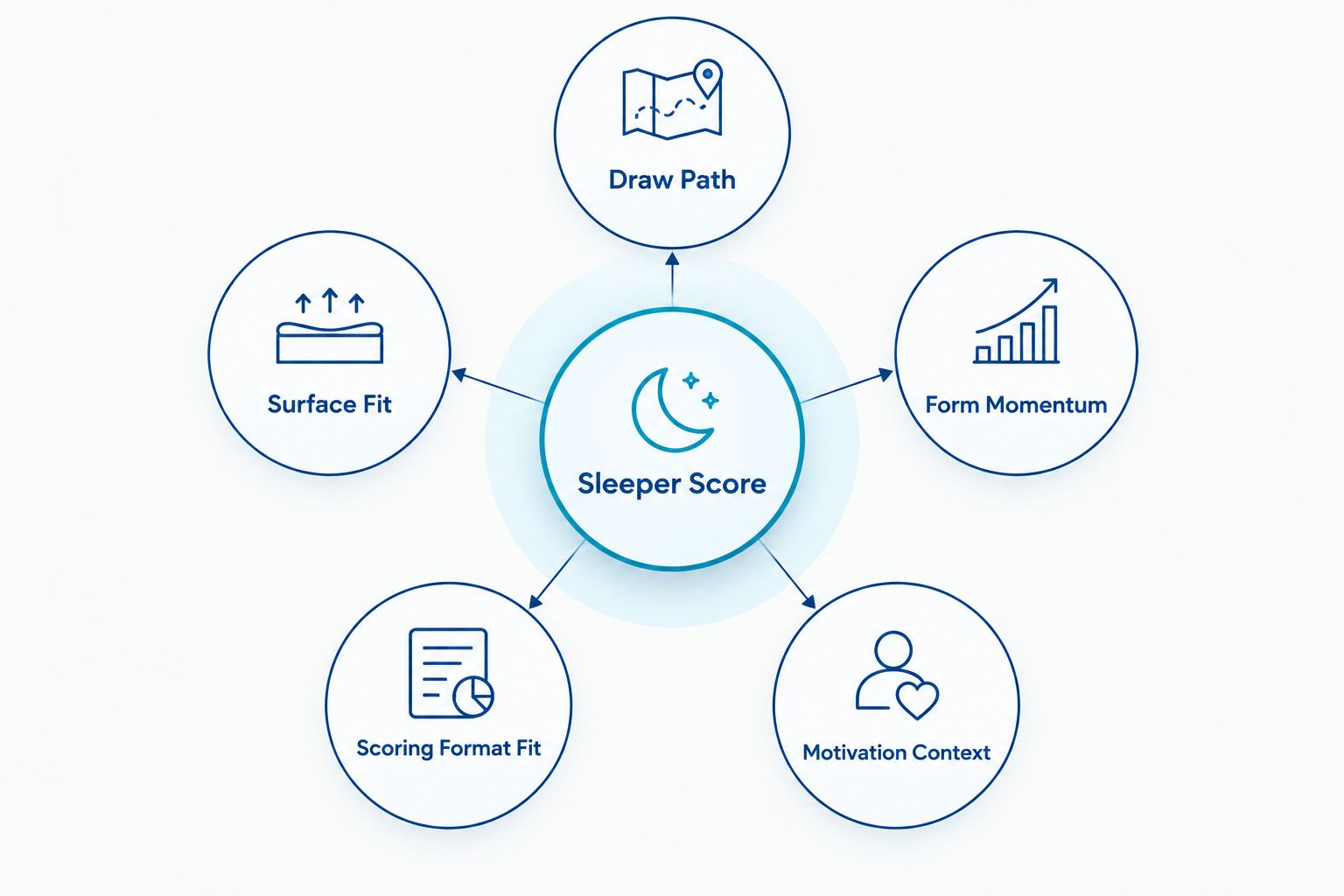
- Draw path — an early seed already eliminated or a soft first two rounds
- Surface fit — a serve or ground game built for that specific major's court
- Recent form momentum — a title run or deep semifinal finish in the prior six weeks
- Scoring format fit — set-bonus formats favor grinders, match-only formats favor upset artists
- Health and fitness status — no lingering injury flags entering the draw
- Motivation context — ranking points, prize money milestones, or a ranking cliff on the line
Sleeper types at a glance
| Sleeper type | Best for | Standout feature | Key limitation |
|---|---|---|---|
| Big-Serving Underdog | Hard-court majors | Match wins independent of return games | Vanishes on clay |
| Clay-Court Grinder | Roland Garros deep runs | Wins long rallies, wears down favorites | Nearly useless on grass or hard courts |
| Grass-Court Specialist | Wimbledon early rounds | Short points, fast exits for opponents | Small sample size each year |
| Hot-Streak Qualifier | Tournament-length GPPs | Free ranking status, house money mentality | High variance, can lose round one |
| Motivated Veteran | Cash-game floor | Consistent match completion, low fold risk | Ceiling capped by age and legs |
| Rising Breakout Talent | Season-long rosters | Upside compounds across all four majors | Second-week inexperience |
1. Big-Serving Underdog: best for hard-court majors
A player who lives on aces and holds serve without needing a big return game turns the Australian Open and the US Open into their best two weeks of the year. These players lose long rallies but win short matches, and fantasy formats that score points per hold or per ace reward that shape directly.
Big-Serving Underdog pros:
- Match outcomes depend on one skill, which is easier to project
- Hard courts at both majors favor serve speed over movement
- Low fitness demands mean fewer late-round fades
Big-Serving Underdog cons:
- Return games stay weak, capping set-differential scoring
- One off night on serve ends the run in straight sets
Best for: GPP and cash lineups built around the Australian Open or US Open draw. Verdict: Buy.

2. Clay-Court Grinder: best for Roland Garros deep runs
Roland Garros rewards a completely different skill set, and the same underdog who was worthless at the Australian Open can be a top sleeper in Paris. Long rallies, high topspin, and stamina over a five-set match matter more than raw serve speed on clay.
Clay-Court Grinder pros:
- Wins matches through attrition against favorites who tire
- Clay slows the ball, neutralizing big-serving opponents
- Match completion rate stays high across the two weeks
Clay-Court Grinder cons:
- Nearly worthless outside the clay swing and Roland Garros
- Fatigue accumulates across a long clay season entering the major
Best for: One-tournament lineups built specifically around Roland Garros. Verdict: Buy for clay only, Skip elsewhere.
3. Grass-Court Specialist: best for Wimbledon early rounds
Wimbledon's two-week grass window rewards short points and low-bounce serves, and a player who only shows up on this surface becomes a genuine sleeper for exactly one major. The same logic drives PGA Tour sleepers picks in fantasy golf — a specific-course or surface edge that disappears everywhere else still wins for the two weeks it applies.
Grass-Court Specialist pros:
- Serve-and-volley style shortens points and rush opponents
- First-week grass draws are often softer than hard-court majors
Grass-Court Specialist cons:
- Sample size is tiny; one bad bounce swings a match
- Second-week grass opponents are usually elite grass players too
Best for: Single-major GPP builds at Wimbledon. Verdict: Hold for the first week, reassess after round two.
4. Hot-Streak Qualifier: best for tournament-length GPPs
A qualifier who just won three qualifying rounds enters the main draw with zero pressure and a full head of steam. This is the highest-variance, highest-ceiling sleeper on the list, and it fits GPP formats where one deep run pays for the entire lineup.
Hot-Streak Qualifier pros:
- House-money mentality against seeded, higher-pressure opponents
- Match rhythm from three straight qualifying wins
- Cheap or unowned in most fantasy pools
Hot-Streak Qualifier cons:
- Can lose round one just as easily as win three rounds
- No track record against main-draw-level competition
Best for: GPP lineups chasing tournament-winning upside. Verdict: Buy in GPPs, Skip in cash games.
5. Motivated Veteran: best for cash-game floor
A veteran chasing a ranking points deadline, a seeding cutoff, or a career milestone tends to show up focused and finishes matches. This is the floor play of the group — lower ceiling, far less likely to no-show.
Motivated Veteran pros:
- Rarely retires mid-match or tanks sets
- Experience managing five-set pressure in majors
- Motivation is public and trackable through ranking deadlines
Motivated Veteran cons:
- Ceiling is capped; deep semifinal runs are rare
- Physical decline shows up in best-of-five fourth and fifth sets
Best for: Cash games and season-long formats needing reliable floor. Verdict: Buy for floor, Hold for ceiling.
6. Rising Breakout Talent: best for season-long rosters
A young player who broke into the top 50 or 60 during the season carries compounding value across all four 2026 majors, even in years they exit in the second week. Their fantasy value grows every tournament they play.
Rising Breakout Talent pros:
- Value increases across the calendar as ranking climbs
- Draw path softens as seeding improves at each major
- Media and fan attention creates roster-building narratives
Rising Breakout Talent cons:
- Second-week inexperience shows up against seasoned major winners
- Inconsistent across the four different major surfaces
Best for: Season-long or dynasty-style fantasy tennis leagues. Verdict: Hold and build around across the season.
How we ranked
Each sleeper type is scored against the six criteria above: draw path, surface fit, form momentum, scoring format fit, health status, and motivation context. Types that score high on multiple criteria at once, like the Big-Serving Underdog on hard courts, rank ahead of types that need everything to break their way, like the Hot-Streak Qualifier.
“The safest sleeper at a Grand Slam isn't the underdog with upside. It's the veteran with something left to prove.”
Get more fantasy sleeper breakdowns
Fresh sleeper picks and matchup analysis across every major sport.
Which Grand Slam sleeper should you draft?
For a hard-court major in 2026, the Big-Serving Underdog is the default pick — the skill set travels well and the format usually rewards match wins over rally quality. For a GPP built entirely around one tournament, take the Hot-Streak Qualifier and accept the round-one risk for tournament-winning upside. For a cash-game lineup where a no-show sinks the whole card, the Motivated Veteran is the play. Match the sleeper type to the major and the format before you match it to a name.
FAQ
What is a sleeper in fantasy tennis?
A fantasy tennis sleeper is a player drafted or valued low who is positioned to win multiple matches through draw path, surface fit, or recent form. The label applies most at Grand Slams, where a 128-player draw guarantees upsets every round.
Are Grand Slam fantasy tennis sleepers better for GPPs or cash games?
It depends on the profile. Hot-streak qualifiers fit GPPs because of their high variance, while motivated veterans fit cash games because they rarely fail to finish a match.
Do surface specialists work across all four majors?
No. A grass-court specialist is a strong Wimbledon sleeper but is close to unrostered value at the Australian Open, French Open, or US Open. Surface fit is the single biggest factor separating a sleeper from a bust.
How many players are in a Grand Slam main draw?
Each Grand Slam singles main draw holds 128 players. That size guarantees seeded players face soft early-round matchups and sleepers face soft early-round opponents too.
Why do qualifiers make good fantasy tennis sleepers?
A qualifier who wins three qualifying rounds enters the main draw with match rhythm and no pressure, which often produces an upset in round one or two of the major itself.
Is a veteran player a good fantasy tennis sleeper pick?
Yes, for floor. A veteran chasing ranking points or a seeding deadline tends to finish matches and avoid retirements, which makes them a low-ceiling, low-risk cash-game play.
How many Grand Slams happen each year?
Four majors run each year: the Australian Open, the French Open, Wimbledon, and the US Open, each on a different surface that changes which sleeper profile fits.
One last thing
The single biggest mistake in Grand Slam fantasy tennis drafting is rostering a sleeper for the wrong major. A grass-court specialist that wins three rounds at Wimbledon is a first-round exit waiting to happen at the US Open two months later — the same player, the wrong surface, a wasted roster spot.