An NFL game usually lasts about 3 hours in real time; plan for 3 to 3½ hours from kickoff through the final whistle in 2026. Regulation contains 60 minutes on the game clock, but halftime, breaks and clock stoppages extend the broadcast. That viewing window does not account for overtime.
- An NFL game usually lasts about 3 hours; allow 3 to 3½ hours to watch in 2026.
- The NFL game clock covers 60 minutes across four 15-minute quarters, not the full broadcast.
- Overtime can extend the finish; SportsOrca's NFL analysis is best for fans following the matchup as well as the clock.
Why this matters
A 60-minute game is not a 60-minute appointment. If you are planning a watch party, a ride home or what to watch next, use the real-time window. If you are following a matchup or a live market, watch the clock and the situation on the field instead. SportsOrca's guide to NFL odds movement before kickoff covers the pregame side; once the game starts, the clock works by a different set of rules.
How long does an NFL game usually last?
About 3 hours is the practical answer in 2026. Set aside 3 to 3½ hours if you need to see the ending, and leave additional room if the game goes to overtime. The clock on the scoreboard measures regulation play, not the time you spend watching.
| What you are measuring | Time to use | What it includes |
|---|---|---|
| Regulation game clock | 60 minutes | Four 15-minute quarters |
| Time to watch a typical game | About 3 hours; plan for 3 to 3½ hours | Play, stoppages, halftime and breaks |
| Game with overtime | Longer than regulation | Additional play after a tied fourth quarter |
That distinction settles the question most fans are asking. If kickoff is the start of your plan, use the viewing window, not the game clock. A quarter can take much longer than 15 minutes to watch because the clock stops while other parts of the game continue.
The estimate is a planning window, not a promised finish time. Two games with the same kickoff time need not end together. A running clock can move one game along; repeated stoppages can stretch another, particularly near the end of a close contest.
The 60-minute clock versus the broadcast
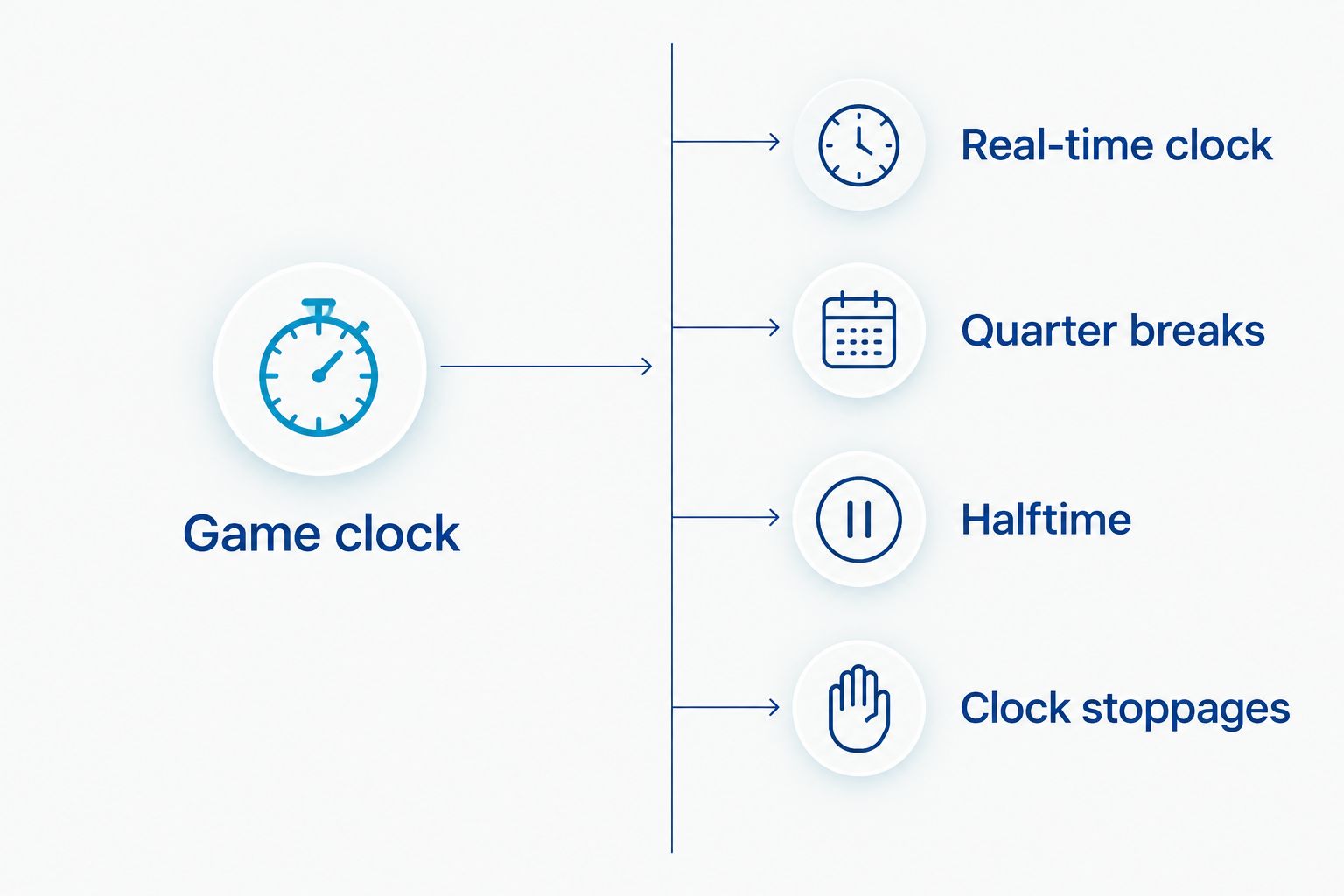
Regulation has four quarters of 15 minutes each. Those 60 minutes count football time: the game clock runs during eligible portions of play and stops under league rules. Halftime falls between the second and third quarters, while breaks also separate the other quarters. None of those pauses subtracts from the 60 minutes of regulation.
The broadcast has a different job. It stays with the game while officials spot the ball, teams change personnel, coaches make decisions and viewers wait through breaks. That is why a 2026 NFL game occupies an evening even though the displayed game time totals one hour.
Think of it as two clocks running alongside each other:
- Game clock: Shows how much regulation time remains. It controls the late-game decisions you see on the field.
- Real-time clock: Shows how long you have been watching. It keeps moving through halftime and stoppages.
A game can appear nearly over on the scoreboard and still take time to finish. The final minutes bring timeouts, clock-management decisions and plays that stop the clock. For scheduling, the broadcast clock wins; for understanding whether a team has time to respond, the game clock wins.
What makes one NFL game run longer than another?
The 3-to-3½-hour window gives you room for a normal finish in 2026, but the action determines how much of it a game uses. These are the factors to watch:
- Incomplete passes: An incomplete pass stops the game clock. A drive with repeated incompletions can use more real time without using much game time.
- Out-of-bounds plays: The clock can stop when a player goes out of bounds. When it restarts depends on the game situation, so the effect is especially noticeable late in a half.
- Scoring plays and possession changes: Touchdowns, field goals, kickoffs and turnovers create transitions before the next sequence of plays.
- Timeouts and the two-minute warning: Teams can stop play with timeouts, and the two-minute warning interrupts each half. In a close finish, those pauses matter to both teams' decisions.
- Reviews and officiating stoppages: An official review or an on-field discussion holds up real time while the status of the play is settled.
- Overtime: A tie after regulation adds a period of play. The rules for ending that period differ between the regular season and the playoffs.
These factors do not add a fixed number of minutes to every broadcast. A stoppage-heavy finish is different from a game in which one team can run down the clock. Watch the score and the timeouts remaining if you need to judge how soon the final whistle will come.
How long are the four quarters?
Each NFL quarter has 15 minutes on the game clock. Four quarters therefore make 60 minutes of regulation play. The first and third quarter breaks separate stretches of action; halftime splits the game into two halves.
A 15-minute quarter is not a 15-minute viewing block. The clock stops for events governed by NFL rules, and the broadcast continues through those stoppages. If you turn on a game with one quarter left, do not assume you will be free in 15 minutes.
The fourth quarter is the hardest one to schedule around. A team protecting a lead has reason to keep the clock running. A team chasing the lead has reason to preserve time through its play calls and timeouts. The same amount of game time can produce a very different wait for viewers.
How much time does halftime add?
Halftime adds time to your viewing window without changing the 60-minute regulation clock. It happens after the second quarter, when the teams leave the field before play resumes for the second half.
Do not subtract halftime from a 3-hour viewing plan: it is already part of the time you spend watching or waiting. For a 2026 game-night schedule, kickoff-to-final-whistle matters more than adding quarter lengths and halftime separately. The Super Bowl calls for extra schedule flexibility because its halftime presentation is different from an ordinary game.
Halftime also marks a clean point to reassess the matchup. A team trailing at the break still has two quarters of regulation left; a broadcast that has reached halftime is not necessarily halfway through its real-time window. Use the game clock for the competitive picture and the wall clock for your evening.
Does overtime change how long an NFL game lasts?
Yes. If the score is tied after the fourth quarter, overtime extends the game beyond the usual regulation viewing window. Do not plan a fixed end time for a game that can reach overtime.
In the 2026 regular season, an overtime period has a 10-minute game clock. That is additional game time, not a guarantee that the broadcast will end 10 real minutes later. Stoppages and breaks still affect how long you watch, and a regular-season game can finish tied under the overtime rules.
In the playoffs, overtime uses 15-minute periods and play continues until there is a winner under postseason rules. That difference matters if you are planning to watch an elimination game from kickoff to finish: the normal 3-to-3½-hour allowance is a starting point, not a firm limit.
| Game situation | Overtime clock | What to plan for |
|---|---|---|
| Regular season | 10 minutes | A finish beyond the regulation viewing window |
| Playoffs | 15-minute periods | No fixed real-time finish until a winner is decided |
Overtime is the clearest reason to keep your postgame plans loose. Even when the scoreboard shows little time left in regulation, a tied game can still have more football ahead.
Is a televised NFL game longer than the time on the scoreboard?
Yes: the scoreboard's 60 minutes count regulation play, while the telecast includes the pauses between plays and quarters. In 2026, plan around the roughly 3-hour real-time game rather than treating the displayed clock as a countdown to when you can leave.
This matters if you join a game late. A scoreboard showing time left in the fourth quarter tells you how much regulation remains, not how much wall-clock time the broadcast needs. A close finish with clock stoppages can take longer to watch than the display suggests.
Should I allow extra time for a playoff game?
Yes: allow more than the usual 3-to-3½-hour window if you must stay through a possible playoff overtime finish. A postseason game tied after regulation continues until a winner is determined. The regulation game still has 60 minutes on the clock; the uncertainty is what happens after them.
If you only need the opening portion of a game, the usual viewing estimate is less useful. If you need the final result, it is essential. Plan for the possibility of overtime rather than assuming the fourth-quarter clock will decide your schedule.
Can an NFL game end in a tie?
Yes, a regular-season NFL game can end in a tie after overtime. A playoff game cannot: its overtime rules produce a winner. For a viewer in 2026, that means a regular-season tie does not trigger endless additional periods, while a tied postseason game has no fixed finish time.
FAQ
How long does an NFL game last in 2026?
An NFL game usually lasts about 3 hours in real time in 2026; plan for 3 to 3½ hours from kickoff through the final whistle. Overtime can extend that window.
How many minutes are in an NFL game?
An NFL game has 60 minutes of regulation play across four 15-minute quarters. Halftime and clock stoppages make the real-time viewing window much longer.
Why does a 60-minute NFL game take about 3 hours to watch?
The 60-minute game clock stops for events during play, while halftime and breaks add time outside regulation. About 3 hours is the practical viewing estimate, not the length shown on the scoreboard.
How long should I set aside to watch an NFL game?
Set aside 3 to 3½ hours for a typical NFL game in 2026. Leave additional time if you need to watch a possible overtime finish.
Does NFL overtime add 10 minutes to the broadcast?
No. Regular-season overtime has a 10-minute game clock, but stoppages mean it can take longer than 10 real minutes to watch. Playoff overtime follows different rules.
Is NFL playoff overtime longer than regular-season overtime?
NFL playoff overtime uses 15-minute periods, while regular-season overtime has a 10-minute game clock. A playoff game continues until a winner is determined.
Can an NFL game end in a tie after overtime?
A regular-season NFL game can end in a tie after overtime. A playoff game continues until there is a winner.
One last thing
The most useful clock changes with your question. Use 60 minutes to understand regulation, about 3 hours to plan your evening and extra time if overtime remains possible. SportsOrca covers NFL analysis for fans following the matchup; the clock tells you how much of that matchup is left to play, not exactly when you will be done watching.