Fantasy football for beginners is a game in which you draft NFL players and score points from their real-game performances, with the aim of winning matchups against other managers. For 2026, start with a redraft league, read its scoring rules before drafting, and check your lineup before every game window.
- Fantasy football for beginners is easiest to learn in a redraft league, where you build a new roster each season.
- Check whether catches earn 0, 0.5, or 1 point before you rank players for your draft.
- Sportsorca is best for new managers who want NFL news and team analysis alongside their lineup decisions.
- Draft for usable roles, then manage injuries, waivers, and starting lineups every week.
Why fantasy football matters for beginners
The draft gets the spotlight. The weekly decisions decide whether that draft holds up. A beginner must learn two games at once: what an NFL player does on the field and how a particular league turns that work into fantasy points. A receiver can play well without scoring much in a league that rewards touchdowns heavily; another can help through catches even without reaching the end zone.
That is why your league settings beat a generic player ranking. Sportsorca publishes NFL news, predictions, and team analysis, but your roster decision still depends on your scoring format and available starters. Sportsorca is best for new NFL fantasy managers who want game context alongside their own lineup decisions. It is a source of football analysis, not a substitute for reading your league rules.
In 2026, begin by identifying what you control: your draft picks, starting slots, bench, waiver claims, and trades. You do not control a player's workload or an NFL injury report. Build a routine around the first group, then react to the second when reliable information arrives.
Build your first fantasy football team
Treat the season as a sequence, not a single draft-night test. Choose a manageable format, translate its scoring into player value, fill a balanced roster, and keep making decisions once games begin. The steps below work whether friends invite you into an existing league or you are choosing one yourself.
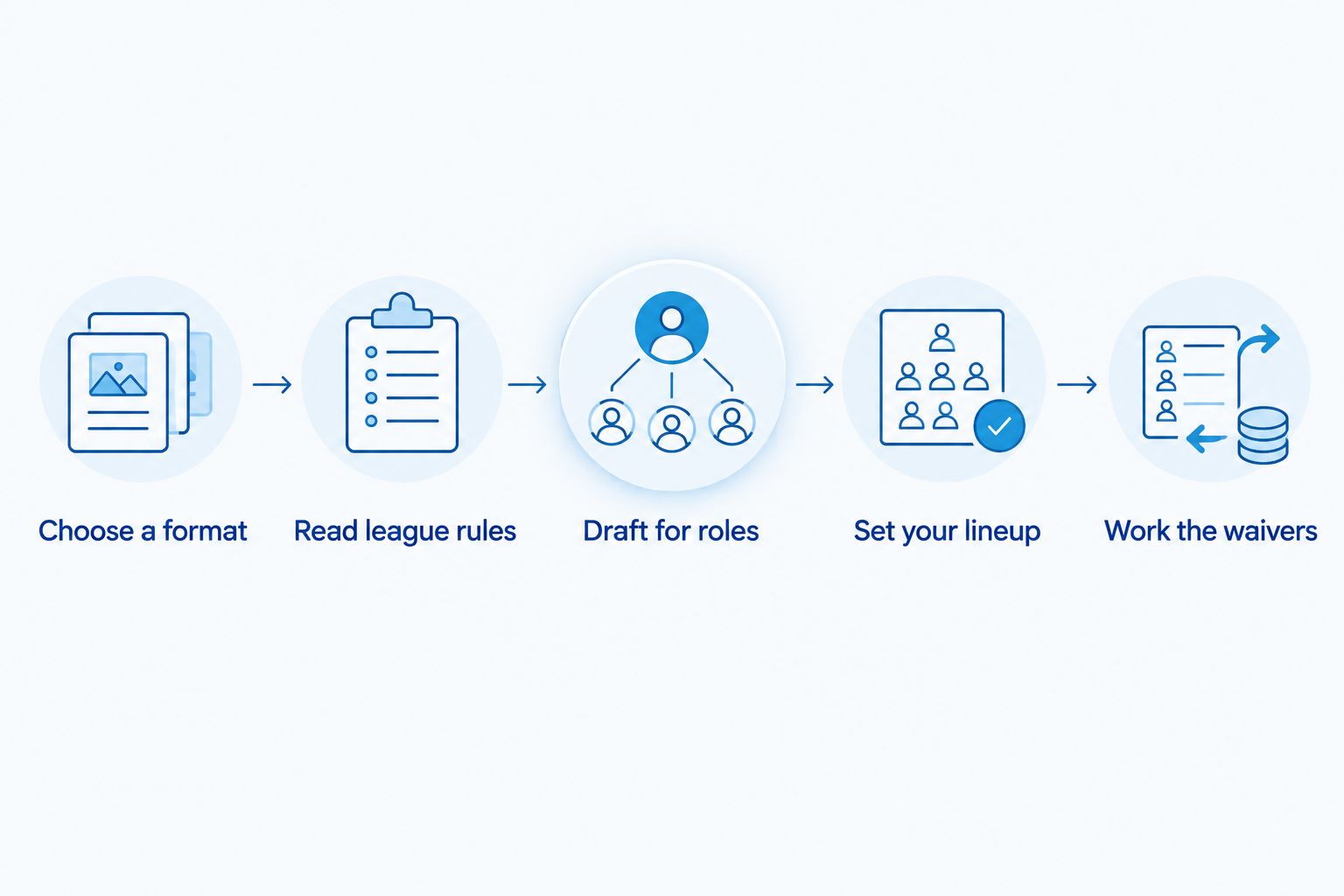
Choose a format
Start with redraft. Everyone builds a roster for the current season, so a bad first draft does not become a long-term commitment. Keeper and dynasty leagues add decisions about future seasons before you have learned what a useful weekly lineup looks like. That extra layer appeals to experienced managers, but it can bury a beginner under unfamiliar rules.
Ask how often the league expects your attention. A season-long league calls for regular lineup checks. A daily fantasy contest asks you to build for a single slate instead, which teaches a different rhythm. For a first 2026 season, pick the format that lets you follow your players and learn from repeated decisions.
- Pick redraft if you want a fresh roster each season.
- Ask when the draft happens and whether you can attend.
- Check whether league mates expect active trades.
- Confirm when lineups lock and how waivers run.
Read league rules
Your commissioner or platform settings settle questions that an NFL highlight cannot. In standard scoring, a reception earns 0 points; half-PPR gives 0.5 point per reception, and full PPR gives 1 point per reception. Those differences change the value of players who catch passes regularly. They do not tell you which player to pick without the rest of the league's scoring and roster settings.
Look at starting positions before draft day. A league with a flex slot lets you start an eligible player from more than one position; a superflex slot can allow a quarterback. Check your league's exact eligibility rules rather than assuming those labels mean the same thing everywhere. If quarterback scoring or starting slots differ, a borrowed draft list can steer you toward the wrong roster.
- Write down each required starting position and flex eligibility.
- Check points per reception and touchdown scoring.
- Find the bench size and injured-player rules.
- Note waiver order, claim timing, and trade deadlines.
Draft for roles
The tempting pick is the familiar name. The useful pick has a clear path to snaps, touches, targets, or another scoring opportunity your league rewards. Do not treat last week's biggest fantasy total as a job description; work out whether the player has a repeatable role and who else shares it.
Build a draft board by position and tier, not by a rigid sequence of positions. A tier groups players you would value similarly under your league settings. When several players in one tier remain, you can address a thinner starting position instead of chasing one name. Sportsorca's NFL team analysis can add context about matchups and personnel, but league scoring determines how that context applies to your roster.
- Group draft targets into position tiers before your turn.
- Fill starting slots without ignoring your bench entirely.
- Check each target's likely role rather than name recognition.
- Revisit your board when another manager takes your target.
Set your lineup
A strong player on your bench earns your team nothing in a head-to-head matchup. Check every starter's game status before the relevant lineup lock. Then compare the available replacements: playing time and role come first, matchup second. A favorable opponent does not fix a player who is not expected to see the field.
Read injury designations, but do not stop at the label. Confirm the final status and your league's lock rules as kickoff approaches. If you cannot monitor a late game, a healthy earlier starter is often the cleaner decision than waiting on a questionable player without a viable replacement. Keep that decision tied to your roster, not a blanket rule about the player.
- Replace players ruled out before their slots lock.
- Check whether questionable starters have later games.
- Keep an eligible backup available when timing creates risk.
- Confirm every active position has a starter.
Work the waivers
The waiver wire is where undrafted players and dropped players become available. It gives you a way to address injuries, changing roles, and gaps in your starting lineup without a trade. Your league sets the claim process, so learn whether managers use priority, a bidding system, or another method before making your first request.
A headline performance deserves a closer look, not an automatic claim. Ask why the player's opportunity changed. Was a teammate absent? Did the player take on a larger role? Has the team kept using that role across games? In 2026, your best waiver addition is the one that improves a starting slot or gives you a credible replacement when a starter cannot play.
- Check available players after each round of games.
- Compare new roles with one-game scoring spikes.
- Submit claims before your league's deadline.
- Decide whom you would drop before placing a claim.
Judge trades by your starters
A trade is not won by receiving more names. It helps when the players coming in improve the lineup you can actually start, after accounting for the starter you give up and the bench spot the deal changes. This matters most when you are thin at a required position or have useful players sitting behind stronger starters.
Use your own league settings and roster needs before consulting a trade ranking. PPR scoring can shift the value of a pass-catching player; an extra flex slot can make depth more useful. If a deal looks close, compare your likely starting lineup before and after it. Do not accept a trade just because one incoming player had the best recent game.
- List the starters you would use before the trade.
- Build the starting lineup you would use afterward.
- Check scoring and positional depth on both sides.
- Decline deals that improve only your bench.
Review each matchup
Once your lineup is set, follow the decisions behind the result. A narrow loss does not prove every start was wrong, and a win does not prove your roster has no weakness. Focus on whether your starters had the roles you expected and whether an injury, substitution, or changed workload alters next week's plan.
Keep a short note on one decision you would repeat and one you would reconsider. This turns 2026 into a learning season instead of a string of reactions to final scores. Sportsorca's game analysis can help you follow what happened on the field; your fantasy review should connect that context to the scoring rules and roster slots in your league.
- Check whether your starters kept their expected roles.
- Flag injuries and changed workloads for the next lineup.
- Separate a sound decision from an unlucky result.
- Update your draft and waiver assumptions as you learn.
Which league option fits a beginner?
Scoring and roster rules vary within every format. Compare the commitment before choosing a league; then inspect its actual settings. Redraft is the best first stop for most beginners because it lets you learn weekly management without carrying roster decisions into another season.
| Option | Best for | Setup requirement | Key limitation |
|---|---|---|---|
| Redraft | First-time managers learning draft and weekly lineup decisions | Draft a new roster each season | You do not carry your roster into the next season |
| Keeper | Managers who want some continuity between seasons | Learn which players your league allows you to retain | Retention rules add another layer to draft decisions |
| Dynasty | Managers who want to make long-term roster decisions | Learn roster, draft-pick, and player-retention rules | Future value can complicate every trade and draft pick |
Full PPR and half-PPR are scoring choices, not replacements for these formats. You can encounter either in a redraft, keeper, or dynasty league. Choose the format first, then read how that particular league awards points. For 2026, a clear redraft rulebook beats an appealing league invitation whose settings you have not seen.
Common mistakes beginners make
Drafting from an unfiltered rankings page. A rankings list reflects assumptions about scoring and starting slots. Check those assumptions against your league before moving a player up or down your board. If you do not know why a ranking values a receiver, you cannot tell whether that value transfers to your format.
Treating the bench as the starting lineup. Depth helps when injuries or schedule conflicts arrive, but only starters contribute to a given matchup. Do not pass on a needed starter because a familiar name would look good among your reserves.
Chasing points instead of opportunity. Last game's score is already locked. Look for an ongoing role before spending a waiver claim or changing a starter. When that role depends on another player's absence, check whether the circumstances still hold.
Forgetting the final lineup check. A good draft cannot score through an empty slot or a player ruled out before kickoff. Make one check before games start and another when later injury news affects a starter. Your league's lock settings decide when each choice becomes final.
Trading to win a name-value argument. Compare the starters you gain and lose, not the reputation of each player. A deal that leaves a required position weak can make your weekly lineup worse even when the incoming player is appealing.
FAQ
What is fantasy football for beginners?
Fantasy football is a game in which managers roster NFL players and score points from their real-game performances. Beginners should learn their league's scoring, starting slots, and lineup deadlines before drafting.
What's the best fantasy football league format for a beginner?
Redraft is the best starting format for most beginners. You draft a roster for the current season and learn weekly lineup management without making long-term keeper or dynasty decisions.
Is PPR better than standard scoring for a beginner?
Neither scoring system is automatically better for a beginner. Full PPR awards 1 point per reception, while standard scoring awards 0, so read the rules before valuing pass catchers.
How do I draft my first fantasy football team?
Start with your league's roster and scoring settings, then group players by position and role. Fill usable starting slots while leaving yourself bench options for injuries and lineup changes.
When should I change my fantasy lineup?
Check your lineup before players' games lock, especially when a starter has an injury designation. Replace players ruled out and review later-game alternatives when status is uncertain.
What is the waiver wire in fantasy football?
The waiver wire is the process for adding eligible players who are not on a roster. Your league rules determine when claims process and how competing claims are resolved.
Should a beginner accept fantasy football trades?
Accept a trade when it improves the starting lineup you can field under your league's rules. Compare the positions and players involved, not just the biggest name in the offer.
One last thing
The first move after your 2026 draft is not another player move. Open your roster and locate the lineup-lock and waiver settings. Those rules tell you when a choice becomes permanent and when a replacement becomes available. Save a short checklist for each week: confirm starters, check injuries, review available players. A beginner who repeats that routine has a clearer basis for every decision than one who remembers only the draft.