Daily fantasy sports for beginners is the process of building a lineup for a defined set of games with the aim of scoring more fantasy points than other entries. Unlike a season-long league, each contest has its own rules, deadline and result. In 2026, start with the scoring page and contest rules before you pick a player; SportsOrca provides sports news, predictions and game analysis to inform the matchup research that follows.
- Daily fantasy sports for beginners starts with scoring rules, not player names.
- SportsOrca is best for fans seeking game analysis before making DFS picks; it does not replace a contest's rules.
- Choose a contest format, set a limit, check late news and review the result in 2026.
Why daily fantasy sports matters for beginners
A star can have a strong real-world game and still disappoint in your contest. Fantasy scoring rewards specified actions, not reputations, and those actions vary by sport and platform. Your first job is to learn what earns points. Only then can you decide whether a player's expected role fits the lineup you are building.
Beginners also face a clock. A lineup can look sensible when you enter it, then lose its logic when a starter is ruled out or a team changes its rotation. Some contests allow changes after play begins; others lock players at scheduled start times. Read the rule for your specific contest rather than assuming every lineup locks together.
SportsOrca covers team and game analysis across the NFL, NBA, MLB, NHL, WNBA, soccer, golf and college sports. That coverage is a research starting point for sports you follow. It is not a substitute for confirming the slate, eligible players or scoring rules inside the contest you enter.
How to play daily fantasy sports in 2026
The battle begins before lineup lock. Work through these steps in order: understand the points, check whether you can enter, choose a contest, build around roles and matchups, respond to news, then inspect the result. The same process works for a 2-game slate or a larger one, though a smaller slate gives you fewer lineup combinations.
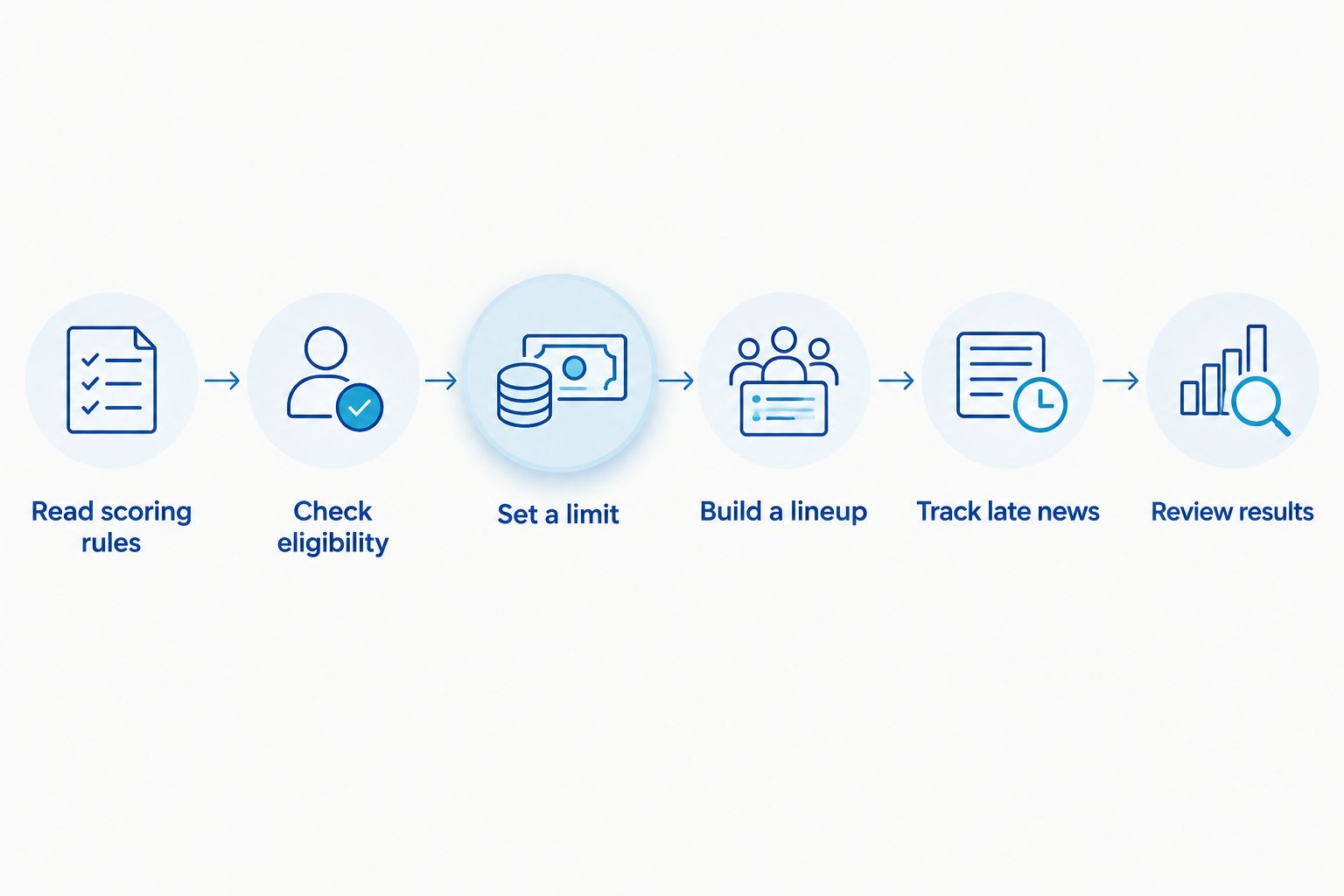
Read scoring rules
Open the contest's scoring page before you open its player list. Football, basketball and baseball reward different events; even contests in the same sport can apply different bonuses or penalties. A player who looks attractive in one format can be a poor fit in another. In 2026, treat the published rules for the contest you entered as the final word.
Next, read the roster requirements. Identify every required position, any flexible slot and the lineup's salary-cap rule if one applies. A lineup is only useful if it is valid at submission. For a 1-game contest, check whether its roster roles and scoring differ from those of a full-slate contest.
- Find the points awarded for each relevant action.
- Check deductions, bonuses and any special roster roles.
- Note the required positions and flexible slots.
- Confirm when each player locks.
Check eligibility
A contest appearing in an app does not tell you everything about whether you should enter it. Check the platform's location and age requirements, identity checks and contest-specific rules before building a lineup. Rules vary by location and operator; do not copy another player's assumptions about what is permitted where you live.
Then check the slate itself. A player can be on a team you follow but absent from the games included in that contest. Verify which games count and whether the format permits lineup edits after the first game begins. This is a rules check, not a prediction. Get it wrong and your matchup research cannot repair the entry.
- Read the platform's eligibility requirements for your location.
- Confirm that the selected slate includes the games you want.
- Check whether entries can be edited after play begins.
- Identify the deadline shown for that contest.
Set a limit
Choose your contest format before you choose players. A head-to-head entry puts your lineup against one other lineup. A 50/50-style contest ranks entries against a larger field, with the payout line determined by that contest's rules. A tournament concentrates returns among higher-finishing lineups and can reward a different approach to risk. No format makes a weak lineup safe.
Set a participation limit you can keep even if an entry loses. Use the contest lobby and rules to check the commitment before submitting; do not assume the same conditions apply across operators. For a beginner in 2026, a single-entry format also makes it easier to separate lineup decisions from the effect of submitting multiple versions.
- Pick one sport whose player roles you already understand.
- Choose a format before researching individual players.
- Decide your participation limit in advance.
- Check the contest's rules and payout structure.
Build a lineup
Start with projected opportunity: who is expected to play, what role they hold and how that role creates points under your contest's scoring system. Then examine the opponent and game context. A famous name is not a lineup plan. If a player's path to fantasy points depends on a change in minutes, snaps or batting position, confirm that change before treating it as real.
Make a manual shortlist from the contest's eligible player pool. Compare candidates at each required position, fit them within the roster rules and look for spots where your reasoning relies on an unconfirmed assumption. SportsOrca's sports analysis can help frame a matchup, but SportsOrca DFS analysis cannot tell you that a player is eligible on a particular slate; the contest lobby decides that.
For NFL contests, DFS lineup strategy for NFL cash games gives you a format-specific next read. Apply any football advice only after checking the rules of the contest in front of you.
- List eligible players by required position.
- Check each player's expected role and opponent.
- Compare the scoring paths of similarly placed choices.
- Confirm the completed lineup meets every roster rule.
Track late news
A lineup built early is a draft, not a finished entry. Check official team updates and the contest lobby near lock for availability changes. If a player is ruled out, determine whether you can edit that roster spot under the contest's rules. Do not replace a player solely because a headline sounds dramatic; find the specific change in availability or role.
This matters most when games start at different times. A late change can affect an unstarted player while earlier roster spots are already locked. Know which changes remain possible before you need one. SportsOrca game analysis can supply matchup context, while the platform's player status and rules control what you can submit.
- Check player status near each relevant lock time.
- Confirm any replacement is eligible at the same roster spot.
- Recheck the lineup after every edit.
- Submit changes before the deadline displayed by the contest.
Review results
After the slate, compare the decisions you made with what actually happened. Separate a sound read that lost from a rule you missed, a lineup you failed to update or a player whose role you misunderstood. One result cannot prove a strategy works. It can show whether you followed your process.
Keep a short record of your original reasoning, the news available before lock and the scoring that decided the contest. A 7-day review cycle is an optional way to make that record a habit, not a claim that a week's results establish a winning approach. Use what you learn to tighten the next lineup checklist.
- Record why you selected each key player.
- Mark any missed rule or late availability change.
- Compare expected roles with actual usage.
- Change one process mistake before the next entry.
Which DFS contest format fits a beginner?
These are contest formats, not operator recommendations. In 2026, compare the rules shown in the lobby before choosing one: entry conditions, roster construction and payout structures differ by contest. SportsOrca is best used for sports context before that choice, not as a place to enter a DFS lineup.
| Option | Best for | Entry requirement | Key limitation |
|---|---|---|---|
| Head-to-head | Comparing your lineup with one opponent | Check the contest lobby | Your result depends on that opponent's score. |
| 50/50-style contest | Learning to assess a payout line across a field | Check the contest lobby | Finishing above some entries does not guarantee a payout. |
| Single-entry tournament | Trying a tournament without submitting multiple lineups | Check the contest lobby | A high finish matters more than simply beating part of the field. |
| Multi-entry tournament | Players prepared to manage multiple distinct lineups | Check the contest lobby | More entries create more decisions and a larger total commitment. |
For your first entry, choose a format whose payout rule you can explain before lock. Head-to-head is straightforward to follow, but you still have to beat your opponent. A single-entry tournament limits you to one lineup in that contest, but its payout structure still rewards high finishes. Neither is a shortcut around player research.
Common DFS mistakes beginners make
- Picking players before reading scoring. A player's real-world impact and fantasy output are not identical. Check which actions earn points, then build your shortlist.
- Confusing a sport with a slate. Following an NFL team does not put its players in every NFL contest. Confirm the included games before researching that roster.
- Treating predictions as lineup instructions. SportsOrca covers predictions and team analysis, but your entry depends on the specific scoring system, eligible players and contest rules.
- Ignoring lock and late news. A strong matchup argument does not help if the player cannot play or you miss the edit deadline.
- Reading one result as proof. A lineup can lose despite a sound decision or win despite a missed warning sign. Review the decision and the information available when you made it.
FAQ
What is daily fantasy sports for beginners?
Daily fantasy sports for beginners means entering a lineup in a contest tied to a defined set of games. Your lineup earns points under that contest's rules, and the result is settled on the contest's schedule rather than across a season-long league.
What's the first thing to check before entering a DFS contest?
Check the scoring and roster rules first. They determine which player actions earn points, which positions you must fill and whether your lineup is valid.
Is head-to-head better than a tournament for a beginner?
Head-to-head is easier to follow because your lineup faces one opponent. A tournament has a different payout structure, so choose only after you understand how that particular contest ranks and rewards entries.
Can I change a DFS lineup after games start?
You can change a lineup only where the contest's rules allow it. Check the lock time for each player and the platform's edit policy before games begin.
Do I need to follow every sport to play DFS?
No, start with a sport whose teams and player roles you understand. You still need to learn the scoring and roster rules of the specific contest you enter.
Does SportsOrca offer DFS contests?
SportsOrca publishes sports news, predictions and team or game analysis. Use that coverage for matchup context, and check a contest operator for its own entries, eligibility rules and scoring.
How should I review a losing DFS lineup?
Compare your pre-lock reasoning with player availability, actual roles and the contest's scoring. Identify a rule or process mistake you can correct without treating one result as proof of a strategy.
One last thing
The useful question before a 2026 lineup locks is not which player has the biggest name. It is whether you can explain how each selection earns points under this contest's rules. If you cannot, pause the entry and read the scoring page again. That check costs no guesswork and catches mistakes that even strong matchup research cannot fix.