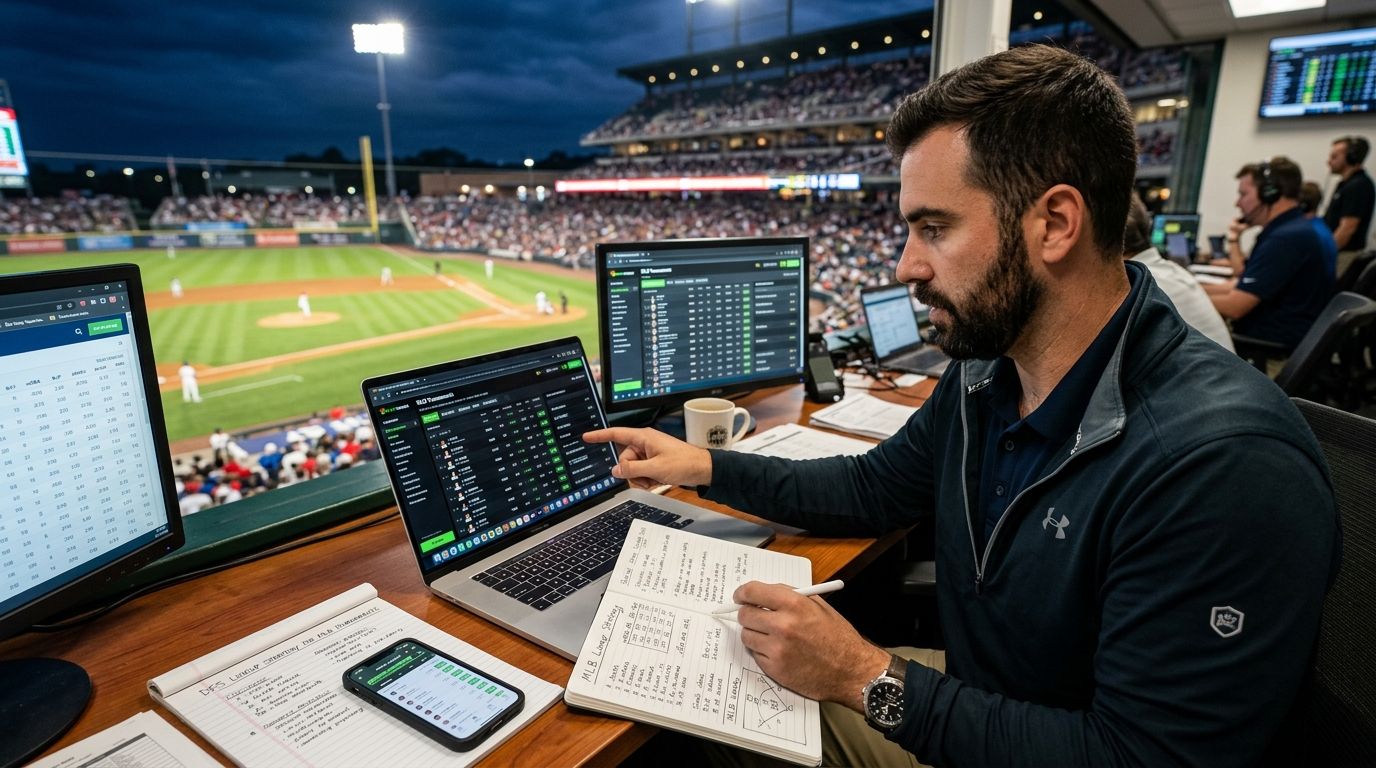
MLB tournament DFS players build lineups to survive massive GPP fields, not to lock a safe cash line, and that single distinction changes every roster decision from Game 1 of the 2026 season to the World Series slate. Tournament rosters chase ceiling, cash rosters chase floor — a stack piece with 30% ownership upside beats a locked-in .280 hitter every time in a 50,000-entry GPP.
- DFS lineup strategy for MLB tournaments starts with stacking a team's order, not stacking single-player projections.
- Ownership leverage separates GPP winners from cash-game grinders across the 2026 MLB slate.
- Multi-entry players need 3-5 differentiated stacks, not one lineup cloned twenty times.
- Bullpen matchups and weather swing tournament outcomes more than a starting pitcher's win total.
Why DFS lineup strategy for MLB tournaments matters
Cash games reward the player who avoids busts. Tournaments reward the player who finds the one stack nobody else rostered. A 15-team GPP field and a 150,000-entry GPP field call for the same skill — correlation — but the volume of entries in modern MLB slates means chalk plays get diluted fast, and a lineup built to not lose almost never finishes in the top 1% of a large field. Read the 2026 slate the way SportsOrca reads a matchup preview: game script first, player names second.
The MLB slate structure makes this sharper than NFL or NBA tournaments. Baseball variance runs higher — a single at-bat can flip a game total — so a five-man stack against a tired bullpen in a flyball-friendly ballpark carries tournament equity that a locked cash play simply doesn't need. Ignore that distinction and you're building a cash roster with a GPP entry fee attached.
Build stacks around implied team totals, not individual projections
Single-player projections tell you what a hitter is worth on average. Team totals tell you where the game breaks open — and tournament equity lives in the breakout, not the average.
- Target the top 2-3 implied run totals on the slate before picking a single hitter
- Build 4-5 man stacks from the top of an order down, not scattered picks across three lineups
- Weight the stack toward a bullpen ranked in the bottom third in ERA or WHIP that week
- Check park factors — Coors Field and Great American Ball Park inflate stack ceiling
- Confirm the batting order is finalized within 90 minutes of first pitch before locking
Attack the pitching matchup for strikeout upside, not win probability
A favored pitcher with a low strikeout rate is a cash-game play. A tournament ace needs swing-and-miss stuff against a lineup that chases.
- Prioritize starters facing a team with a strikeout rate in the bottom third of the league
- Check swinging-strike rate over the last three starts, not season-long averages
- Read exit velocity and barrel rate data on the opposing lineup — hard-hit rates spike variance against a mediocre arm
- Fade a pitcher on a short leash or pitch-count restriction in a marquee GPP
- Pair a high-strikeout starter with a stack from the opposite dugout when the total sits above 9 runs
Diversify roster construction across multiple entries
One cloned lineup entered 20 times wins nothing extra. Tournament equity comes from covering multiple outcomes, and the larger GPP fields of 2026 punish single-build strategies harder than ever.
- Build 3-5 core lineup shells with a different stack team in each
- Vary the pitcher pool across builds — don't run the same ace in all 20 entries
- Split salary allocation: some builds pay up for one stud bat, others spread across a full stack
- Run at least one contrarian build with a low-owned stack per contest
- Cut player overlap between builds before final lock
Chase ceiling over floor at every roster spot
A GPP lineup that can't lose almost never wins. Every roster spot answers one question: does this player have a path to a 5x-plus score, not just a safe one.
- Roster power hitters in favorable wind and park conditions over high-average contact bats
- Prioritize leadoff and two-hole hitters in a stack — more plate appearances, more upside
- Avoid locking a pitcher only because he carries the highest projected floor on the slate
- Don't roster a bat solely because it's cheap if the matchup lacks upside
- Bench any player likely to face a shutdown reliever in a close-and-late spot
Use ownership leverage to find the field's blind spot
Half the tournament field rosters the same three chalk stacks every slate. The other half wins the big prizes.
- Fade a stack projected above 25% ownership unless the matchup is genuinely elite
- Roster at least one hitter under 10% projected ownership in large-field GPPs
- Pair a chalk pitcher with a low-owned stack to hedge public overlap
- Track ownership shifts after lineup news breaks — late swaps create leverage windows
- Skip the safe stack in single-entry GPPs where differentiation matters more than raw ceiling
Lock weather and lineup news before the slate closes
A wind gust or a scratched cleanup hitter changes a stack's math in minutes. Tournament players who lock early give that edge away.
- Check wind direction and speed at first-pitch time, not the morning forecast
- Confirm no rain-delay risk in your stacked game — a shortened game caps upside
- Watch for a late lineup swap that bumps a bench bat into a stack spot
- Re-check bullpen availability if a team burned its top arm the night before
- Hold one or two roster spots open until 15 minutes before lock when possible
Manage entry allocation across contest sizes
How you split entries across formats matters as much as who you roster.
- Put the bulk of entries into mid-size GPPs where a strong build has real win equity
- Reserve a small share of a bankroll for massive-field lottery-ticket GPPs
- Avoid entering the same build into five overlapping contests
- Track win rate and average finish by contest size over a full month, not one slate
- Cut single-entry volume if multi-entry builds consistently outperform
MLB tournament contest formats compared
| Format | Best for | Stacking approach | Key limitation |
|---|---|---|---|
| Single-entry GPP | Players who want one disciplined build | One strong stack, no hedging | No room to diversify outcomes |
| Multi-entry GPP | Players building 3-5+ lineups | Differentiated stacks per entry | Requires more research time per slate |
| 50/50s and double-ups | Cash-focused players, not tournament chasers | Safe, high-floor picks | Ceiling capped — wrong format for GPP strategy |
| Satellite and qualifier GPPs | Players targeting a bigger-field ticket | Aggressive, high-variance build | Little prize equity outside the top finishes |
The verdict: multi-entry GPPs reward differentiated stacking, and that's where a real DFS lineup strategy for MLB tournaments pays off over a full 2026 season.
“If your GPP lineup looks safe, you built a cash-game roster and paid a tournament entry fee for it.”
Common mistakes MLB tournament players make
- Building for floor instead of ceiling — locking a .280 contact bat over a boom-or-bust power hitter kills tournament equity before the first pitch.
- Ignoring bullpen matchups — fixating on a starter's win total while ignoring the middle relief that finishes the game.
- Cloning lineups across entries — running 20 near-identical builds instead of covering multiple game outcomes.
- Skipping ownership projections — rostering the same chalk stack as half the field, then wondering why a top-5% score missed the payout line.
- Locking too early — submitting lineups hours before first pitch and missing a late scratch or wind shift that changes the stack math.
Get today's MLB DFS breakdown
Matchup notes, stack targets, and pitcher reads before first pitch.
FAQ
What's the best DFS lineup strategy for MLB tournaments in 2026?
Stack 4-5 hitters from a top-3 implied team total against a weak bullpen, then pair that stack with a high-strikeout pitcher. Chase ceiling over floor at every roster spot rather than locking safe, low-upside picks.
Is stacking better than picking individual hitters in MLB DFS?
Yes, for tournaments. A correlated stack multiplies scoring when a team's order breaks open, while individual picks only pay off on their own, which is why stacking is the core edge in large-field GPPs.
How many lineups should I enter in a multi-entry MLB GPP?
Build 3-5 differentiated shells with different stack teams and pitchers rather than cloning one lineup 20 times. Differentiation, not volume, creates tournament equity.
Should I fade high-ownership stacks in MLB tournaments?
Fade a stack projected above roughly 25% ownership unless the matchup is clearly elite. Rostering at least one hitter under 10% ownership creates the separation needed to win a large-field GPP.
Does weather matter for MLB DFS tournament lineups?
Wind direction and speed at first pitch can swing a stack's scoring ceiling, especially at hitter-friendly parks. Check conditions close to lock time rather than relying on a morning forecast.
What's the difference between cash game and tournament MLB DFS strategy?
Cash games reward safe, high-floor picks built to clear a 50/50 line. Tournaments reward high-ceiling, correlated stacks built to separate from a massive field, even at a higher bust rate.
How important is the starting pitcher matchup in MLB tournaments?
Strikeout upside against a lineup with a weak contact profile matters more than a pitcher's projected win. A high win-probability arm with low strikeout stuff is a cash-game pick, not a tournament one.
One last thing
The biggest leak in MLB tournament DFS isn't the stack pick — it's locking a lineup before checking the batting order one final time. A ninth-place hitter who moves to cleanup 20 minutes before first pitch changes a stack's ceiling more than any projection model catches, and in 2026 the players who wait to lock keep beating the ones who submit at 10 a.m. for a 7:10 p.m. slate.