Best overall: Standard Bracket Pool. Best for bracket-savvy groups: Confidence Pick Pool. Best for casual offices: Random Draw Squares Pool. SportsOrca's 2026 verdict is that the right March Madness office pool rules depend on how much bracket knowledge your group brings.
- Standard bracket pools with round-weighted scoring are the best March Madness office pool rules for most groups in 2026.
- Confidence pools reward bracket knowledge but need a written scoring scale and tiebreaker before Selection Sunday.
- Calcutta auction pools suit competitive private groups willing to run a live draft, not typical offices.
- Random draw squares pools require no bracket knowledge and keep participation simple for casual offices.
- Lock every deadline, tiebreaker and payout split in writing before the 68-team field tips off.
Why this matters
An office pool with no written rules falls apart as soon as the first disputed pick lands. The fight is rarely about who understood the bracket better. It starts with an undefined tiebreaker, a vague payout split or a deadline that moved after tip-off.
The NCAA tournament has a 68-team field and 67 games in total. Standard office brackets generally score the 63 games played after the First Four, so organizers must state whether those opening games count before accepting entries.
SportsOrca's March Madness office pool rules start with one demand: publish the format before Selection Sunday. A clear rules sheet lets everyone focus on the bracket instead of negotiating after the games begin. Organizers who want a simple model can borrow the participation-first approach used for office pool picks.
What makes the best March Madness office pool rules
- A locked entry deadline: State the date, time and time zone. Do not accept late brackets.
- A written scoring formula: Show how many points each round earns before anyone submits picks.
- A defined tiebreaker: The predicted combined score of the championship game is simple and familiar.
- A clear payout structure: List the exact share assigned to each finishing position before collecting entries.
- A format suited to the group: A casual office needs simpler rules than a bracket-focused friend group.
- A collection policy: Decide how entries are confirmed and what happens when someone misses the deadline.
March Madness office pool formats at a glance
| Format | Best for | Standout feature | Key limitation |
|---|---|---|---|
| Standard Bracket Pool | First-time organizers | Round-weighted scoring rewards deep tournament picks | A strong favorite can separate the field quickly |
| Confidence Pick Pool | Bracket-savvy groups | Points reflect certainty as well as correct picks | Casual entrants face a steeper learning curve |
| Calcutta Auction Pool | Competitive private groups | A live auction creates team ownership before tip-off | Requires an auctioneer and careful money handling |
| Upset Bonus Pool | Groups that chase chaos | Seed-difference bonuses reward bold picks | The scoring formula needs extra explanation |
| Random Draw Squares Pool | Large casual offices | No bracket knowledge is required | Results depend on luck rather than analysis |
| Survivor Elimination Pool | Groups seeking round-by-round tension | One wrong selection can eliminate an entrant | Eliminated players can lose interest early |
1. Standard Bracket Pool: best for first-time organizers
Entrants complete a full bracket before the deadline, then earn points for every correct winner. Points usually increase by round, making an accurate Final Four more valuable than an early-round pick.
The format works because almost everyone recognizes it. New entrants can understand the objective without learning an auction process, confidence scale or upset multiplier.
Standard Bracket Pool pros:
- Familiar bracket structure keeps explanations short
- Round-weighted scoring rewards accurate deep-tournament picks
- Organizers can score entries manually or through a bracket platform
- Every entrant remains tied to the same tournament path
Standard Bracket Pool cons:
- A popular champion can make many brackets look alike
- Losing a champion early can destroy an otherwise strong entry
- Late-entry exceptions create an immediate fairness problem
Best for: offices running their first pool in 2026.
Verdict: Buy. Standard Bracket Pool is the default choice when the organizer needs familiar rules and a clean scoring system.
2. Confidence Pick Pool: best for bracket-savvy groups
A Confidence Pick Pool adds a second decision to every selection: how strongly does the entrant believe in it? Correct high-confidence picks earn more than correct low-confidence picks under the scale published by the organizer.
The format rewards participants who evaluate matchups instead of copying higher seeds across the bracket. Understanding NCAA tournament seeding becomes more valuable because every confidence assignment carries an opportunity cost.
Confidence Pick Pool pros:
- Rewards both correct picks and conviction
- Creates more separation between similar brackets
- Gives knowledgeable entrants another strategic choice
- Keeps lower-profile matchups relevant to the scoring race
Confidence Pick Pool cons:
- Requires a clearly published confidence scale
- Takes longer to complete than a standard bracket
- Can overwhelm entrants who follow college basketball casually
Best for: competitive groups with experienced bracket players.
Verdict: Buy for bracket veterans; skip for a casual office.
3. Calcutta Auction Pool: best for a private draft night
Teams are sold through a live auction before the tournament, and participants earn returns based on how far their purchased teams advance under the published payout rules. The core skill is valuing teams against the rest of the room, not predicting every game on a bracket.
The auction creates tension before tip-off, but it also creates administrative work. Someone must run the bidding, record every purchase and explain how tournament results divide the pool.
Calcutta Auction Pool pros:
- Turns team valuation into the central decision
- Creates a live event before tournament play begins
- Lets participants support several purchased teams
- Rewards patience when other bidders chase favorites
Calcutta Auction Pool cons:
- Requires an auctioneer and a complete ownership record
- Needs detailed payout rules before bidding starts
- Can conflict with workplace policies involving money
Best for: private groups comfortable with auctions and detailed accounting.
Verdict: Hold for an office; buy only for a private group with written rules.
4. Upset Bonus Pool: best for groups that love chaos
An Upset Bonus Pool starts with standard bracket scoring, then awards an additional bonus when a lower seed defeats a higher seed. The organizer can base that bonus on the seed difference, but the exact formula must appear on the rules sheet.
This format makes a 15-seed over a 2-seed more valuable than a 9-seed over an 8-seed. Participants studying March Madness bracket upset picks gain a path to separate from entrants who choose favorites throughout.
Upset Bonus Pool pros:
- Rewards successful underdog selections
- Discourages brackets built entirely around favorites
- Adds scoring interest to early-round games
- Gives a trailing entrant a route back into contention
Upset Bonus Pool cons:
- The bonus formula can confuse new participants
- Aggressive upset picking can become too valuable if the scale is unbalanced
- Manual scoring requires careful recordkeeping
Best for: experienced groups that already understand seed matchups.
Verdict: Buy for pool veterans; skip when simple scoring matters more.
5. Random Draw Squares Pool: best for large casual offices
Participants draw teams, numbers or bracket positions instead of predicting winners. Tournament results determine the outcome, so the format asks for participation rather than college basketball knowledge.
Random assignment is both the strength and the limitation. Everyone can enter immediately, but no amount of matchup analysis improves an entrant's chance after the draw.
Random Draw Squares Pool pros:
- Requires no bracket research
- Keeps the entry process quick
- Makes the tournament accessible to casual fans
- Avoids complicated round-by-round scoring
Random Draw Squares Pool cons:
- Rewards luck rather than accurate analysis
- A weak draw can reduce an entrant's interest
- Experienced college basketball fans gain no strategic edge
Best for: casual offices where accessibility matters more than bracket skill.
Verdict: Buy for broad participation; skip for a group that wants strategy.
6. Survivor Elimination Pool: best for round-by-round tension
Each entrant selects a team to survive the current round. A wrong selection eliminates that entrant, while a correct selection keeps the run alive under the organizer's published team-use rules.
The format creates immediate pressure because every pick can end an entry. It also needs a policy covering whether participants can select the same team more than once during the tournament.
Survivor Elimination Pool pros:
- Uses a simple survive-or-exit result
- Requires fewer selections than a full bracket
- Builds pressure with every tournament round
- Needs no weighted points table
Survivor Elimination Pool cons:
- One wrong selection ends an entrant's run
- Eliminated participants have no route back
- Reuse rules must be stated before the first pick
Best for: groups that want tension without a full scoring spreadsheet.
Verdict: Hold. Survivor works better as a side pool than as the only office competition.
How SportsOrca ranked the formats
SportsOrca measured each format against the same six criteria: deadline clarity, scoring clarity, tiebreaker quality, payout transparency, fit for the group and ease of administration. Standard Bracket Pool and Random Draw Squares Pool win on simplicity. Confidence Pick Pool and Upset Bonus Pool do more to reward research.
The fastest decision is whether the group wants skill or accessibility. Standard Bracket, Confidence Pick, Upset Bonus and Survivor Elimination require tournament decisions from every entrant. Calcutta Auction and Random Draw shift attention toward bidding or luck rather than completing a full bracket.
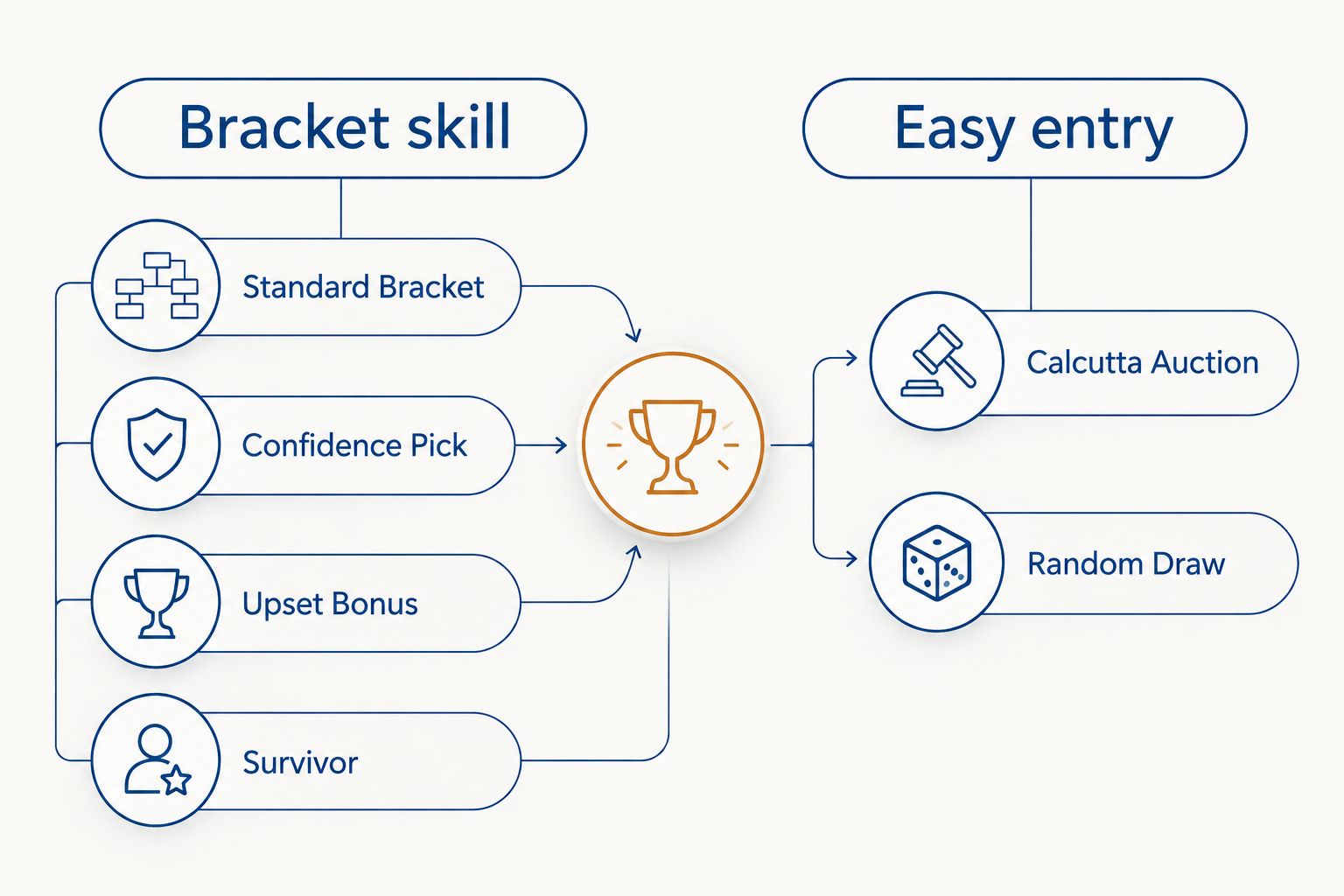
That split eliminates the wrong formats quickly. A casual office does not need a confidence-weighted scoring sheet, while a group of bracket obsessives gains little from a random draw that ignores matchup research.
Rules every organizer should publish
The format chooses the game. The rules sheet keeps the game fair. Publish one document before accepting entries and keep it unchanged after the deadline.
- Eligibility: State who can enter and whether each person can submit more than one bracket.
- Deadline: Include the exact closing time and time zone. State that no pick can change after the lock.
- Scoring: List the points available in every round and explain any upset or confidence bonus.
- Tiebreaker: Ask for the combined championship-game score and define how the closest prediction wins.
- Further tie: Explain what happens if the primary tiebreaker still leaves entrants level.
- Payouts: Assign a fixed share to every paid finishing position before collecting entries.
- Communication: Identify where standings, corrections and official decisions will appear.
Do not change a weak rule after seeing whom it hurts. If an unusual result exposes a gap, apply the published language for 2026 and repair the rule before the next tournament.
Build your 2026 bracket strategy
Use SportsOrca analysis to study seeds, matchups and upset cases before tip-off.
Which March Madness office pool rules should you choose?
For most offices in 2026, choose a Standard Bracket Pool with round-weighted scoring, a championship-score tiebreaker and a hard entry deadline. It is familiar, strategic and easy to administer without turning the organizer into a full-time commissioner.
Choose a Confidence Pick Pool when the group follows college basketball closely. Choose Random Draw Squares when the office wants simple participation. Keep Calcutta auctions outside a typical workplace unless company policy and applicable law clearly permit the format.
SportsOrca's default remains the Standard Bracket Pool because it gives casual fans a clear entry point without removing the strategic value of a correct Final Four. Write the tiebreaker and payout structure before the 68-team field tips off in 2026. Those two lines prevent more confusion than any scoring platform can fix later.
FAQ
What are the best March Madness office pool rules for 2026?
The best March Madness office pool rules use a Standard Bracket Pool with round-weighted scoring, a hard entry deadline and a championship-game score tiebreaker. Publish the scoring and payout structure before accepting brackets.
How do you score a March Madness bracket pool?
Most standard pools award points for every correct winner and increase the point value in later rounds. The organizer must publish the exact round values before the bracket deadline.
What is a Confidence Pick Pool in March Madness?
A Confidence Pick Pool weights correct selections according to how strongly each entrant rates them. It rewards both accuracy and conviction but requires a clear scoring scale.
What is the best March Madness pool for casual fans?
Random Draw Squares is the simplest option for casual fans because it requires no bracket knowledge. A Standard Bracket Pool is better when participants want to make tournament picks.
Is running a March Madness office pool legal?
Legality depends on applicable state law and the employer's workplace policy. Organizers should confirm both before collecting money or offering a prize in 2026.
What is a good tiebreaker for a March Madness pool?
Use each entrant's predicted combined score for the championship game. State whether the closest prediction wins regardless of going over the actual total.
How does a Calcutta pool work for March Madness?
A Calcutta pool auctions tournament teams to participants before play begins. Returns are distributed according to how far each purchased team advances under rules published before bidding.
Should First Four games count in an office pool?
First Four games should count only when the organizer says so before brackets are submitted. Standard bracket scoring often begins with the 63 games after the First Four.
One last thing
Do not hide the rules in a group chat. Put the deadline, scoring, tiebreaker and payout structure in one document that every entrant can reopen during the 2026 tournament. When a disagreement reaches the championship game, the written rule decides it — not the loudest person in the office.