Every office in America is running a Winter Olympics pool for Milan-Cortina 2026, and picking the wrong category early costs you the leaderboard by week two. These six pick categories tell you where to spend your draft picks, from Team USA's deepest medal count to the sleeper sports nobody else in your pool is watching.
- Winter Olympics office pool picks split into six categories, and Team USA medal contenders win on volume alone.
- Figure skating is the easiest sport to track start to finish, which makes it the best pick for new pool players.
- Sleeper sports like curling and biathlon are where office pools actually get won on tiebreakers.
- Alpine skiing headliners carry the highest bust risk tied to weather and course conditions.
- Speed skating and short track combine for more medal events than any other category on this list.
Why this matters
Office pools live and die on draft order. Grab a category too early and you're stuck defending a pick nobody else wanted; wait too long and the household names are gone before your turn comes back around.
The 2026 Winter Games run February 6-22 in Milan and Cortina d'Ampezzo, and casual fans who've never watched a luge run in their life are about to fill out a bracket anyway. That's the entire appeal of an office pool: it turns curling into appointment viewing for people who couldn't name a single Team USA medal contender a month ago.
The six categories below rank by draft value, not by which sport is "best" in some abstract sense. Team USA medal contenders top the list because volume wins pools, but the categories underneath it exist for a reason — they win different pools, at different draft slots, for different types of players.
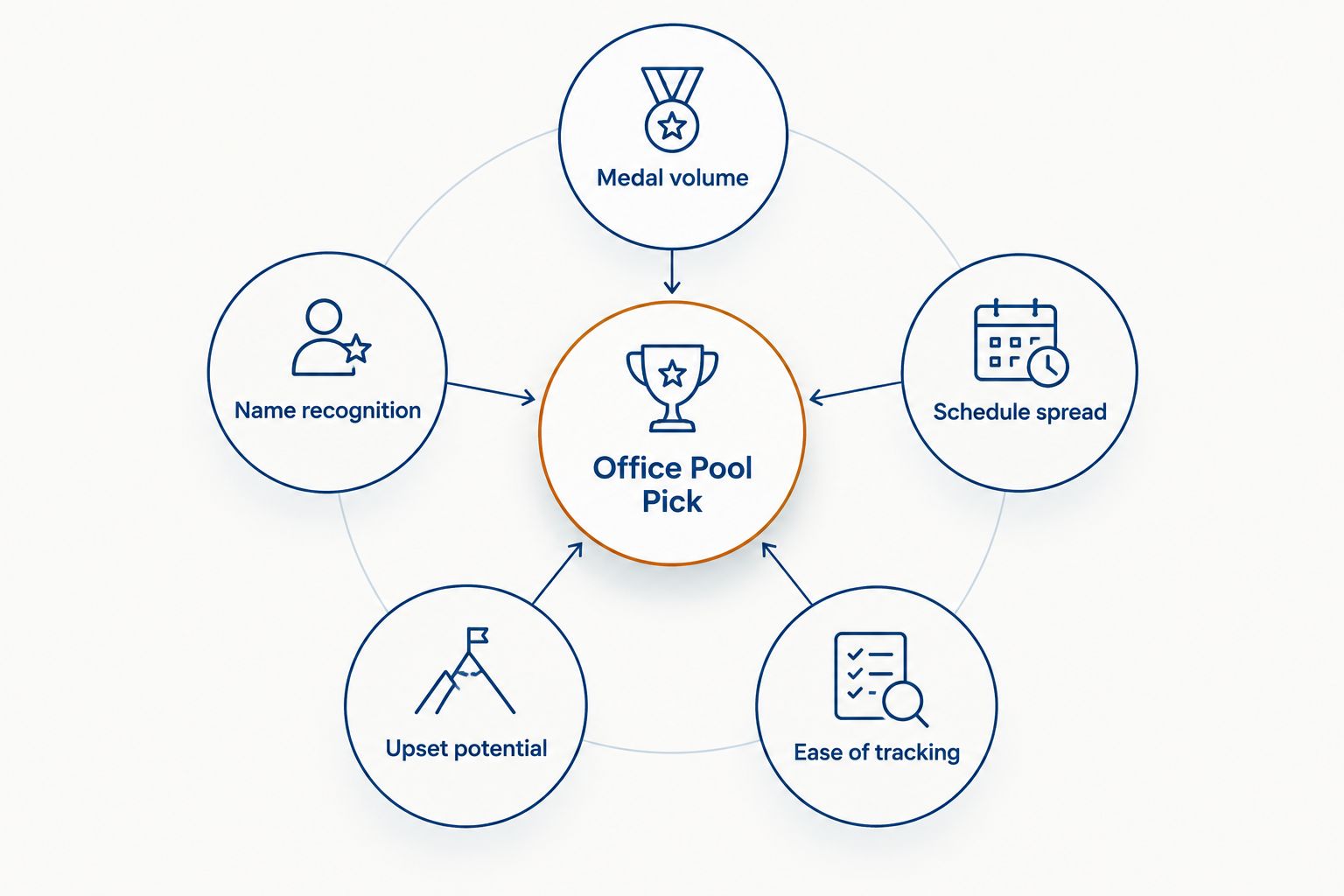
What makes the best office pool pick
- Medal volume — sports with more events give you more chances to score points across 17 days.
- Name recognition — picks built around athletes casual fans already know hold value even in random-draft formats.
- Schedule spread — a pick that produces medals across the whole window beats one that front-loads or back-loads all its scoring.
- Upset potential — categories with unpredictable results create separation once the obvious picks are already claimed.
- Ease of tracking — if you need a spreadsheet to know whether you're winning, the category is too complicated for a casual pool.
Winter Olympics office pool picks at a glance
| Category | Best for | Standout feature | Key limitation |
|---|---|---|---|
| Team USA Medal Contenders | Maximizing total pool points | Spreads scoring across multiple sports | Requires research before draft day |
| Figure Skating Storylines | Easiest sport to follow beginning to end | Household names, clean scoring format | Fewer total medal events than alpine or speed skating |
| Sleeper Sports (curling, biathlon, luge) | Late-round tiebreaker value | Almost nobody else in the pool drafts these | Harder to project a winner |
| Alpine Skiing Headliners | Drafting a recognizable superstar | Marquee downhill and slalom names | Boom-or-bust, tied to weather and course conditions |
| Speed Skating & Short Track | Volume strategy across many events | Highest medal-event count on this list | Lower mainstream awareness among casual pool players |
| Olympic Hockey Brackets | Group pools scoring playoff-style upsets | Bracket format familiar from March Madness | Single-elimination format raises variance |
1. Team USA Medal Contenders: best winter olympics office pool pick for volume
Team USA's medal contenders span alpine skiing, snowboarding, speed skating and more, which is exactly why this category tops the office pool picks list for 2026. Drafting the U.S. contingent as a bloc means every discipline that produces a medal adds to your point total, instead of betting your whole pool entry on one sport going your way.
Team USA Medal Contenders pros:
- Covers the widest spread of sports of any single draft pick
- Built-in fan interest — most office pools track USA results by default
- Medal chances stretch across the full 17-day window, so you're never out early
Team USA Medal Contenders cons:
- Requires homework before draft day to know which disciplines are real medal threats in 2026
- Popular pick, so you'll likely face competition for it at the top of a snake draft
- Overlap risk if your pool caps how many USA-specific picks each player can hold
Best for: pool players who draft early and want a pick that scores across the whole schedule.
Verdict: Draft it.
2. Figure Skating Storylines: best winter olympics office pool pick for easy tracking
Figure skating carries built-in drama every four years — team event, pairs, ice dance and the singles competitions that always produce a breakout storyline. For a casual fan filling out a 2026 office pool for the first time, figure skating is the one category you can watch start to finish without a rulebook.
Figure Skating Storylines pros:
- Simple scoring system: judges' scores decide medals, no ambiguity
- Easiest sport in the Games to explain to someone who's never watched it
- Prime-time coverage means you won't miss the results
Figure Skating Storylines cons:
- Fewer total medal events than alpine skiing or speed skating caps your upside
- Judged scoring occasionally produces results that don't match the pre-Games favorites
Best for: first-time pool players who want a sport they can actually follow live.
Verdict: Draft it.
3. Sleeper Sports: best winter olympics office pool pick for tiebreakers
Curling, biathlon and luge rarely get drafted before round three, which is exactly why they matter. Once the obvious names are gone, sleeper sports are where office pools actually separate the winner from the pack — nobody else is tracking these results as closely as you will.
Sleeper Sports pros:
- Almost zero competition for these picks in a casual draft
- Low expectations mean any medal feels like a win
- Great value in the late rounds when star power is already claimed
Sleeper Sports cons:
- Harder to project which country or athlete medals
- Lower TV coverage makes results harder to track in real time
Best for: pool players picking in the back half of the draft order.
Verdict: Draft it — but only after round two.
4. Alpine Skiing Headliners: best winter olympics office pool pick for star power
Alpine skiing produces some of the most recognizable names in the entire Winter Games, and drafting a marquee downhill or slalom skier gives your pool entry instant credibility. The risk is built into the sport itself: a single icy patch or a weather delay can end a favorite's run before it starts.
Alpine Skiing Headliners pros:
- Star power casual fans already recognize going into 2026
- High-visibility events with heavy prime-time coverage
- Multiple disciplines — downhill, slalom, giant slalom, combined — give one athlete several chances to medal
Alpine Skiing Headliners cons:
- Boom-or-bust: weather and course conditions can wreck a favorite's run
- A crash or disqualification zeroes out the pick entirely, with no partial credit
Best for: pool players who want a recognizable name and can stomach volatility.
Verdict: Hold — draft it only if the projected favorite is healthy going into February.
5. Speed Skating & Short Track: best winter olympics office pool pick for event volume
Speed skating and short track combine for more individual medal events than any other category on this list, which makes them the volume play for a pool that rewards total medal count. The tradeoff is awareness — casual fans know far fewer speed skating names than alpine or figure skating stars.
Speed Skating & Short Track pros:
- Highest medal-event count of any category in this ranking
- Team pursuit and relay events add extra scoring chances beyond individual races
- Fast-paced format keeps races short and easy to check between meetings
Speed Skating & Short Track cons:
- Lower mainstream name recognition than figure skating or alpine skiing
- Dense schedule is easy to miss if you're not checking daily
Best for: pool players in a format that scores every medal equally, regardless of sport.
Verdict: Draft it if your pool counts total medals over star power.
6. Olympic Hockey Brackets: best winter olympics office pool pick for upset scoring
Men's and women's hockey run as single-elimination brackets once pool play ends, which means office pools that score upsets the way a March Madness bracket does get real value out of this category. The format that makes hockey exciting — win or go home — is the same format that can knock out a favorite in one bad period.
Olympic Hockey Brackets pros:
- Bracket format is already familiar to anyone who's filled out a March Madness sheet
- Upset scoring rewards pool players who avoid chalk
- Group play gives you data before the elimination rounds start
Olympic Hockey Brackets cons:
- Single-elimination format raises variance — one bad period ends a run
- Only pays off in pools that specifically score bracket-style results
Best for: office pools running a bracket-scoring format alongside the medal count.
Verdict: Wait — draft this only if your pool explicitly scores hockey brackets.
How we ranked these office pool picks
Each category above gets weighed against the five criteria from the section above: medal volume, name recognition, schedule spread, upset potential and ease of tracking. Team USA Medal Contenders and Figure Skating Storylines score highest on recognition and tracking ease, which is why casual pools draft them first in 2026. Sleeper Sports and Speed Skating & Short Track trade recognition for volume and upset value — the picks that separate a leaderboard once the obvious names are gone.
Which winter olympics office pool pick should you draft?
If you're picking first or second, take Team USA Medal Contenders — no single category spreads scoring across more sports in the 2026 Games. If that pick is already gone and you want something you can actually watch without a rulebook, grab Figure Skating Storylines. Sitting in the back half of the draft order with nothing but sleeper picks left? Curling, biathlon and luge earn more points per surprise than any star name still on the board.
Follow every Winter Olympics angle
New picks, previews and coverage running through the closing ceremony.
FAQ
What's the best winter olympics office pool pick for a beginner?
Figure skating storylines are the best pick for a first-time pool player in 2026 because the scoring is straightforward and the events run in prime time. Team USA medal contenders work too, but they require more research before draft day.
Is Team USA the best category to draft first?
Yes, Team USA medal contenders top this ranking because the pick spreads scoring chances across multiple sports instead of betting on one discipline. It also carries the most competition for the top draft slot in a casual pool.
How do most office pools score Winter Olympics picks?
Most casual pools award points per medal a drafted athlete, country or category earns during the Games, often weighting gold higher than silver or bronze. Rules vary by pool, so confirm the exact scoring before draft day.
Which sports have the most medal events at the 2026 Winter Olympics?
Speed skating and short track combine for more individual medal events than any other category on this list, making them the volume play for pools that count every medal equally.
Should I draft alpine skiing or speed skating first?
Draft alpine skiing if you want name recognition and can accept the boom-or-bust risk tied to weather and course conditions. Draft speed skating if your pool rewards total medal count over star power.
When do the 2026 Winter Olympics start and end?
The 2026 Winter Games run February 6-22 in Milan and Cortina d'Ampezzo, Italy. That 17-day window is the scoring period for most office pools.
What's a good sleeper pick for a winter olympics office pool?
Curling, biathlon and luge are the strongest sleeper picks for 2026 because almost nobody else in a casual pool drafts them, which turns any medal into separation on the leaderboard.
Does hockey matter in an office pool?
Hockey only matters if your pool specifically scores bracket-style upsets the way a March Madness sheet does. In a standard medal-count pool, the single-elimination format makes it a riskier pick than the categories above it.
One last thing
The pool player who wins most often isn't the one who drafts the biggest name first — it's the one who spreads picks across all six categories instead of stacking three picks in one sport. Balance your board before the puck drops on hockey group play in 2026, because a pool built entirely on star power collapses the moment one favorite has a bad run.