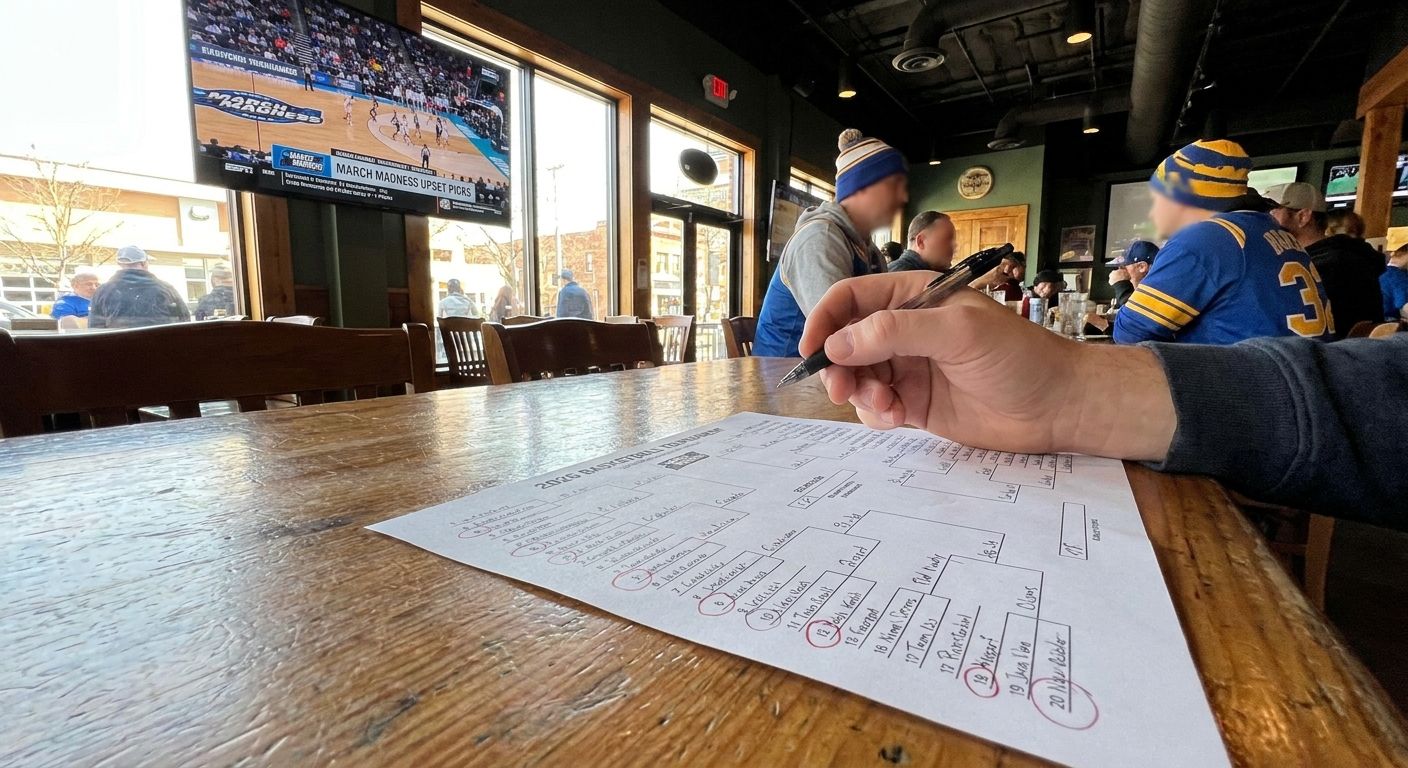
The bracket breaks or it holds, and the difference almost always comes down to one upset pick nobody else in the pool believed in. Here's where 2026 bracket upsets actually live, ranked by seed line history instead of gut feel.
- The 12-seed over 5-seed line is the safest march madness upset pick for a 2026 bracket build.
- 15-over-2 upsets are rare but program-defining — Saint Peter's ran it to the Elite Eight in 2022.
- 16-over-1 has happened exactly once since seeding began in 1985: UMBC over Virginia in 2018.
- 11-over-6 and 10-over-7 are the highest-frequency near-coin-flip lines for filling out bracket depth.
Why this matters
Most bracket pools score upsets on a curve — a correct 12-over-5 call is worth more than picking the 1-seed to win its opener, and a correct 15-over-2 call can single-handedly separate you from 90% of a pool by the second weekend. The 2026 field will follow the same seeding math it always has. Chalk wins most games; upsets win pools.
Selection Sunday drops the bracket, but the SportsOrca homepage tracks every seed reveal and matchup breakdown as soon as the committee sets the field, so you're not building your 2026 bracket blind on Thursday morning.
What makes the best march madness upset pick
- Seed differential history since 1985 — some seed lines flip far more often than others, and the gap is not close
- Style clash, not just record — a guard-heavy mid-major built to push tempo against a slow, half-court power-conference team creates real upset conditions
- Late-season form entering Selection Sunday — a team that won its conference tournament carries different energy than a bubble team backing in
- Efficiency gap over win-loss record — margin against comparable schedules tells you more than a seed number
- Bracket pool scoring rules — upset points are usually weighted by round, so a 12-over-5 in round one pays differently than a 13-over-4 upset in round two
- Public bracket bias — in pools where everyone picks the same chalk, a correct contrarian call separates you fast
Upset seed lines at a glance
| Seed matchup | Best for | Standout feature | Key limitation |
|---|---|---|---|
| 12 over 5 | Balanced bracket building | Most consistent historical hit rate of any seed line | Rarely survives past the first weekend |
| 11 over 6 | Low-risk bracket value | Near coin-flip frequency most tournaments | Modest payout in most pool scoring systems |
| 10 over 7 | Depth picks in deep pools | Frequent but low-profile | Easy to overlook and skip entirely |
| 13 over 4 | Second-weekend separation | Bigger point swing when it lands | Far less frequent than 12-over-5 |
| 15 over 2 | All-or-nothing pool wins | Program-defining tournament runs | Happens in only a handful of tournaments |
| 16 over 1 | Longshot flex slot | The one verified hit in tournament history | Essentially never repeats |
1. 12-seed over 5-seed: best upset pick for building a balanced bracket
The 12-over-5 line has earned its reputation as the go-to march madness upset pick for a reason — it shows up in some form nearly every tournament, often more than once. The classic profile is a mid-major team that plays fast, shoots threes at volume, and catches a 5-seed that limped into the field after a mediocre conference stretch.
12-over-5 pros:
- Historically the most reliable upset seed line in the bracket
- Usually gives you two or three viable candidates each year, not just one
- Low opportunity cost — you're not sacrificing a Final Four pick to take the flyer
12-over-5 cons:
- Rarely advances past the round of 32
- Overused pick means it doesn't separate you much in a pool full of sharp bettors
Verdict: Buy. Pick at least one 12-over-5 every year — the line is too consistent to skip in a 2026 bracket.
2. 11-seed over 6-seed: best upset pick for low-risk bracket value
The 11-over-6 matchup runs close to a coin flip most seasons, especially when the 11-seed comes from a power conference that got a weak seed for a down year rather than a true mid-major Cinderella.
11-over-6 pros:
- High hit frequency, close to 50/50 in most bracket years
- Often features a power-conference 11-seed with tournament-tested talent
11-over-6 cons:
- Payout in most pool formats is modest since it's an expected upset
- Harder to identify the right side without watching late-season conference play
Verdict: Hold. Worth one pick if you've watched the teams play; skip it if you're guessing off seed number alone.
3. 10-seed over 7-seed: best upset pick for filling out depth without exposure
The 10-over-7 line gets ignored because it lacks the drama of a double-digit blowup, but it hits at a rate that quietly wrecks brackets that assume all 7-seeds are safe.
10-over-7 pros:
- Frequent enough that skipping it entirely is a mistake
- Low profile means it's genuinely undervalued by casual bracket fillers
10-over-7 cons:
- Easy to forget when filling out a bracket in a hurry
- Rarely swings a pool by itself since the seed gap is small
Verdict: Hold. Fill in at least one 10-over-7 upset as a depth pick, not a headline call.
4. 13-seed over 4-seed: best upset pick for second-weekend separation
A 13-over-4 upset carries more weight than a 12-over-5 in most scoring systems because it's rarer and it removes a legitimate contender before the Sweet 16.
13-over-4 pros:
- Bigger point swing than the 12-over-5 line when it hits
- Removes a real threat from the bracket, which matters for later rounds
13-over-4 cons:
- Happens far less often than 12-over-5
- Wrong call here costs you more than a missed 12-seed pick
Verdict: Wait. Only take a 13-over-4 flyer if the 4-seed has a specific, visible weakness — a bad matchup at point guard, a thin bench, a late-season slide.
5. 15-seed over 2-seed: best upset pick for all-or-nothing pool wins
This is the seed line that makes bracket legends. Saint Peter's rode a 15-seed all the way to the Elite Eight in 2022, and Oral Roberts pulled off the same upset a year earlier in 2021. Both runs turned brackets that took the pick into pool champions overnight.
15-over-2 pros:
- When it hits, it can carry a bracket for multiple rounds, not just one game
- Separates you completely from every bracket that didn't take the risk
15-over-2 cons:
- Happens in only a small minority of tournaments
- A wrong call here barely costs you anything, but a right call is rare
Verdict: Wait. Take one 15-over-2 swing in a large pool where you need separation, but don't build your whole strategy around it.
6. 16-seed over 1-seed: best upset pick for a longshot flex slot
Since seeding began in 1985, a 16-seed has beaten a 1-seed exactly once — UMBC over Virginia in 2018. That's the entire sample size for this seed line, and it's why nobody should build a 2026 bracket strategy around it.
16-over-1 pros:
- Maximum novelty value if you're in a pool that rewards a single correct longshot
- Costs you nothing to pencil in since nobody expects it anyway
16-over-1 cons:
- The hit rate across 41 years of tournament history is essentially zero
- Picking it as anything more than a fun flex is a losing strategy
Verdict: Skip. Leave the 1-seeds alone in round one unless you're filling a novelty bracket for fun, not a pool you're trying to win.
How we ranked
The order above follows documented tournament history rather than a hunch about any specific 2026 matchup — the 12-over-5 and 11-over-6 lines rank highest because they hit with real frequency across four decades of seeded tournaments, while 15-over-2 and 16-over-1 rank lower because their hit rate is thin even though the payoff, when it lands, is massive. If you build parlays or props around the same kind of frequency-versus-payout math, the logic in building a winning parlay carries over directly to bracket construction.
Track every 2026 bracket reveal
Seed lines, matchup breakdowns, and upset tracking as the field sets.
Which upset pick should you choose for 2026?
If you only take one swing, take the 12-over-5, every single year, because it's the one line with a real, repeatable track record. If your pool is large enough that you need genuine separation, add one 15-over-2 flyer and accept that it usually won't hit. Skip the 16-over-1 unless the bracket is just for fun — the math on that seed line hasn't moved since UMBC broke it in 2018, and it won't move again just because it's 2026.
How you weigh a seed-line upset against the same team's line movement matters too — the same instinct that tells you a 5-seed is vulnerable is the instinct covered in reading odds movement before kickoff, just applied to a single-elimination bracket instead of a weekly slate.
FAQ
What's the best march madness upset pick for 2026?
The 12-seed over 5-seed line is the best default upset pick for a 2026 bracket because it has the most consistent hit rate of any seed matchup in tournament history. It won't produce a Cinderella run, but it's the one upset call worth making every year.
Is a 15-over-2 upset worth picking in 2026?
Only as a high-upside flyer, not a core strategy. Saint Peter's (2022) and Oral Roberts (2021) both proved a 15-seed can carry a bracket for multiple rounds, but the seed line hits in only a small share of tournaments.
How often does a 16-seed beat a 1-seed?
It has happened exactly once since the tournament expanded to 64 teams in 1985 — UMBC over Virginia in 2018. Treat any 16-over-1 pick as a novelty, not a real strategy for a 2026 bracket.
Which seed line is the safest bracket upset pick?
The 12-over-5 and 11-over-6 lines are the safest because they hit with real frequency most tournaments, unlike rarer lines like 15-over-2 or 16-over-1 that hit in only a handful of years.
Should I pick more than one upset per round in my 2026 bracket?
Yes, in the first round. Most bracket pools reward at least one 12-over-5 and one 10-over-7 or 11-over-6 pick, since those lines hit often enough that skipping them entirely usually costs more than a wrong guess.
Does seed history actually predict 2026 upsets?
Seed history shows you where upsets are structurally more likely, not which specific team will pull it off. Pair the seed-line pattern with late-season form and style matchups before locking in a specific team.
What makes a 13-over-4 upset more valuable than a 12-over-5?
A 13-over-4 upset is rarer than a 12-over-5, so it usually carries more weight in pool scoring and removes a stronger contender from the bracket before the Sweet 16.
One last thing
The 16-over-1 line has one data point in 41 years of seeded tournament history — UMBC over Virginia in 2018 — and that single upset is still the most-cited longshot in bracket history for a reason: it's the only proof it can happen at all. Build your 2026 bracket around the seed lines that actually repeat, and save the 16-seed flyer for the pool where nobody's paying attention anyway.