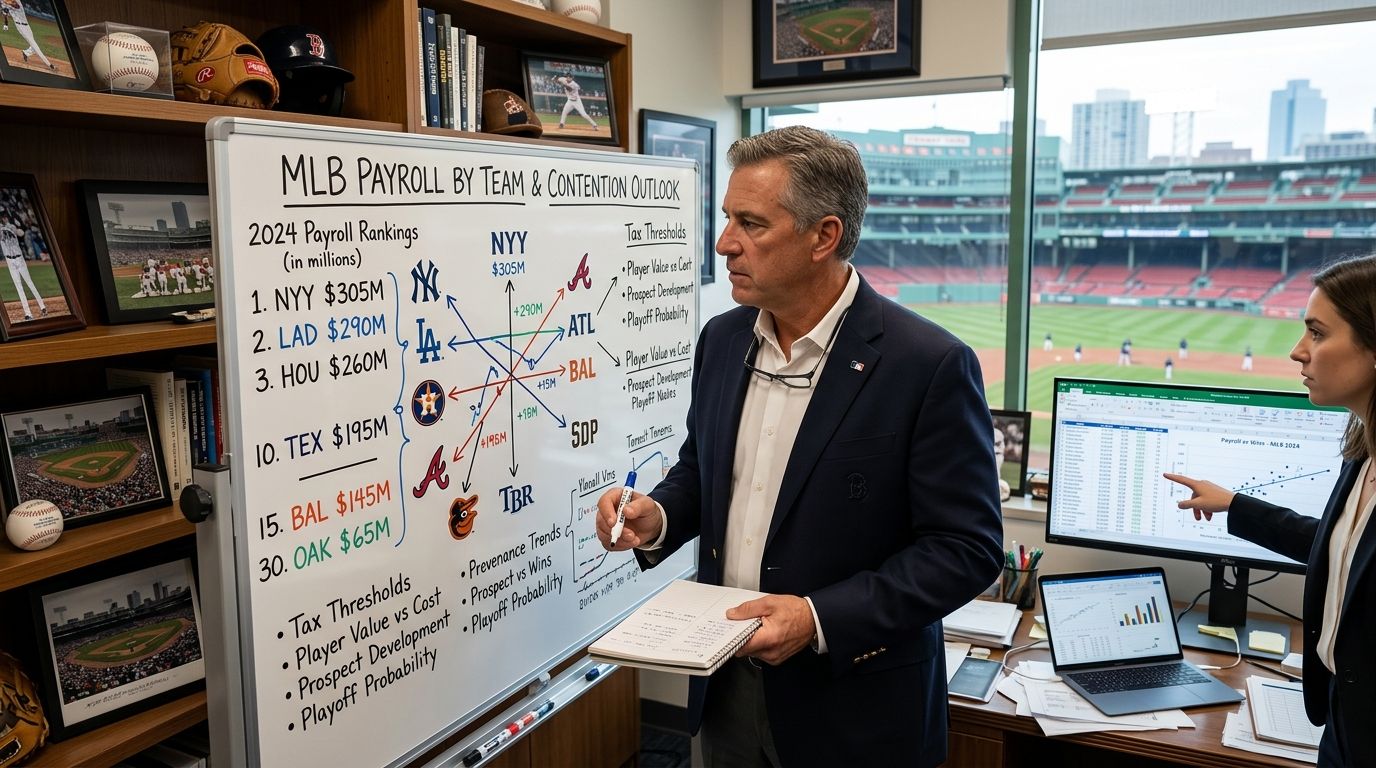
MLB payroll by team tells you who's spending, not who's winning — the rankings are a spending report, not a contention forecast. The Los Angeles Dodgers and New York Mets top the payroll charts nearly every winter, and both have punched through the 2026 Competitive Balance Tax threshold to do it. Reading the list right means separating raw dollars from roster construction, and that's the part most fans skip.
- MLB payroll by team splits into tax-payer spenders, mid-market balancers, and rebuild-mode savers, and rank alone doesn't call contention.
- The Competitive Balance Tax threshold sits at $244 million in 2026, up from $241 million in 2025, with escalating penalties above it.
- Repeat luxury-tax payers face tax rates up to 50% and lose draft-pick value, which shapes how far even rich teams will spend.
- A top-five payroll finishing outside a playoff spot happens almost every season — read the roster, not just the ledger.
Why this matters
Payroll rank gets thrown around as a proxy for contention, and it's a lazy one. A team can sit fifth in spending and miss the postseason because the money went to an aging rotation instead of a bullpen that can hold a lead. Front offices know this — that's why the smart franchises talk about payroll allocation, not payroll size, when they explain a rebuild or a push. MLB trade candidates for teams buying at the deadline usually come from clubs sitting mid-pack in payroll with a gap at one position, not from the top spenders who already filled every hole in the offseason.
How to read MLB payroll rankings for contention chances
Start with three questions before the payroll number means anything: where does the team sit relative to the $244 million threshold in 2026, how much of that payroll is locked into pre-arbitration talent versus aging contracts, and does the front office have a track record of spending in-season. Payroll rank without those answers is just a leaderboard.
| Tier | 2026 CBT Position | What It Signals | Best For Reading |
|---|---|---|---|
| Top spenders | At or above $244M | Ownership backs the front office to buy immediately | Win-now windows, deadline buyers |
| Mid-market | Below threshold, active payroll | Flexibility to add without tax penalty | Teams a hot streak away from buying |
| Rebuild mode | Payroll suppressed by design | Betting on the farm system over free agency | Multi-year outlook, not this season |
The verdict: a payroll near or above the $244 million threshold signals ownership commitment, but it only predicts contention when paired with a farm system still producing cheap, controllable talent underneath it.
Top Tier: Payroll Above the $244 Million CBT Threshold
Teams operating above the 2026 threshold accept a tax bill to keep adding. First-time offenders pay 20% on the overage, but repeat spenders — the Dodgers and Mets fall into this bucket most years — pay up to 50% on the amount above the line. That penalty structure is why even the richest front offices still ration spending on marginal upgrades instead of buying every available piece.
Mid-Market Tier: Payroll Rank Without Luxury Tax Exposure
This is the most misread group in MLB payroll by team rankings. A club sitting 10th or 12th in payroll often has more in-season flexibility than a team ranked 4th, because it hasn't triggered any tax bracket yet. Watch these teams closest at the trade deadline — they're the ones who can add salary without a penalty attached.
Rebuild Tier: Payroll Suppressed by Roster Control
Low payroll here isn't a lack of ambition, it's a strategy built on pre-arbitration players who cost close to the league minimum. Clubs in this tier lean hard on player development and low-cost reclamation projects — the kind of names that show up on MLB Rule 5 Draft targets for rebuilding teams every winter.
Why MLB payroll by team varies so much
- Local media rights deals — a regional TV contract worth hundreds of millions changes what an owner can spend without blinking.
- Revenue sharing — smaller-market clubs receive shared league revenue, which raises their floor but rarely their ceiling.
- Arbitration class size — a team with six players hitting arbitration in the same winter sees payroll jump even without a single free-agent signing.
- Extension timing — locking a core player into a long-term deal early keeps payroll lower short-term than waiting until free agency.
- Ownership spending will — the same market size can produce wildly different payrolls depending on who signs the checks.
- Farm system output — a system still producing controllable talent lets a front office keep payroll flat while adding talent, which is exactly why teams track MLB prospects to watch for contending farm systems alongside the payroll sheet.
“Payroll rank tells you what a team can do — it doesn't tell you what they will do with it.”
Does the highest MLB payroll always make the playoffs?
No — a top-five payroll misses the postseason almost every year, because payroll buys depth and star power but not health, bullpen luck, or in-season chemistry. Rank the payroll list against the standings from any recent season and at least one top-five spender lands outside the playoff field.
What is the MLB luxury tax threshold for 2026?
The MLB luxury tax threshold for 2026 is $244 million, up from $241 million in 2025 under the current Collective Bargaining Agreement. Teams above it pay a graduated tax rate that climbs to 50% for repeat offenders, plus draft-pick penalties for the largest overages.
Can a low-payroll team win the World Series in 2026?
Yes — low-payroll teams have reached deep October runs by pairing a cheap, controllable rotation with a lineup of players still in their pre-arbitration or first-arbitration years. Payroll rank matters less in a short series than starting pitching depth and bullpen matchups, which is why award tracking like Best MLB MVP candidates for the season often surfaces names from mid-payroll rosters, not just the top spenders.
Track every MLB storyline in one place
Payroll shifts, trade buzz, and contention odds updated all season.
FAQ
What is MLB payroll by team based on?
MLB payroll by team is calculated from active roster salaries, injured list contracts, and buried money still owed to released players. It's tracked separately from the Competitive Balance Tax number, which adds benefits and deferred-money allocations on top.
How much does the top MLB payroll spend compared to the bottom?
The gap between the highest and lowest MLB payrolls typically spans well over $200 million, driven by media deals and ownership spending rather than market size alone. Rebuilding clubs deliberately keep payroll low to stay flexible for future free-agent classes.
Is MLB payroll by team the same as the luxury tax number?
No — the luxury tax figure (Competitive Balance Tax payroll) includes benefits, deferred money, and player option buyouts that raw payroll totals leave out. A team can rank differently on each list depending on how it structures contracts.
Why do small-market MLB teams have low payrolls?
Small-market teams have lower local media revenue and rely more on shared league revenue, which caps aggressive spending. Many offset this by investing heavily in scouting and player development instead of free agency.
Does payroll rank predict MLB win totals?
Payroll rank correlates loosely with win totals but breaks down often — several top-ten payroll teams miss 85 wins in a given season. Roster health and bullpen performance move win totals more than raw spending does.
What happens if a team goes over the luxury tax threshold multiple years in a row?
Repeat offenders face tax rates up to 50% on the amount over the $244 million 2026 threshold, plus additional surtax penalties the further above the line they spend. Multi-year overages can also cost a team draft-pick slot value.
Can payroll drop and a team still contend the next season?
Yes — a team can cut payroll by letting expensive contracts expire while promoting cost-controlled prospects, keeping win totals steady. This is common the year after a core extension window closes.
One last thing
The number that actually predicts contention isn't total payroll — it's how much of that payroll is locked into players over 32 with declining production. A $244 million roster full of players in their prime reads completely differently than the same number spent on back-loaded, aging deals, even though both hit the identical spot on the 2026 payroll rankings.