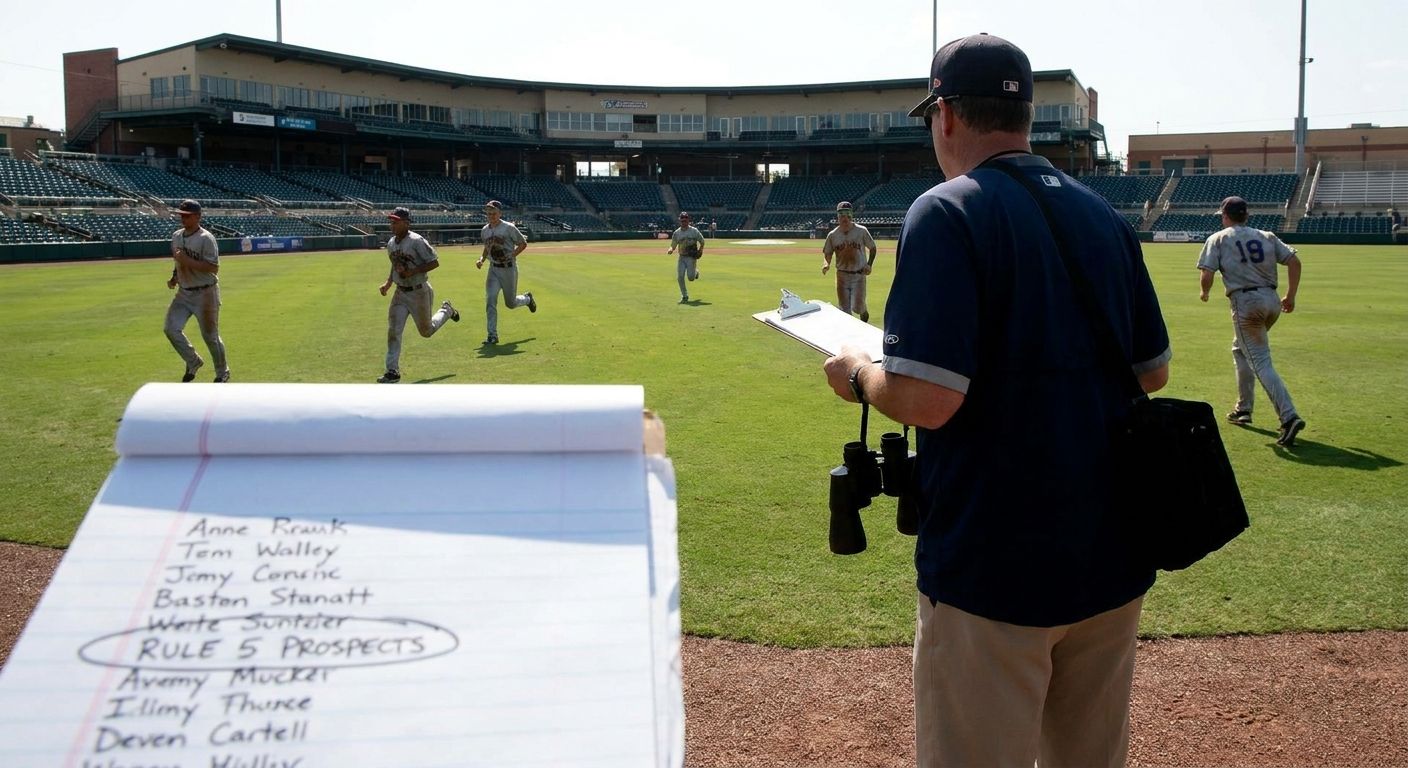
Rebuilding teams' Rule 5 draft targets are players buried on a crowded 40-man roster somewhere else, unprotected by mid-November and up for grabs at the Winter Meetings, with the aim of stealing a real bullpen arm or bench piece for nothing more than a roster spot. A last-place club doesn't need the Rule 5 draft to fill a lineup hole the way a contender does — it needs a body who can survive the full 2026 season on the active roster while the farm system keeps developing behind him. That's a different math problem than what a 90-win team runs in December, and it's why the worst rosters in baseball often walk away from the Rule 5 draft with the best value.
- Rebuilding teams pick first in the 2026 Rule 5 draft because selection order mirrors reverse standings.
- The best mlb rule 5 draft targets are relievers and up-the-middle defenders who can survive a full year on the active roster.
- Any Rule 5 pick must stay on the 26-man roster all season or get offered back at half the price paid.
- Rebuilding clubs have open bench and bullpen innings that contenders don't, which is the real edge here.
Why the Rule 5 draft matters for rebuilding teams
A club fighting for a Wild Card in September can't burn a bench spot on a project who might not be ready. A club that lost 95 games can. That open roster real estate is the entire strategic advantage rebuilding front offices have every winter, and it's why teams like the Athletics, Rockies and White Sox have leaned on the Rule 5 draft harder than division winners in recent cycles — rebuilding clubs shopping their own trade chips at the deadline are often the same front offices restocking through the Rule 5 board months later.
History backs the strategy. Roberto Clemente went from the Dodgers' system to Pittsburgh via the 1954 Rule 5 draft. Johan Santana was taken by the Marlins in 1999 before landing in Minnesota. Josh Hamilton went from Tampa Bay's organization to Cincinnati in 2006. Odubel Herrera left the Rangers' system for Philadelphia in 2015 and made an All-Star team two years later. None of those players cost a real prospect. All of them required a team willing to carry a roster spot on faith through a slow April.
Map the eligibility board before Winter Meetings
Every Rule 5-eligible player becomes public the moment the 40-man protection deadline passes in mid-November, and rebuilding front offices treat that list like a scouting department, not a rumor mill.
- Cross-reference every unprotected player against organizational depth charts, not just raw stat lines
- Flag players stuck behind a 40-man logjam at a shallow position league-wide (catcher, shortstop, high-leverage relief)
- Note which clubs are carrying the most 40-man overflow — deep systems leak the most talent
- Track option status separately; Rule 5 picks can't be optioned to the minors once selected
Target power arms that fit a stash-all-year bullpen spot
The single most common successful Rule 5 profile since MLB scrapped the Triple-A phase of the draft is a hard-throwing reliever who was never going to crack a crowded big-league bullpen elsewhere.
- Prioritize arms who miss bats in short bursts over ones who need innings to find a rhythm
- Look for a fastball that already plays in the mid-90s; stuff translates faster than command in year one
- Check for a swing-and-miss secondary pitch that doesn't require a full four-pitch mix
- Avoid recent Tommy John rehabs unless the team can stomach carrying a non-contributor for months
Screen for contact bats who can hold a bench role
A rebuilding team doesn't need a middle-of-the-order hitter off the Rule 5 board. It needs a bench bat who won't embarrass the lineup on the days he starts.
- Favor contact rate and strikeout avoidance over raw exit velocity or minor league power numbers
- Check platoon splits closely — a Rule 5 bat's value is often tied to matching him against the right-handed or left-handed side
- Look for a track record against advanced pitching at Double-A or above, not just gaudy A-ball stats
- Confirm he can handle multiple outfield spots or a corner infield spot without a defensive downgrade
Prioritize up-the-middle defenders over offensive ceiling
Glove-first players at catcher, shortstop, second base and center field survive a Rule 5 season more often than bat-first prospects because their value doesn't disappear if the offense is slow to develop.
- Weight defensive metrics and scouting grades above wRC+ or slugging percentage
- Target players who already have reps at multiple infield spots — versatility buys extra bench value
- Check catch-and-throw grades separately for catchers; framing takes longer to translate than raw power
- Ask whether the player can be a late-inning defensive replacement even if the bat never plays
Build your 26-man math before draft day
A front office that walks into the Rule 5 draft without a clear roster plan wastes a pick. Every selection has to answer the question: who loses a roster spot to make room for this player in 2026?
- List every open bullpen and bench spot on the projected Opening Day 26-man roster
- Identify which current 40-man players are the most likely camp cuts or waiver casualties
- Model the worst-case scenario — a Rule 5 pick who struggles in March but still has to make the club
- Decide in advance which spot on the roster is the most expendable if the pick needs regular reps
Follow every rebuild-era roster move
SportsOrca tracks MLB roster and trade decisions through the winter and into camp.
Have the offer-back plan ready
A Rule 5 pick who can't stick on the active roster all of 2026 has to be offered back to his original organization at half the price paid, or he clears outright to the open market. Rebuilding teams that ignore this rule end up either forcing a bad roster fit through September or handing back value for nothing.
- Set an internal evaluation checkpoint at the end of spring training, not mid-June
- Decide before Opening Day what a "passing" 60-game stretch looks like for the pick
- Keep the original team's contact informed early if the fit clearly isn't working — it preserves trade leverage later
- Never assume the player will simply figure it out; the clock on the offer-back rule doesn't pause
Rule 5 profile comparison for rebuilding front offices
| Profile type | Best for | Roster cost | Key limitation |
|---|---|---|---|
| Hard-throwing reliever | Bullpen depth on a losing club | One 26-man bullpen spot, all season | Command often lags stuff early in year one |
| Contact-first bench bat | Platoon and pinch-hit duty | One bench spot, all season | Limited offensive ceiling if defense slips |
| Up-the-middle defender | Late-inning defense, developmental catcher/SS reps | One bench or platoon spot, all season | Bat may never be big-league average |
| Depth starter/swingman | Innings eater in a thin rotation | One 26-man rotation or long-relief spot | Rarely survives a full 162-game workload |
Common mistakes rebuilding teams make in the Rule 5 draft
- Drafting the best pure talent instead of the best roster fit. A rebuilding club with no open bullpen innings gains nothing from taking the hardest thrower on the board if there's nowhere to pitch him.
- Underestimating the offer-back clock. Teams that stash a player through May with no real plan lose leverage the moment he needs to be sent back.
- Ignoring how deep MLB's top farm systems run. The clubs with the most talent to lose in the Rule 5 draft are usually the same ones stacked at the position a rebuilding team is trying to fill — that overlap is where the best value hides.
- Chasing upside bats over survivable gloves. A .220-hitting shortstop who can play three infield spots clears more Rule 5 seasons than a .280-hitting one who can only play first base.
- Skipping the 26-man math until after the pick is made. By then the roster crunch is already a problem, not a plan.
FAQ
What is the Rule 5 draft in MLB?
The Rule 5 draft is an annual MLB event, held at the Winter Meetings in early December, where teams can select players left unprotected on another organization's 40-man roster. The selecting team must keep the player on its active 26-man roster for the entire following season or offer him back to his original club.
Why do rebuilding teams target the Rule 5 draft?
Rebuilding teams have open bullpen and bench spots that contenders can't spare, which lets them carry a Rule 5 pick through a slow start without hurting a playoff push. That roster flexibility is the main edge rebuilding front offices have every winter.
Who picks first in the Rule 5 draft?
Selection order mirrors the reverse order of the prior season's standings, so the team with the worst 2025 record picks first in the 2026 Rule 5 draft, the same structure used in MLB's amateur draft.
Can a Rule 5 pick be sent to the minor leagues?
No. A player selected in the Major League phase of the Rule 5 draft must stay on the selecting team's active roster all season. If he can't stick, the team has to offer him back to his original organization at half the original price.
What position gets picked most in the Rule 5 draft?
Relief pitchers dominate Rule 5 selections because a bullpen arm only needs to hold up for short outings, making the transition to a full big-league season easier than it is for an everyday position player.
Is the Rule 5 draft still a two-phase event?
No. MLB eliminated the Triple-A phase of the Rule 5 draft, so today's draft is Major League phase only, which is why every selection now comes with the full active-roster commitment.
How much value can a rebuilding team actually get from a Rule 5 pick?
History includes real contributors taken through the Rule 5 draft, including Roberto Clemente in 1954, Johan Santana in 1999, Josh Hamilton in 2006 and Odubel Herrera in 2015, all acquired for a roster spot instead of a prospect package.
One last thing
The part rebuilding front offices undersell is the timeline pressure built into the offer-back rule — a Rule 5 pick isn't a project you develop patiently through 2026, it's a bet you have to grade by spring training's final week. Teams that treat the pick like a normal prospect stash lose the leverage that makes the whole exercise worth running in the first place.