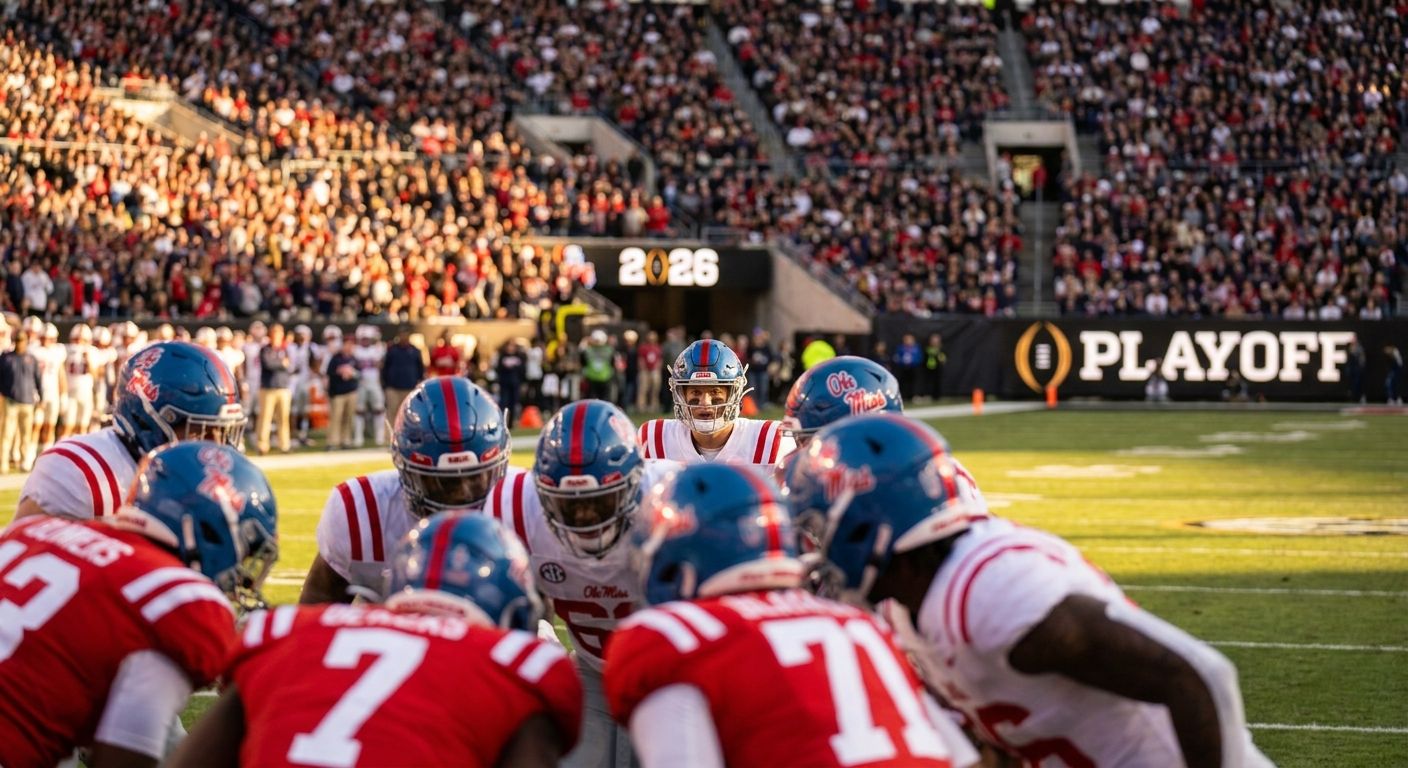
College football playoff contenders for bettors are the programs whose résumé survives committee scrutiny and market pressure at the same time, not just the teams sitting highest in the preseason polls. The 2026 season keeps the 12-team format in its third year, which means the contenders list stays alive later into November than it ever did under the old four-team bracket. For a bettor, that's the whole game: knowing which one-loss team still has a real path beats knowing which team looked best in September.
- College football playoff contenders for 2026 compete for 12 bracket spots, not four, so one loss rarely ends a season.
- Five automatic bids go to conference champions, including the highest-ranked Group of Five program — always check that path.
- Seven at-large bids run through committee criteria weighing strength of record over raw win totals.
- Futures market swings bigger than a few points after one Saturday signal the clearest change in contender status.
Why college football playoff contenders matter for bettors
A fan wants the storyline. A bettor wants the number the market hasn't caught up to yet, and in the 12-team era that number moves every week instead of collapsing after one bad Saturday. Full breakdowns of this kind of weekly market movement live on SportsOrca, and the same discipline that applies to reading NFL lines applies here.
Under the four-team format, a ranked team lost once and its futures price cratered overnight. Under the 12-team format built for the 2024 season and running through 2026, five automatic bids go to conference champions — including the highest-ranked Group of Five program — and seven at-large bids go through committee resume criteria. That structure keeps more teams mathematically live longer, which keeps futures markets active deeper into the season and creates more windows to find a mispriced number.
How to identify real college football playoff contenders
Track the conference championship math first
Automatic bids remove guesswork for five slots. Before anything else, check where a team sits in its own conference race, because winning the conference solves the résumé debate entirely.
- Confirm which five conferences are sending an automatic-bid champion
- Track head-to-head tiebreakers inside divisionless conference races
- Watch the highest-ranked Group of Five program for the sixth automatic path
- Note which teams control their own conference title game destiny
Read the committee's public criteria, not just the eye test
The selection committee has published resume factors for years now, and strength of record consistently outweighs a clean win total. A 10-2 team with three wins over ranked opponents often outranks an 11-1 team that beat nobody of consequence.
- Weight head-to-head results above computer ratings when the committee has both
- Check common-opponent results before assuming a team is better
- Count conference championships won, not just games won
- Track strength of record separately from strength of schedule
Weight strength of schedule over win totals
Win totals lie. A 9-3 team that played five ranked opponents is a stronger contender than an 11-1 team that avoided them, and the committee has rewarded that pattern repeatedly since the 12-team field opened up more at-large slots.
- Count Power conference road games specifically, not just Power conference games
- Flag non-conference schedules built entirely around cupcake opponents
- Check how many remaining opponents currently sit inside the committee's top 25
The faster path here: instead of building this schedule model yourself every Sunday, the same odds-reading framework SportsOrca uses for NFL odds movement applies directly to CFP futures — track the move, not just the current number.
Monitor injury reports at the positions that decide close games
A playoff contender's price is only as durable as its starting quarterback and offensive line. One long-term injury at either spot can turn a top-10 team into a bubble team within two weeks.
- Track backup quarterback experience level, not just starter health
- Watch offensive line depth charts for cumulative missed starts
- Check secondary depth against the two toughest remaining opponents
Watch how the futures market reacts after each Saturday
The market often knows before the poll does. A futures line that moves more than a few points after a single result is telling you something the committee hasn't confirmed publicly yet.
- Compare the opening line to the closing line on conference title futures
- Track a program's next-game spread the week after a signature win or loss
- Note when public betting percentage and line movement disagree — that's sharp money
“If the futures line moves more than a few points after one Saturday, the market already knows something the polls don't.”
Check remaining schedule difficulty, not current record
A 9-1 team with three ranked opponents left is a shakier contender than a 7-3 team that's already played its toughest games. Back-loaded schedules are where contenders fall apart in November.
- Map remaining games against the committee's current top 25
- Flag road trips to hostile environments in the final month
- Check bye week placement heading into a rivalry or title-implication game
Use the conference championship game as the swing event
Under the 12-team format, a conference title game loser can still make the field if the resume holds up, which changes how much weight to put on that single game.
- Separate "must-win for the automatic bid" from "must-win for the résumé"
- Track rematches specifically — a second loss to the same team hurts more than a first
- Watch how the committee treats close losses to top-5 teams versus blowout losses to unranked ones
Comparing the tools bettors use to track contenders
| Option | Best for | Key limitation |
|---|---|---|
| Committee weekly rankings | Baseline consensus on the field | Lags real résumé changes by up to a week |
| Computer/predictive ratings | Forward-looking team strength | Ignores head-to-head and résumé qualifiers the committee weighs |
| Conference standings trackers | Automatic-bid clarity | Doesn't capture at-large chances at all |
| Futures betting market | Real-time sentiment shifts | Moves on public money, not always sharp information |
Verdict: no single tool replaces the other three — the committee ranking sets the baseline, the schedule model explains the trend, and the market tells you who else has already noticed.
Common mistakes bettors make with playoff contenders
- Betting name-brand programs on preseason reputation instead of checking whether their 2026 schedule actually supports the ranking
- Confusing a predictive computer ranking with a committee resume ranking and betting the wrong number as a result
- Overreacting to one loss in a 12-team field where the at-large path stays open far longer than bettors assume
- Chasing line movement after it already corrected instead of getting in before the Saturday result that caused it
- Undervaluing the Group of Five automatic-bid path, which changes at-large math for every Power conference bubble team
FAQ
How many teams make the college football playoff in 2026?
The 2026 field holds 12 teams: five automatic bids for conference champions, including the highest-ranked Group of Five program, and seven at-large bids selected by the committee.
Is a one-loss team still a college football playoff contender in 2026?
Yes, a one-loss team is almost always still a contender in the 12-team format since seven at-large spots remain open even after a single loss with a strong overall resume.
How does the selection committee rank playoff contenders?
The committee weighs strength of record, head-to-head results, common opponents, and conference championships won above raw win totals when ranking contenders each week.
Does the top Group of Five team make the college football playoff?
Yes, the highest-ranked Group of Five conference champion receives one of the five automatic bids in the 12-team format, taking a spot away from Power conference at-large hopefuls.
What's the fastest way to track line movement on CFP futures?
Compare the opening futures line to the current line every Sunday and flag any move bigger than a few points, since that gap usually reflects information the public rankings haven't caught up to yet.
How often do playoff contender rankings change during the 2026 season?
Committee rankings update weekly starting in early November, and futures market prices move even more often, sometimes shifting after a single Saturday result.
Can a conference championship game loser still make the college football playoff?
Yes, a title game loser can still make the 12-team field if their overall resume, including strength of record and quality wins, holds up against other at-large candidates.
One last thing
The part bettors skip most often: strength of record and win-loss record can disagree by five spots or more in the same weekly release, and the gap between them is exactly where the committee's real thinking shows up. Track that gap instead of the raw ranking number, and the 2026 contenders list stops surprising you in November.