Texas enters 2026 as the deepest, most tested roster in the country and the safest bet to punch another ticket to Omaha. Tennessee, the reigning national champion, is the best pick if you want proof a program can go from also-ran to title-holder in one cycle. Wake Forest is the best dark-horse play for anyone chasing value on a bracket that rewards teams with bats deep enough to survive a bad rotation night.
College baseball doesn't hand out participation trophies, and neither does this list. Every team below earns its spot on program history, roster construction, and postseason track record — not hype. SportsOrca breaks down which programs actually have the pitching depth and portal reinforcements to survive a 64-team bracket that starts in May and doesn't end until three teams are left standing in Omaha in June 2026.
- Texas is the top college world series contender for 2026 on rotation depth and postseason pedigree.
- Tennessee, the 2024 national champion, is the best bet to prove last year's title wasn't a one-off.
- Wake Forest is the highest-upside dark horse if the bracket breaks toward offense-first teams.
- LSU and Vanderbilt bring championship blueprints built on pitching and player development, respectively.
- Arkansas remains the program with the most Omaha trips still chasing its first national title.
Why this matters
A loaded regular-season resume means nothing if a program can't survive a super regional. The teams that actually make Omaha share a specific profile: multiple weekend starters who can go twice in a regional, a bullpen that doesn't collapse in extra innings, and a lineup that doesn't need a signature win to feel confident. Ranking college world series contenders for 2026 means separating teams built for a 16-game postseason gauntlet from teams that simply had a great April.
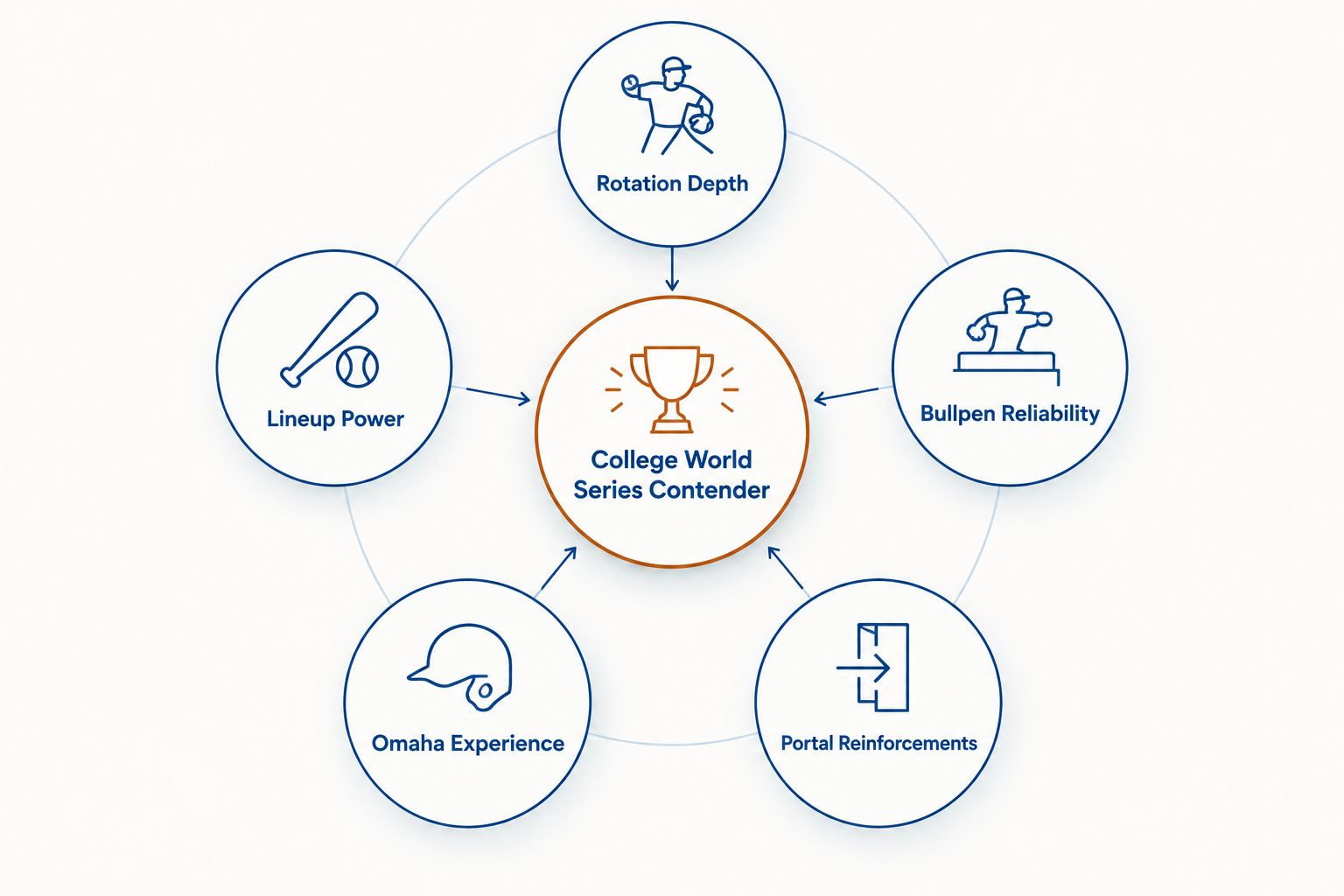
What makes a true College World Series contender
- Weekend rotation depth — three arms capable of starting and winning a regional game, not just one ace
- Bullpen reliability — a closer and a setup arm who've thrown meaningful innings in close games
- Transfer portal reinforcements — programs that used the transfer portal to patch holes instead of papering over them
- Omaha experience — a roster or coaching staff that has actually played postseason baseball under pressure
- Lineup power and plate discipline — the ability to manufacture runs when the ace on the mound isn't hittable
- Schedule strength — a non-conference slate tough enough to hold up under postseason seeding scrutiny
Contenders at a glance
| Team | Best For | Standout Strength | Key Limitation |
|---|---|---|---|
| Texas | Overall postseason pedigree | Most all-time trips to Omaha | Faces the deepest league gauntlet in the SEC |
| Tennessee | Proving a title wasn't a fluke | Reigning 2024 national champion | Replacing departed draft-eligible arms |
| LSU | Pitching-driven title runs | Seven national titles since 1991 | Requires elite starting pitching to peak in June |
| Vanderbilt | Player development track record | Two titles built on developed talent (2014, 2019) | Needs continuity after heavy MLB draft losses |
| Wake Forest | Dark-horse, offense-first brackets | 2023 CWS finalist with a power-heavy lineup | Bullpen depth has been the recurring soft spot |
| Arkansas | Postseason volume without a title yet | Among the most frequent Omaha participants | Hasn't converted trips into a championship |
| Oregon State | Best non-SEC/ACC underdog storyline | Three national titles since 2006 | Faces a lighter conference schedule for seeding credit |
1. Texas: best college world series contender for overall pedigree
Texas has been to Omaha more times than any program in NCAA history, and that track record shapes how the roster is built every year — deep pitching staffs, veteran leadership, and a coaching staff that treats regionals as routine. The Longhorns don't need a signature midseason win to be taken seriously; the resume speaks for itself heading into 2026.
Texas pros:
- Most all-time College World Series appearances of any program
- Recruiting and portal pull strong enough to reload every offseason
- Coaching continuity built around postseason experience
Texas cons:
- Plays in the toughest conference gauntlet in the country every weekend
- High external expectations mean early tournament losses get magnified
Best for: Bettors and fans who want the program with the deepest postseason resume in the sport.
Verdict: Buy.
2. Tennessee: best college world series contender defending a title
Tennessee won its first national championship in program history in 2024, and that changes the calculus for 2026 — the Volunteers aren't a surprise anymore, they're the team everyone else is measuring themselves against. The offense-first identity that carried them through Omaha hasn't gone anywhere.
Tennessee pros:
- Reigning national champion with a roster culture built around big-game execution
- Power-heavy lineup that can erase deficits in a single inning
- Recruiting momentum from the title run
Tennessee cons:
- Replacing draft-eligible arms and bats every offseason is a real challenge
- Target on their back means every opponent circles the series
Best for: Anyone who wants proof a program can sustain contender status after a breakthrough title.
Verdict: Buy.
3. LSU: best college world series contender for pitching-driven runs
LSU's blueprint has always been the same: stack the rotation, let the bullpen close, and let the offense pile on. Seven national titles since 1991 make LSU the standard for programs that win with arms first, bats second — the 2023 title run under that model is still the most recent proof point.
LSU pros:
- Seven national championships, more recent titles than almost any program
- Pitching-first recruiting and development that consistently produces MLB draft arms
- Deep home-crowd advantage that translates into postseason hosting
LSU cons:
- Title windows have historically opened and closed with specific pitching classes
- Needs an ace-caliber weekend starter to peak in June, not just May
Best for: Fans who trust pitching depth over lineup power in a short postseason series.
Verdict: Buy.
4. Vanderbilt: best college world series contender for player development
Vanderbilt's two national titles, in 2014 and 2019, came from a program built around developing draft prospects rather than simply importing finished products. That development pipeline is the reason Vanderbilt keeps reloading even after losing multiple first-round picks in a single draft class.
Vanderbilt pros:
- Two national championships built on in-house player development
- Consistent MLB draft pipeline that keeps talent evaluators watching
- Strong academic-athletic reputation that helps recruiting
Vanderbilt cons:
- Heavy draft losses can hit roster continuity harder than at other programs
- Needs a full offseason cycle to replace departed arms before June
Best for: Programs-as-brand fans who care about long-term development over one-year splashes.
Verdict: Hold.
5. Wake Forest: best college world series contender as a dark horse
Wake Forest's run to the 2023 CWS championship series proved the Demon Deacons can hang with anyone when the bats are hot. The formula is offense-first: outslug teams that can't match the power in the middle of the order, and let the scoreboard do the work bullpen depth sometimes can't.
Wake Forest pros:
- Reached the CWS finals in 2023 on the back of an elite lineup
- Power-heavy offense that can win shootouts against any rotation
- Program momentum from recent postseason success
Wake Forest cons:
- Bullpen depth has been the recurring weak point in close games
- Relies on offense carrying the team through cold pitching stretches
Best for: Bettors looking for value on a team that can outscore anyone on a good night.
Verdict: Wait.
6. Arkansas: best college world series contender still chasing a title
Arkansas shows up in Omaha more often than almost any program that hasn't won it all. That combination of consistent postseason presence and an elusive championship makes the Razorbacks one of the more interesting storylines in NCAA tournament seeding discussions every spring.
Arkansas pros:
- Among the most frequent Omaha participants of the modern era
- Strong recruiting base and fan support that fuels home postseason hosting
- Deep roster continuity year over year
Arkansas cons:
- Hasn't converted repeated trips into a national championship
- Postseason letdowns have become a recurring narrative
Best for: Fans who want volume of contention even without the trophy to show for it.
Verdict: Hold.
7. Oregon State: best college world series contender outside the SEC/ACC
Oregon State's three national titles since 2006 make it the clearest proof that Omaha contention isn't limited to the SEC and ACC. The Beavers built championship rosters without the recruiting advantages of a power-conference schedule, which is exactly why they're worth tracking as an underdog storyline in 2026.
Oregon State pros:
- Three national championships since 2006, more than most power-conference programs
- Proven ability to win without SEC/ACC-level recruiting muscle
- Strong coaching continuity historically
Oregon State cons:
- Lighter conference schedule can hurt postseason seeding credit
- Fewer marquee non-conference matchups to build an at-large resume
Best for: Fans rooting for a program outside the sport's two dominant conferences.
Verdict: Wait.
Track the odds before the bracket sets
Compare lines on the top college world series contenders.
How this list was ranked
Each program was weighed against the six criteria above: rotation depth, bullpen reliability, portal reinforcements, Omaha experience, lineup power, and schedule strength. Title history and recent postseason runs carried the most weight, since a program that has already solved late-inning pressure in June is the safest projection for doing it again in 2026.
Which college world series contender should you back?
If you want the safest projection, Texas carries the deepest postseason resume in the sport heading into 2026. If you want the team validating last year's breakthrough, Tennessee is the pick. And if you want value at longer odds, Wake Forest's offense gives it a real path to another finals appearance.
FAQ
Who are the best college world series contenders for 2026?
Texas, Tennessee, LSU, Vanderbilt, Wake Forest, Arkansas and Oregon State headline the 2026 field based on postseason pedigree and roster depth. Texas and defending champion Tennessee sit at the top of that group.
Is Texas the favorite to win the 2026 College World Series?
Texas holds the most all-time College World Series appearances of any program, which makes it the safest projection for another deep run in 2026. Favorite status still depends on how the rotation shapes up heading into the postseason.
How many national titles does LSU have?
LSU has won seven national championships since 1991, most recently in 2023. That total makes LSU one of the most decorated programs in college baseball history.
Why is Tennessee a top college world series contender in 2026?
Tennessee won its first national championship in program history in 2024, and the offense-first roster culture that carried the title run remains intact. That track record makes the Volunteers a legitimate repeat threat.
Has Arkansas ever won a College World Series title?
No — Arkansas is one of the most frequent Omaha participants in the sport without a national championship to show for it. That gap is a recurring storyline every postseason.
When is the College World Series played?
The College World Series is played every June in Omaha, Nebraska, following regionals and super regionals earlier in the postseason. The finals typically wrap up by late June.
How does the transfer portal affect College World Series contenders?
Programs use the transfer portal to patch specific roster holes — a missing weekend starter or a power bat — rather than rebuilding from scratch. Teams that use it well tend to show up higher in postseason seeding.
Can a non-SEC or ACC team win the College World Series?
Yes — Oregon State has won three national titles since 2006 without the recruiting advantages of a power-conference schedule. It's proof that Omaha contention isn't limited to the SEC and ACC.
One last thing
The program with the best odds to reach Omaha in 2026 isn't necessarily the program that finishes the regular season ranked first — postseason baseball punishes one-dimensional rosters, and every team on this list earned its spot by surviving a short series, not by dominating a long one.