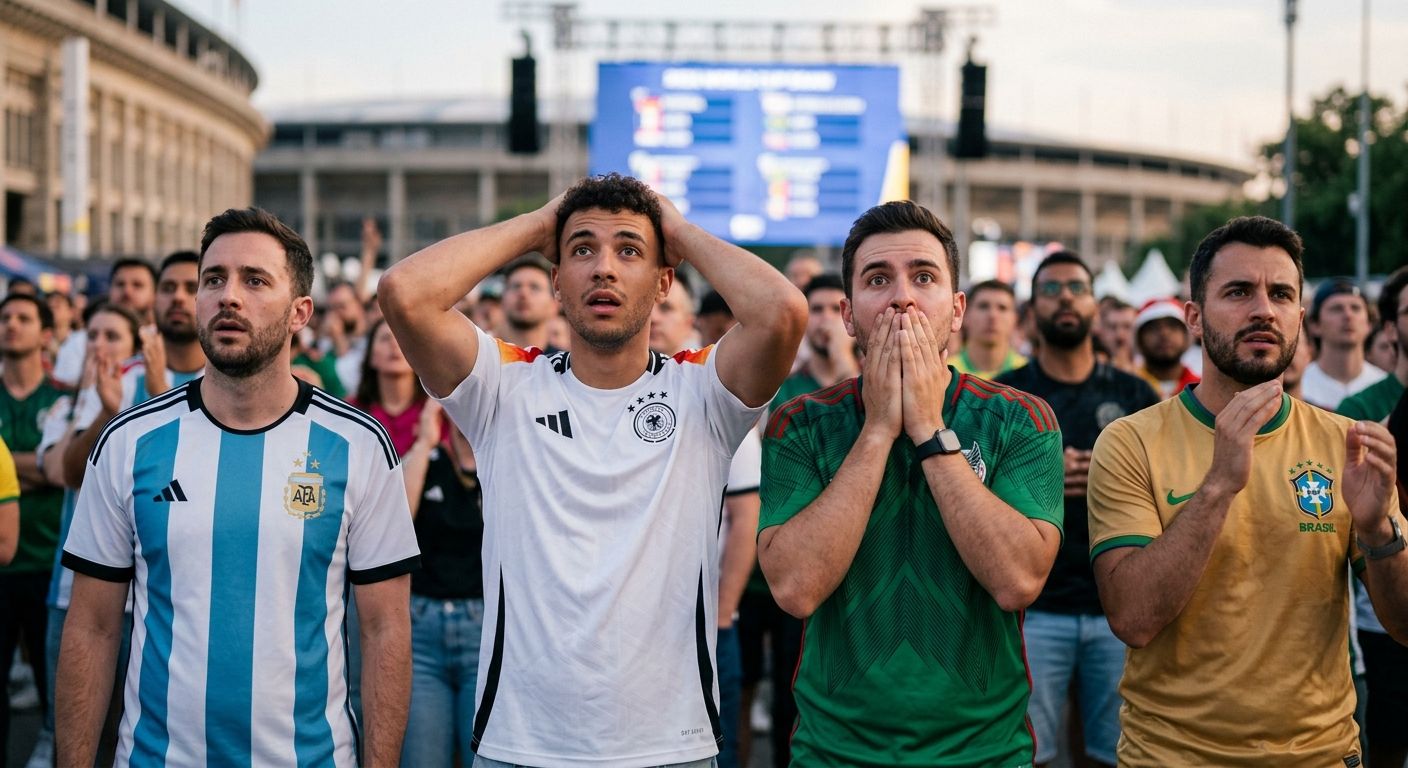
The 2026 World Cup expands to 48 teams for the first time, and that math alone guarantees at least one group that turns the group stage into a bloodbath. Best overall Group of Death contender: a heavyweight pileup of Argentina, France, Brazil, and England. Best for host-nation drama: a group built around Mexico or the United States drawing a loaded Pot 2 side. Best dark-horse trap: Morocco or Japan landing next to a giant that overlooks them.
- A heavyweight pileup of Argentina, France, Brazil and England projects as the top world cup group of death 2026 scenario.
- The 2026 field expands to 48 teams and 12 groups, raising the odds of a brutal draw somewhere on the bracket.
- Host nations USA, Mexico and Canada get a seeding cushion, but their groups can still turn hostile fast.
- Dark horses like Morocco and Japan have already proven they can wreck a favorite inside the group stage.
Why this matters
The 2026 World Cup is the first 48-team edition in tournament history, co-hosted across the United States, Mexico, and Canada. Twelve groups of four means more math, more scenarios, and more room for FIFA's seeding pots to collide in ways that would have been impossible under the old 32-team, eight-group format.
A bigger field usually means softer groups on average — more slots for mid-tier nations dilutes the danger. But it also means more total groups, and more chances for a genuine buzzsaw group to form when two Pot 1 nations end up boxed in with an in-form Pot 2 side and a dark horse nobody wants to play. That's the scenario this piece ranks. For the broader continental picture heading into the tournament, the Champions League dark horse landscape gives a good read on which club-level form is translating to international rosters right now.
What makes a true Group of Death
- Two or more Pot 1-caliber nations in the same four-team group
- A Pot 2 or Pot 3 team playing above its seed, based on recent form and qualifying results
- At least one team with a genuine knockout pedigree — quarterfinal appearances or better across the last two or three cycles
- A dark horse capable of an upset, not just a filler nation making up the numbers
- Travel and climate variance across the US/Mexico/Canada map, which can flatten a favorite that draws brutal altitude or heat scheduling
- Depth at the goalkeeper and center-back positions across the group, since Group of Death matches are usually decided by set pieces and mistakes, not open-play blowouts
Group of Death scenarios at a glance
| Scenario | Best for | Standout feature | Key limitation |
|---|---|---|---|
| Heavyweight Pileup | Star power collision | Two former champions in one bracket | Only one gets a favorable knockout draw |
| Host Nation Gauntlet | Home crowd chaos | Elevated home support pressure | Host still gets a seeding cushion by rule |
| European Powder Keg | Tactical chess | Deep coaching pedigree across all four | Low-scoring, grindy group stage |
| South American Ambush | Counterattack drama | High individual talent density | Travel fatigue across US time zones |
| Dark Horse Trap | Upset potential | Favorite gets overconfident | Dark horse still needs a result vs. two elite sides |
| Balanced Bloodbath | Pure toss-up drama | No clear favorite on paper | Hardest group to predict for bettors |
1. Heavyweight Pileup: best Group of Death for a star-power collision
This is the nightmare scenario every seeding committee tries to avoid and every neutral fan secretly wants: two or three traditional powers landing in the same bracket before the knockout stage even starts. Think Argentina and France both drawing into a group with an in-form England or Brazil side — a group where the eventual group winner might have been good enough to win the whole tournament in a softer bracket.
Heavyweight Pileup pros:
- Guarantees must-watch matchdays from the opening whistle
- Produces a group runner-up strong enough to make a knockout run anyway
- Maximizes TV audience and betting interest across all three matchdays
Heavyweight Pileup cons:
- Eliminates a genuine title contender before the round of 32
- Can produce cautious, low-event soccer if both sides fear elimination
Heavyweight Pileup verdict: circle it. If the draw produces this, it's the group every prediction column will be arguing about for weeks.
2. Host Nation Gauntlet: best Group of Death for home-crowd drama
FIFA's seeding rules give the United States, Mexico, and Canada protected Pot 1 status as co-hosts, which softens their opening draw on paper. That protection doesn't guarantee an easy group — a loaded Pot 2 nation paired with a physical Pot 3 side can still turn a host's group into a genuine fight, especially with the pressure of playing in front of a home crowd expecting knockout football.
Host Nation Gauntlet pros:
- Massive home attendance and atmosphere across every host match
- A host stumble creates the tournament's biggest storyline overnight
- Travel logistics favor the host, offsetting some seeding disadvantage
Host Nation Gauntlet cons:
- Home pressure has buried favorites before — hosting is not a guarantee of advancing
- A soft seeding cushion means this group rarely reaches true "Group of Death" heat
Host Nation Gauntlet verdict: watch closely. Worth tracking, but it needs an unlucky draw in Pot 2 or 3 to earn the full Group of Death label.
3. European Powder Keg: best Group of Death for tactical football
A group stacked with two or three European nations — Netherlands, Croatia, Belgium, Portugal-tier sides — tends to produce the tightest, most tactically dense football of the tournament. These are teams built on structured possession and set-piece discipline rather than pure individual talent, and that makes for grinding, low-scoring group play where a single mistake decides who advances.
European Powder Keg pros:
- Deep managerial pedigree across every bench in the group
- Set-piece battles and disciplined defending reward patient viewers
- Historically produces the most 1-0 and 1-1 scorelines of any group type
European Powder Keg cons:
- Can be a slog for casual viewers looking for goals
- Depth across midfield often means fewer individual breakout storylines
European Powder Keg verdict: circle it for bettors, skip it if you want fireworks.
4. South American Ambush: best Group of Death for counterattacking chaos
Pair Uruguay or Colombia with a Pot 1 nation and a dark horse, and you get a group built on transition speed rather than possession. South American qualifying is brutal by design — every CONMEBOL side that reaches the tournament has already survived a gauntlet most confederations don't have — which means even a lower-seeded South American team can be battle-tested in a way its seeding doesn't reflect.
South American Ambush pros:
- High individual talent density even outside the top seed
- Counterattacking speed creates highlight-reel moments every matchday
- CONMEBOL qualifying toughness means no team in this scenario is truly soft
South American Ambush cons:
- Travel across US time zones and climates can wear down squads unused to the heat
- Depth can thin out fast if a starting XI loses a key player to suspension
South American Ambush verdict: lock it in as a sleeper pick for chaos.
5. Dark Horse Trap: best Group of Death for upset potential
Every tournament has one group where a favorite gets careless against a team it should beat comfortably — and doesn't. Morocco's run to the 2022 semifinal and Japan's group-stage wins over Germany and Spain that same year are the template. Pair either type of program with a Pot 1 nation that hasn't faced real pressure in qualifying, and the trap sets itself.
Dark Horse Trap pros:
- Produces the tournament's signature "shock result" storyline
- Rewards disciplined, organized underdog programs over raw individual talent
- Keeps betting markets volatile through all three group matchdays
Dark Horse Trap cons:
- The dark horse still needs a result against at least one elite side to advance
- One bad refereeing decision or red card can end the run before it starts
Dark Horse Trap verdict: watch — this is where the best betting value usually sits. The Ballon d'Or conversation every year tends to shift after a dark horse run like this puts a new name on the global radar.
6. Balanced Bloodbath: best Group of Death for pure toss-up drama
Sometimes the toughest group on paper isn't the one with two former champions — it's the one where all four teams sit within a few FIFA ranking points of each other, with no clear favorite and no obvious minnow. These groups are the hardest to predict and often produce the tightest points table in the entire tournament, decided by goal difference on the final matchday.
Balanced Bloodbath pros:
- Every matchday carries real stakes for all four teams
- Final matchday drama is nearly guaranteed with tight points tables
- Rewards squad depth over star power, which levels the playing field
Balanced Bloodbath cons:
- Lack of a marquee name can mean lower casual viewership
- Hardest scenario for prediction markets and bettors to price accurately
Balanced Bloodbath verdict: circle it for parlay and outright markets alike.
Get the latest World Cup 2026 analysis
Fresh predictions and group breakdowns as the draw and qualifying picture develop.
How we ranked these scenarios
Each scenario was measured against the criteria above: seeding collision risk, recent form versus FIFA pot status, knockout pedigree, dark-horse upset history, and travel/climate variance built into the US-Mexico-Canada hosting map. The Heavyweight Pileup ranks first because it's the only scenario that guarantees a genuine former champion misses the knockout round entirely — the single clearest marker of a true Group of Death.
Which Group of Death scenario should you watch for in 2026?
If you want the group that decides tournament history before the knockout stage even begins, watch for the Heavyweight Pileup — two Pot 1 nations in one bracket changes the entire shape of the tournament. If you're building a betting or fantasy strategy, the Dark Horse Trap and South American Ambush scenarios carry the best value, since neither gets priced correctly by markets until after the group stage starts. Scoring depth matters here too — the Premier League Golden Boot picture each season is a solid proxy for which strikers are in the kind of scoring form that travels to a World Cup.
FAQ
What is the world cup group of death 2026?
It refers to whichever group in the 2026 World Cup draw ends up with the most former champions, in-form contenders, or dangerous dark horses packed into one four-team bracket. The final draw determines the real group, but scenario analysis like this ranks the likeliest outcomes before that draw happens.
How many teams are in the 2026 World Cup?
The 2026 World Cup expands to 48 teams, up from 32 in 2022. It's the first World Cup at this size in tournament history.
How many groups are there in the 2026 World Cup?
There are 12 groups of four teams each. The top two from every group plus the eight best third-place finishers advance to a 32-team knockout round.
Do host nations get an easier group in 2026?
The United States, Mexico, and Canada receive protected Pot 1 seeding as co-hosts, which generally softens their group on paper. It doesn't guarantee an easy path — a tough Pot 2 or Pot 3 draw can still make a host's group difficult.
Which teams create the toughest World Cup group of death?
The toughest groups typically form when two Pot 1-caliber nations land together with a Pot 2 side playing above its seed, plus a dark horse with recent upset history. Argentina, France, Brazil, and England pairings are the clearest example of that collision risk in 2026.
Is a bigger 48-team World Cup less likely to produce a group of death?
On average, yes — more slots dilute the overall difficulty across 12 groups instead of eight. But more total groups also means more chances for at least one brutal collision to happen somewhere in the bracket.
What makes a dark horse dangerous in a World Cup group?
A dangerous dark horse combines disciplined organization with a favorable matchup against a favorite that hasn't faced real pressure in qualifying. Morocco's 2022 run and Japan's group-stage upsets that same year are the modern template.
One last thing
The most dangerous groups rarely look dangerous on the seeding sheet — they look dangerous three matchdays in, once form and fatigue expose which "favorite" actually earned its seed. Watch goal difference after matchday two in every group; that's usually the earliest real signal of which bracket turned into 2026's actual Group of Death.