Strokes gained tells you how many strokes a golfer picked up or lost against the rest of the field on every swing, and reading it right turns raw PGA Tour numbers into value picks before the market catches up. The category that predicts future scoring best — SG: Approach — gets buried under flashier putting stats on TV, which is exactly why casual bettors and fantasy players miss it.
- Strokes gained measures a golfer's shot value against the field average, and learning how to read golf strokes gained stats starts with SG: Approach, not putting.
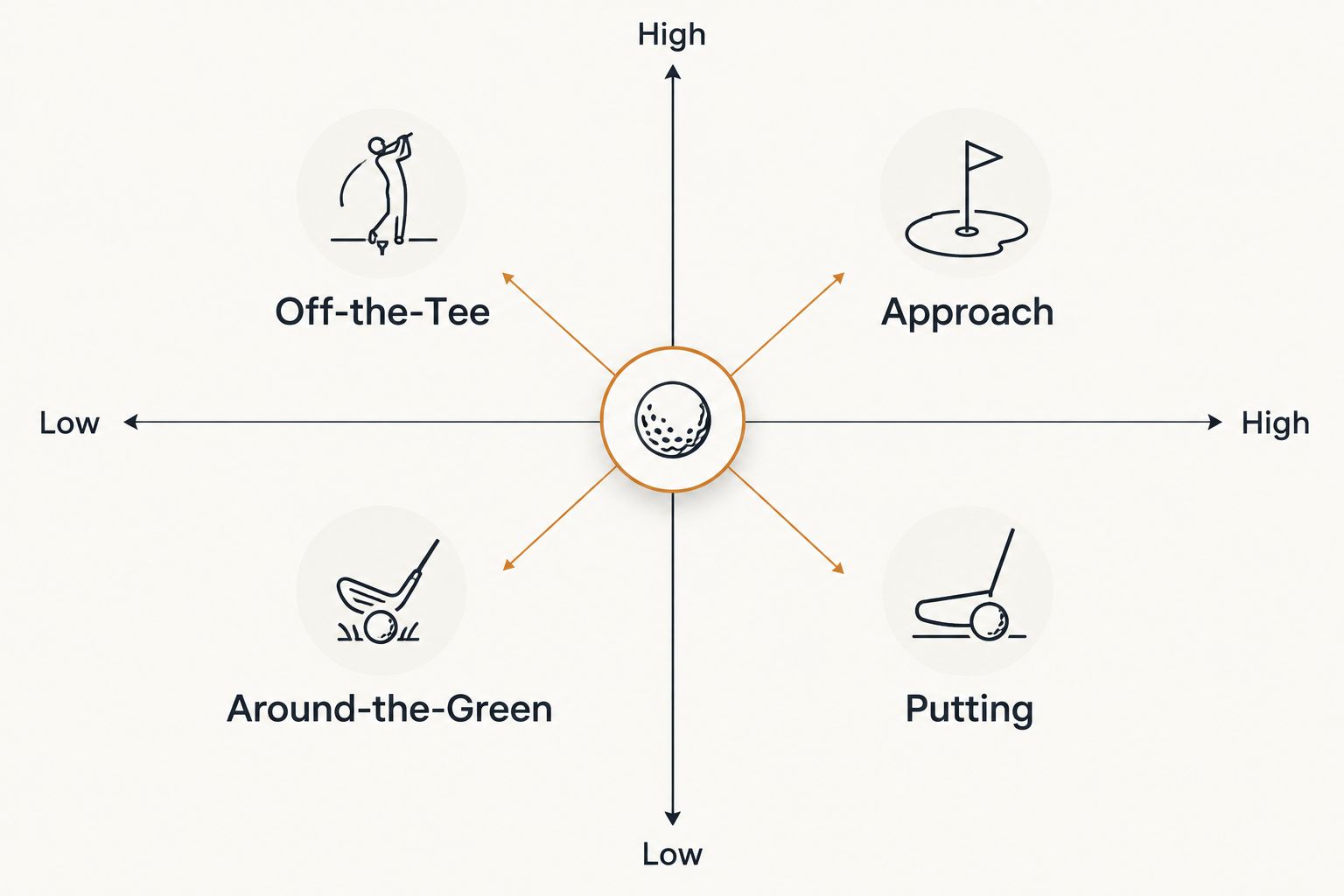
- SG: Total splits into four categories: Off-the-Tee, Approach, Around-the-Green, and Putting, and they sum to the final number.
- SG: Putting swings the most week to week; SG: Approach is the sticky stat that predicts next week's finish.
- A single round of strokes gained data tells you almost nothing — look at a rolling sample before trusting a trend heading into 2026.
- Field strength changes what a positive strokes gained number actually means, so a +1.5 week at a weak-field event isn't the same signal as a major.
Why strokes gained matters more than the leaderboard
A guy can shoot 66 by holing three bombs from off the green and still be playing worse golf than the guy who shot 69 hitting fairways and greens all day. Strokes gained separates the two. It's built off ShotLink data — the PGA Tour has tracked the position of every shot since 2003 — and the methodology comes from Columbia professor Mark Broadie, laid out in his 2014 book Every Shot Counts.
The number is always relative. A SG: Approach of +1.2 means a golfer gained 1.2 strokes on the field average from approach shots alone that round. Zero is average. Negative is below the field. That relative framing is what makes it useful for fantasy golf picks — you're not asking who's playing well in a vacuum, you're asking who's beating the specific players teeing it up that week.
How do you read golf strokes gained stats?
Start with SG: Total, then break it into its four pieces to find out where the strokes actually came from. The table below shows what each category measures and how much you should trust it week to week.
| Category | What it measures | Week-to-week reliability | Best use for value picks |
|---|---|---|---|
| SG: Off-the-Tee | Driving distance and accuracy combined into one shot value | Moderate | Course-fit angles on tight or wide-open layouts |
| SG: Approach | Iron and wedge play from the fairway or rough | High | The most predictive stat for finding underpriced golfers |
| SG: Around-the-Green | Chips, pitches, and bunker shots inside 30 yards | High | Scrambling specialists on firm, fast courses |
| SG: Putting | Every stroke taken on the green | Low | Confirms hot streaks, but don't chase it alone |
A golfer sitting at +0.8 SG: Approach over his last 12 rounds heading into 2026 is a more durable signal than a golfer who leads the field in SG: Putting for one week. The putting stat regresses hard. The approach stat sticks.
SG: Approach carries the most predictive weight
Approach play is where the best players separate from the pack over a full season, and it's the category with the strongest correlation to next-week scoring. A golfer trending up in SG: Approach across a four-to-six round sample is the profile to build fantasy golf lineups for majors around, because approach quality travels to tougher setups better than hot putting does.
SG: Around-the-Green rewards touch on firm courses
This category isolates short-game shots inside 30 yards — chips, pitches, and bunker escapes — and strips out the putt that follows. A player who's strong here has a floor even on a day the putter goes cold, which matters most at major-style setups where greens run firm and misses get punished.
SG: Off-the-Tee separates by course fit, not just talent
Off-the-tee blends distance and accuracy into a single number, so a bomber who's wild and a shorter, straighter hitter can post the same figure through completely different games. Match the player's off-the-tee profile to the course before you lean on the number — a big SG: Off-the-Tee at a wide-open track doesn't carry to a U.S. Open rough setup.
SG: Putting is the noisiest number on the sheet
Putting is the category most likely to flip from elite to poor from one week to the next, because green speeds, grain, and a handful of makes or misses swing the total fast. Treat a strong putting week as confirmation of a signal you already see elsewhere — never as the reason to back a golfer on its own.
Why strokes gained numbers vary week to week
A player's strokes gained figure isn't fixed — it moves with context that has nothing to do with how he's actually playing. Weigh these factors before you treat any single number as gospel:
- Field strength — a +2.0 SG: Total against a weak-field opposite event doesn't mean the same thing as +2.0 at a major with the top 50 in the world.
- Sample size — one round is close to meaningless; a rolling 12-to-24-round window is where the number stabilizes.
- Course setup — firm, fast conditions inflate SG: Around-the-Green for good short-game players; soft conditions flatten the gap.
- Weather — wind and rain distort SG: Off-the-Tee and SG: Approach on any given day more than they distort putting.
- Green speed and grain — SG: Putting swings hardest on courses with unusual surfaces (Bermuda vs. bentgrass), so cross-surface comparisons need a discount.
- Recency vs. season-long — a season-long average smooths variance but can hide a real swing change happening the last month.
“SG: Putting tells you who got hot. SG: Approach tells you who's actually good.”
Once you've weighted those factors, the next step is turning the number into an actual pick. Sleeper hunting off strokes gained data works best when you cross-reference the category leaders against a golfer's recent finish position — a player quietly climbing the PGA Tour sleeper rankings in SG: Approach before his results catch up is the exact value window sharp bettors look for heading into 2026.
Build your 2026 fantasy golf roster
Turn strokes gained trends into a weekly lineup before tee times lock.
Is SG: Approach better than SG: Putting for finding value?
SG: Approach is the more reliable stat for finding value because it correlates more strongly to a golfer's next few finishes, while SG: Putting swings too much week to week to trust on its own. Use approach data to identify the underlying game and putting data only to confirm a player is rolling it well right now.
How many rounds of strokes gained data do you need before trusting a trend?
A rolling window of 12 to 24 rounds is the standard threshold analysts use before treating a strokes gained trend as real rather than noise. Anything shorter — a single tournament or two — is far more likely to be variance, especially in the putting category.
Where can you find strokes gained stats for free?
PGA Tour's official stats site publishes SG: Total and all four sub-categories for every ranked player, updated after each round. Data Golf and other public trackers also break down strokes gained by course type and field strength, which helps when you're weighing a golfer's number against the specific event he's playing in 2026.
FAQ
What is a good SG: Total number in professional golf?
A SG: Total above +1.0 per round over a full season puts a golfer among the tour's elite, while anything above +2.0 typically leads the season-long standings. Single-round spikes well above that number are common and don't carry the same weight as a season average.
How do you read golf strokes gained stats for betting value?
Read golf strokes gained stats for betting by weighting SG: Approach and SG: Around-the-Green over SG: Putting, since those categories predict future scoring more reliably. A golfer trending up in approach play before his finishes reflect it is the clearest value signal.
Is strokes gained the same as scoring average?
No, scoring average just counts strokes taken while strokes gained compares those strokes to the field average on that exact shot. Two golfers can post the same scoring average with completely different strokes gained profiles depending on course difficulty.
Why does SG: Putting change so much from week to week?
SG: Putting changes fast because green speed, grain, and a small number of makes or misses swing the total more than any other category. It's the noisiest of the four strokes gained stats and the least reliable for predicting next week.
Does strokes gained work for amateur golfers?
Strokes gained requires shot-by-shot location data that most amateur rounds don't track, so the PGA Tour-style breakdown is built for tour-level data. Some apps offer simplified amateur strokes gained estimates, but they're rougher approximations.
What's the difference between SG: Tee-to-Green and SG: Total?
SG: Tee-to-Green combines Off-the-Tee, Approach, and Around-the-Green while excluding putting entirely. SG: Total adds putting back in to give the full picture of a round.
How far back should you look at strokes gained trends?
A 12-to-24-round rolling window is the standard sample size for a reliable trend, long enough to smooth out one bad or hot week. Season-long averages work for course-fit projections, but recent-form windows matter more for weekly betting and DFS decisions.
One last thing
The golfer with the best SG: Putting number on a given Sunday almost never leads SG: Approach that same week — the two stats rarely peak together, which is exactly why chasing the hot putter burns bettors every season. Watch the approach numbers instead: a player quietly gaining strokes there for a month, still priced like an afterthought, is the profile worth grabbing before oddsmakers and fantasy pricing catch up in 2026.