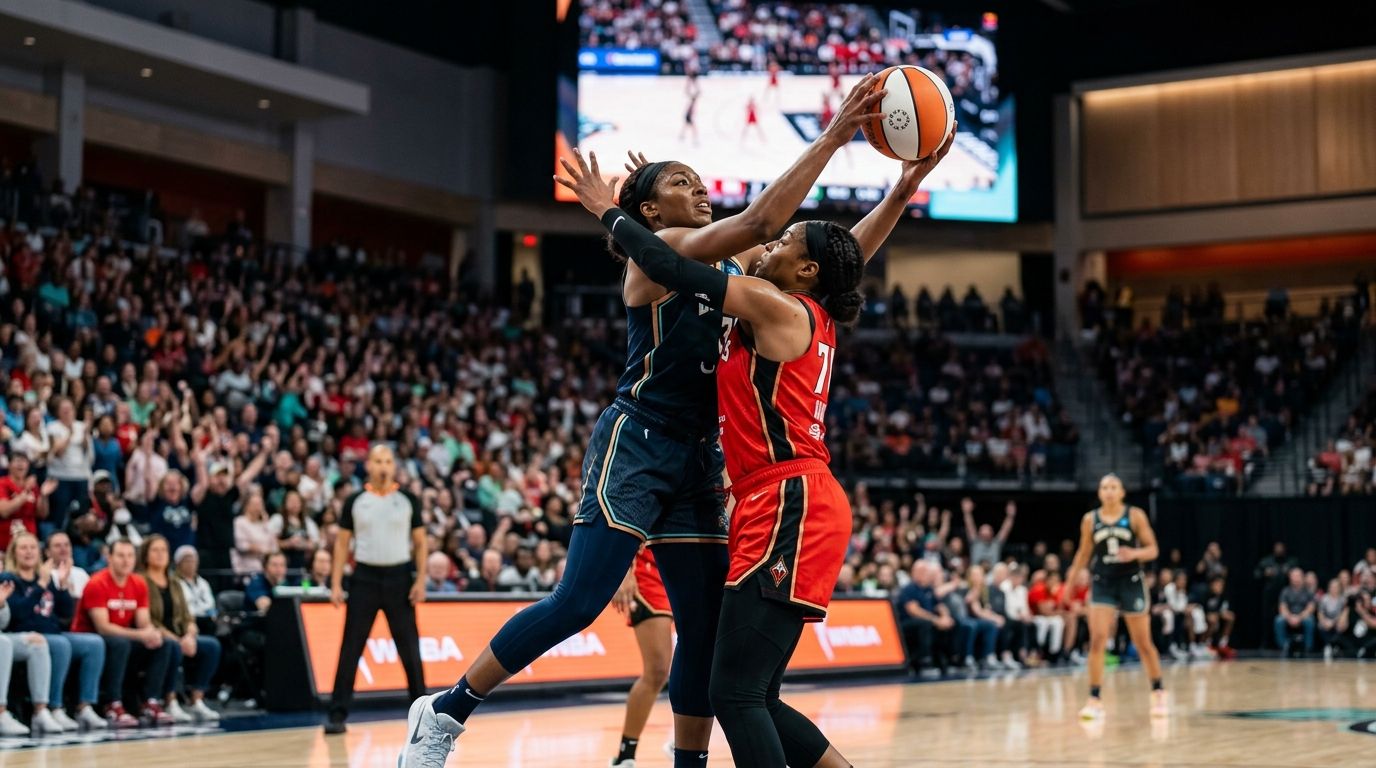
A'ja Wilson is the frontrunner in a stacked 2026 WNBA Defensive Player of the Year race, but Napheesa Collier, Aliyah Boston, Alyssa Thomas, Jonquel Jones, and Kamilla Cardoso all have real cases. Best overall: A'ja Wilson. Best two-way anchor: Napheesa Collier. Best rim protector: Aliyah Boston. Best dark horse: Kamilla Cardoso.
- A'ja Wilson is the 2026 WNBA Defensive Player of the Year favorite as Las Vegas' interior anchor.
- Napheesa Collier and Aliyah Boston bring switchable size that scrambles half-court sets.
- Alyssa Thomas and Jonquel Jones give voters a versatility argument built on positionless defense.
- Kamilla Cardoso is the dark-horse WNBA Defensive Player of the Year candidate on shot-blocking alone.
Why this matters
DPOY voting shapes more than a trophy case. It moves All-Defensive Team ballots, MVP narratives, and — for anyone betting player-award markets — the odds boards that shift every time a candidate strings together a run of statement performances. The 2026 race is unusually crowded because the league's frontcourt talent has gotten deeper across all 13 teams, and voters now have to separate rim protectors from point-of-attack disruptors instead of defaulting to whoever blocks the most shots.
SportsOrca tracks these award races the way beat writers track locker rooms — game to game, not just box score to box score. For the fuller picture on who's actually driving winning basketball this season, the best NBA players right now for casual fans breakdown covers the same principle on the men's side: dominance shows up in ways a stat line doesn't always capture.
What makes the best WNBA Defensive Player of the Year candidate
- Two-way defensive load — guarding the other team's best scorer possession after possession, not just accumulating steals in gaps
- Rim protection or ball pressure — a real specialty, not a generic "good defender" label
- Team defensive rating — voters lean toward players whose teams collapse defensively when they sit
- Versatility across positions — switching 1 through 5 without giving up size or speed mismatches
- Availability — DPOY voters punish missed games hard; a healthy 2026 season matters as much as talent
- Narrative and reputation — past All-Defensive honorees get benefit of the doubt in close votes
WNBA Defensive Player of the Year candidates at a glance
| Candidate | Best for | Standout trait | Key limitation |
|---|---|---|---|
| A'ja Wilson | Overall favorite | Rim protection plus perimeter mobility | Foul trouble against physical bigs |
| Napheesa Collier | Two-way anchor | Guards 1 through 5 without a drop-off | Minnesota's scheme hides some individual metrics |
| Aliyah Boston | Interior rim protector | Verticality and post positioning | Limited range outside the paint |
| Alyssa Thomas | Point-of-attack versatility | Forces turnovers guarding multiple positions | Not a shot-blocking presence |
| Jonquel Jones | Help-side shot blocking | Timing and floor-spacing awareness | Lower steal totals than peers |
| Kamilla Cardoso | Breakout dark horse | Physical post deterrence | Still building foul discipline |
1. A'ja Wilson: best WNBA Defensive Player of the Year candidate overall
A'ja Wilson anchors the Las Vegas Aces at both ends, and in 2026 she's again the name every other candidate gets measured against. She protects the rim without fouling out of the possession, then closes out on shooters as fast as a guard. Her track record as a past DPOY winner gives her the benefit of the doubt in any close ballot.
A'ja Wilson pros:
- Elite rim deterrence combined with real perimeter mobility
- Anchors a Las Vegas defense that struggles noticeably when she sits
- Voter reputation from prior award recognition
A'ja Wilson cons:
- Foul trouble against bigger, more physical post players
- Voter fatigue is a real risk if a fresher name has a career-best stretch
A'ja Wilson pricing: not applicable — this is an award race, not a purchase.
Best for: the reader who wants the safest, most defensible pick. Verdict: Buy the favorite tag.
2. Napheesa Collier: best WNBA Defensive Player of the Year candidate for two-way versatility
Napheesa Collier is the Minnesota Lynx's answer to almost any matchup problem — she guards wings, switches onto bigs, and still gets back in transition. Her defensive versatility is the single strongest non-Wilson case in the field this season. Minnesota's team defense holds up whether she's guarding a stretch four or a scoring guard.
Napheesa Collier pros:
- Switches across four positions without a size or speed penalty
- Elevates Minnesota's defensive rating in high-leverage minutes
- Combines rebounding with perimeter disruption
Napheesa Collier cons:
- Individual defensive stats get diluted inside Minnesota's team-first scheme
- Not the rim-protecting shot-blocker some voters default to
Best for: the reader who values positionless defense over raw block totals. Verdict: Hold as the co-favorite.
3. Aliyah Boston: best WNBA Defensive Player of the Year candidate for rim protection
Aliyah Boston gives the Indiana Fever the interior deterrent their perimeter defense leans on constantly. She wins with verticality and post positioning rather than chasing highlight blocks, which makes her a quieter but genuinely credible candidate. Indiana's frontcourt defense is built around her staying out of foul trouble.
Aliyah Boston pros:
- Textbook post defense and verticality against physical scorers
- Anchors an Indiana defense that needs an interior presence badly
- Durability across a full 2026 slate matters for a young roster
Aliyah Boston cons:
- Limited range defending stretch bigs who pull her away from the rim
- Lower national visibility than the frontrunners hurts ballot recognition
Best for: the reader looking for the purest interior-defense argument. Verdict: Hold, trending up.
4. Alyssa Thomas: best WNBA Defensive Player of the Year candidate for point-of-attack disruption
Alyssa Thomas guards multiple positions and still generates turnovers at a rate few forwards match. Her case rests on activity level — deflections, forced travels, rushed shot clocks — rather than a single highlight stat. She's the name voters point to when they want a defender who changes possessions, not just shot charts.
Alyssa Thomas pros:
- Guards guards and forwards with equal comfort
- Generates extra possessions through hustle plays and forced turnovers
- Battle-tested in high-leverage playoff-style minutes
Alyssa Thomas cons:
- Not a rim-protecting or shot-blocking presence
- Her value shows up more in film than in a traditional stat line
Best for: the reader who trusts point-of-attack chaos over box-score defense. Verdict: Wait and see how the vote splits.
5. Jonquel Jones: best WNBA Defensive Player of the Year candidate for help-side shot blocking
Jonquel Jones reads the floor a beat ahead of most bigs, rotating from the weak side to erase shots at the rim without fouling. Her timing, not her raw athleticism, is what separates her defensively. She's the quieter name in this field, but the tape holds up against anyone above her on this list.
Jonquel Jones pros:
- Elite defensive timing and floor-spacing awareness
- Blocks shots without racking up fouls
- Strong rebounding to finish defensive possessions
Jonquel Jones cons:
- Lower steal totals than the perimeter-oriented candidates
- Less name recognition in a crowded frontcourt field
Best for: the reader who wants the most efficient shot-blocker in the race. Verdict: Wait — a fringe candidate worth tracking.
6. Kamilla Cardoso: best WNBA Defensive Player of the Year candidate as a dark horse
Kamilla Cardoso is the name that could scramble this race if her 2026 season keeps trending the way it started. Her physical presence in the post already deters shots most guards won't attempt, and that alone puts her on the ballot conversation. She's still cleaning up foul discipline, which is the only thing keeping her off the top tier right now.
Kamilla Cardoso pros:
- Physical post deterrence that changes shot selection near the rim
- Upside trajectory that outpaces most young bigs in the league
- A genuine X-factor if Chicago's defense keeps climbing
Kamilla Cardoso cons:
- Foul discipline still needs work in extended minutes
- Not yet a full-season, wire-to-wire candidate
Best for: the reader hunting the long-shot value pick. Verdict: Skip for now — revisit at midseason.
“If a defender changes the shot without ever recording the block, she's already doing DPOY-level work.”
How the candidates were ranked
The order above weighs two-way defensive load first, rim protection or ball pressure second, team defensive rating third, and versatility fourth — with availability and reputation breaking ties. A'ja Wilson wins on the combination of all four; the rest of the field separates on which single criterion they dominate.
Track the WNBA MVP race too
See who's leading the 2026 MVP conversation alongside these defensive standouts.
Which WNBA Defensive Player of the Year candidate should you back?
A'ja Wilson is the pick if you want the safest ballot answer for 2026 — she checks every criterion and carries voter history few can match. If you're chasing upside over safety, Napheesa Collier's positionless versatility is the sharpest counter-argument in the field. Everyone else here is a real candidate, but none of them beat Wilson's combination of two-way load and reputation heading into the stretch run.
FAQ
Who is the favorite for WNBA Defensive Player of the Year in 2026?
A'ja Wilson is the favorite for the 2026 WNBA Defensive Player of the Year award. Her combination of rim protection and perimeter mobility, plus her track record as a past winner, gives her the edge in a crowded field.
Is Napheesa Collier better on defense than A'ja Wilson?
Napheesa Collier isn't clearly better, but her case is built on switching across four positions without a drop-off, which is a genuinely different skill set than Wilson's rim-anchoring style.
Can a rookie or young player win WNBA Defensive Player of the Year?
It's rare but not impossible — voters usually favor established two-way anchors, though a breakout candidate like Kamilla Cardoso shows how quickly a young big can enter the conversation.
Does WNBA Defensive Player of the Year voting favor bigs over guards?
Historically yes, since rim protection and rebounding are easier for voters to see on tape than point-of-attack perimeter defense, though that gap has narrowed as versatile forwards like Alyssa Thomas enter the mix.
What stats matter most for WNBA Defensive Player of the Year voting?
Team defensive rating with the player on and off the floor matters more than raw steals or blocks totals, since voters weigh overall defensive impact over a single counting stat.
Is Aliyah Boston a real threat to win WNBA Defensive Player of the Year in 2026?
Yes — her interior rim protection makes her a legitimate top-three candidate, though her limited range outside the paint keeps her behind the more versatile names above her.
How does All-Defensive Team voting relate to the WNBA Defensive Player of the Year race?
All-Defensive Team ballots are voted on by the same media pool and often mirror the DPOY shortlist, so a strong First Team nod usually signals a real DPOY case.
One last thing
The most underrated part of this race isn't the frontrunner — it's how many of these candidates play multiple positions defensively in a league that's gotten smaller and faster across all 13 teams. That shift is exactly why Alyssa Thomas and Napheesa Collier are legitimate threats to Wilson's reign in 2026, even if the ballot ultimately breaks the same way it usually does.